Verse 15after 1816aa;Nkiye hu))e
G3
1
again it's in our inner-self that we would remain lying at someone's door
2
having placed our head under the burden of the kindness/favor of the Doorkeeper
'Embarrassed, overburdened with expense, borne down with oppression'.
'Kindness or service done (to); favour, obligation; --grace, courtesy; --entreaty, humble and earnest supplication'.
| References | |
|---|---|
| Arshi, Imtiyaz Ali | Ghazal# 190 |
| Raza, Kalidas Gupta | 301-02 |
| Nuskhah-e-Hamidiyah | 284-286 |
| Hamid Ali Khan | Open Image |
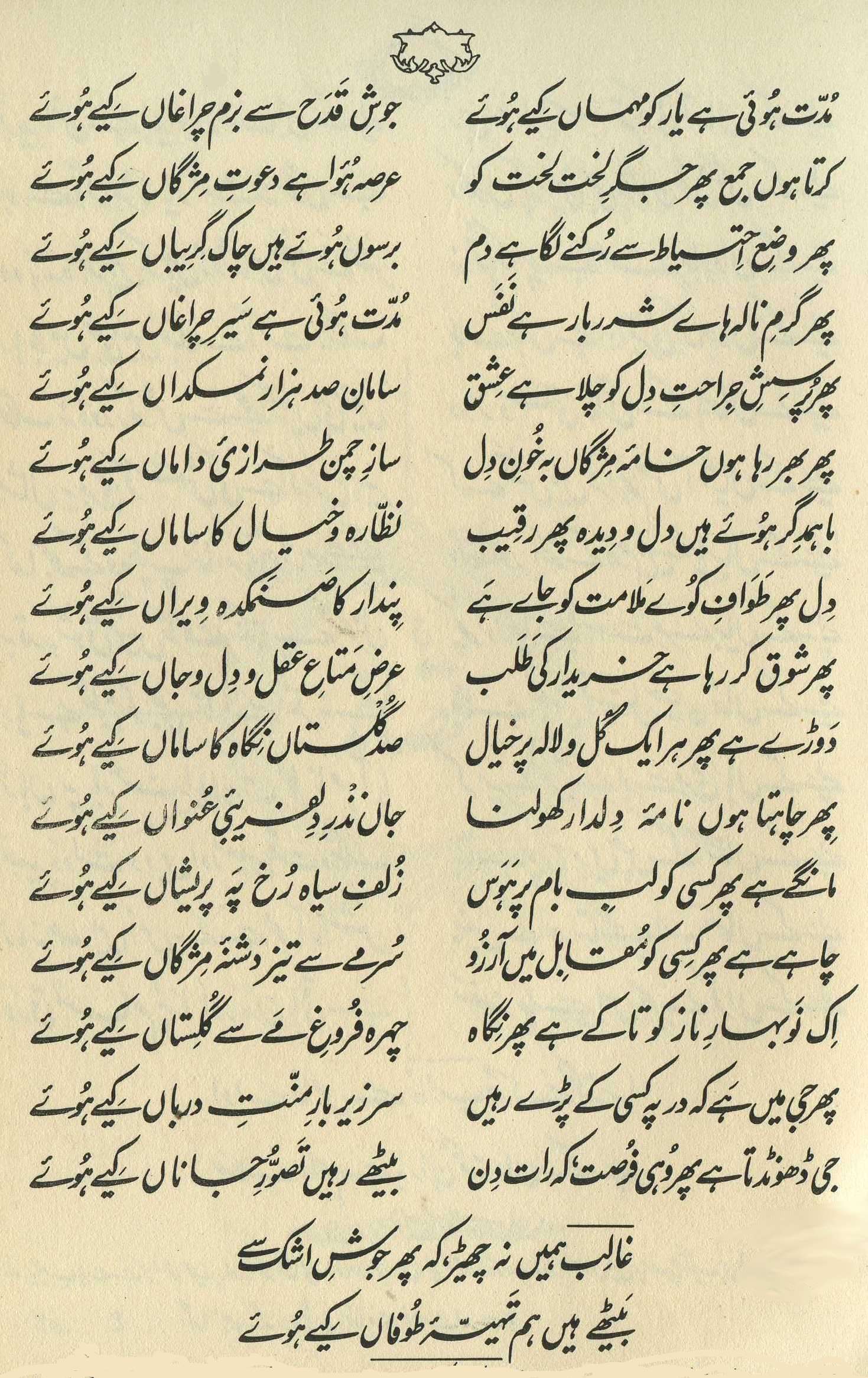
That is, because of the burden of kindness we wouldn't at all be able to rise. (265)
== Nazm page 265

He says, again the urge has developed in our inner-self that, having taken upon our head [the burden of] the kindness of the Doorkeeper, we would remain lying at some beloved's door. (323)
To remain lying at someone's door like a voiceless one, and to become indebted to a low/vile man like the Doorkeeper, was seen to be contrary to one's dignity/glory. Since the heart is becoming out of control, again there's a longing for just such things. (500-01)
On the structure of this ghazal as a kind of loosely 'continuous' one, see 233,1 .
Here again is the reversal of values seen in 233,8 (in which the lover prefers the 'street of blame' to the 'idol-house of pride'), and also in 233,9 (in which 'wisdom', 'heart', and 'life' are goods the lover is eager to sell off as quickly as possible). As Bekhud Mohani observes, to abase oneself before a low-class servant like a Doorkeeper is normally a thoroughly repugnant idea-- but not to the lover, who longs for the opportunity even before it's had a chance to present itself.
The real pleasure of the verse is its enjoyable back-and-forth-ness between literal and metaphorical meanings. For when one is indebted to someone, in Urdu one is 'under a burden' [ , colloquially shortened to ], and the burden consists of that person's kindness or favor []-- which one may have obtained by abjectly begging and pleading for it [] (for this double range of meaning see the definition above). People who are expressing gratitude for a great kindness may extravagantly proclaim that this 'burden' is so heavy that it bows their shoulders down, that they can't 'lift' it. Everybody of course understands the idea to be metaphorical, and so it can be in this case too: the desperate lover will be under the 'burden' of a heavy obligation to the Doorkeeper's kindness in permitting him to remain at the beloved's door and not driving him away with kicks and abuse.
But of course, what the lover wants is to lie prostrate at the beloved's door (and maybe even to be allowed the liberty of performing actual prostrations there; on this see 43,6 ). And lying prostrate is exactly the attitude assumed by someone who is crushed under a massive 'burden' and is unable to 'lift' it. (See for example 130,3 , in which a wall is 'bent' under the 'burden' of the kindness of the worker who built it.) So in the present verse, the lover lies prostrate-- and we can imagine him as literally unable to lift his head beneath such a heavy 'burden'.
As a rule, Ghalib rejects this kind of indebtedness and obligation, not only for himself but for others as well; for many examples of his insistence on independence, see 9,1 . But the relationship of the lover and the Doorkeeper is definitely a special case. It's part of the lover's general madness and his inversion of all worldly values.
graphics/door.jpg