Verse 31821aa;Nu;Thaa))iye
G3
1
the wall, from the burden of the favor/kindness of the workman, is bowed/bent
2
oh house-and-home-wrecked one, don't 'lift' [a burden of] kindness/obligation
'Kindness or service done (to); favour, obligation; — grace, courtesy; — entreaty, humble and earnest supplication; — grateful thanks, praise'.
'House and home, household furniture, everything belonging to the house; household, family'.
'Having a ruined or desolated home; ruined, desolated'.
'Doing that which is good; beneficence, benefaction, benevolent action, benefit, favour, kindness, good offices, obligation conferred'.
| References | |
|---|---|
| Arshi, Imtiyaz Ali | Ghazal# 130 |
| Raza, Kalidas Gupta | 340 |
| Nuskhah-e-Hamidiyah | 178-179 |
| Asi, Abdul Bari | 215-216 |
| Gyan Chand | 330-331 |
| Hamid Ali Khan | Open Image |
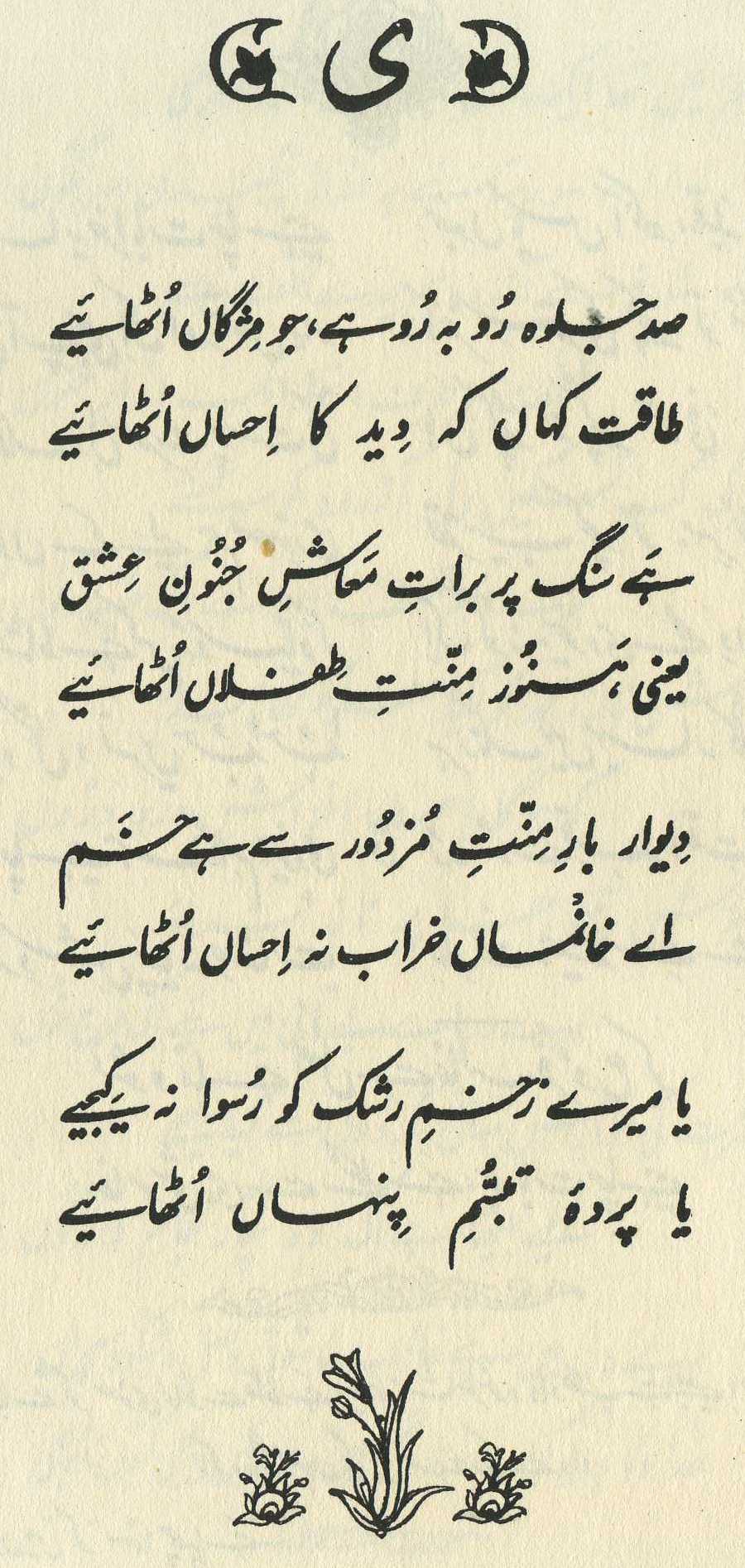
Oh house-wrecked one, look at the wall of your house! Be convinced that there's no other reason for its being bowed except that the burden of the kindness of the workman has caused it to bow. Receive a lesson from this, and don't accept kindness/obligation from anyone, for this burden is impossible to endure. The wall's bending, and that too from the burden of kindness/obligation-- in both things he has created the verbal device of 'poetic claim' []. (139)
== Nazm page 139

He says, kindness/obligation is a thing burdensome to such an extent that even a wall lacks the strength to 'lift' it: it too has become bent by the burden of the kindness of the workman. Oh house-wrecked one, as long as you live in the world, don't 'lift' [the burden of] anyone's kindness/favor! And look at wall and door, and receive a lesson from them: that even such strong things, after lifting such a stony burden, became bowed. (195)
It's a 'poetic explanation' [] that the wall has not become bowed through age, but rather has lifted [the burden of] the workman's labor, and is bowed from the burden of this favor/obligation. Oh house-wrecked one, don't accept anyone's kindness/favor, otherwise your head will not be able to 'lift' itself up []. (259)
On the general metaphor of 'lifting a burden' of kindness or obligation, see the discussion in 130,1 . Deliberately or casually, Bekhud Mohani adds a related image: under the 'burden' of such gratitude, the head will not be able to 'lift' [] itself high (in pride and self-respect), but will remain bowed-- in humiliation, and also in the stance of someone who carries a heavy burden on his back.
The enjoyableness of the verse rests on on the device of assigning a surprising new 'poetic' reason for some ordinary thing. This is called ' elegance in assigning a cause ', though Nazm and Bekhud Mohani provide slightly different terms for the same device.
As usual in such an 'A,B' verse, we can't tell exactly how to connect the two lines. Is the first line primary, so that the verse is contemplating a 'bowed down' or even collapsing wall, and meditating on the cause of its downfall? Might the addressee even be the bowed-down wall itself? Or is the second line primary, as the speaker (perhaps admonishing himself) contemplates the wall of his own wrecked house, and uses it as an illustration to reinforce a moral lesson about his own life?
All three commentators invoke the addressee as 'house-wrecked one' [], the most common form of the phrase. The verse itself, however, uses something more sweeping: 'house-and-home-wrecked one' [], which can include 'household' and 'family' among the wreckage (see the definitions above). Are we meant to conclude that one's family relationships can be destroyed by the burden of mutual favors, kindnesses, and obligations? But surely family relationship can't possibly exist in the absence of mutual favors, kindnesses, and obligations. So the verse seems to be to be ruling out family life entirely.
As you stand in the wreckage of your life, oh house-and-home-wrecked one-- says the verse-- learn a lesson: never accept favors, kindnesses, obligations. Was it that kind of human indebtedness that ruined the addressee's life in the first place? Is the only cure complete solitude? Rather than becoming a 'wall', should the stones have insisted on remaining a disorderly, autonomous, stubbornly un-indebted heap? (Compare the radical isolationism of 127 .)
graphics/ruinedwall.jpg