Verse 11821aa;Nu;Thaa))iye
G3
1
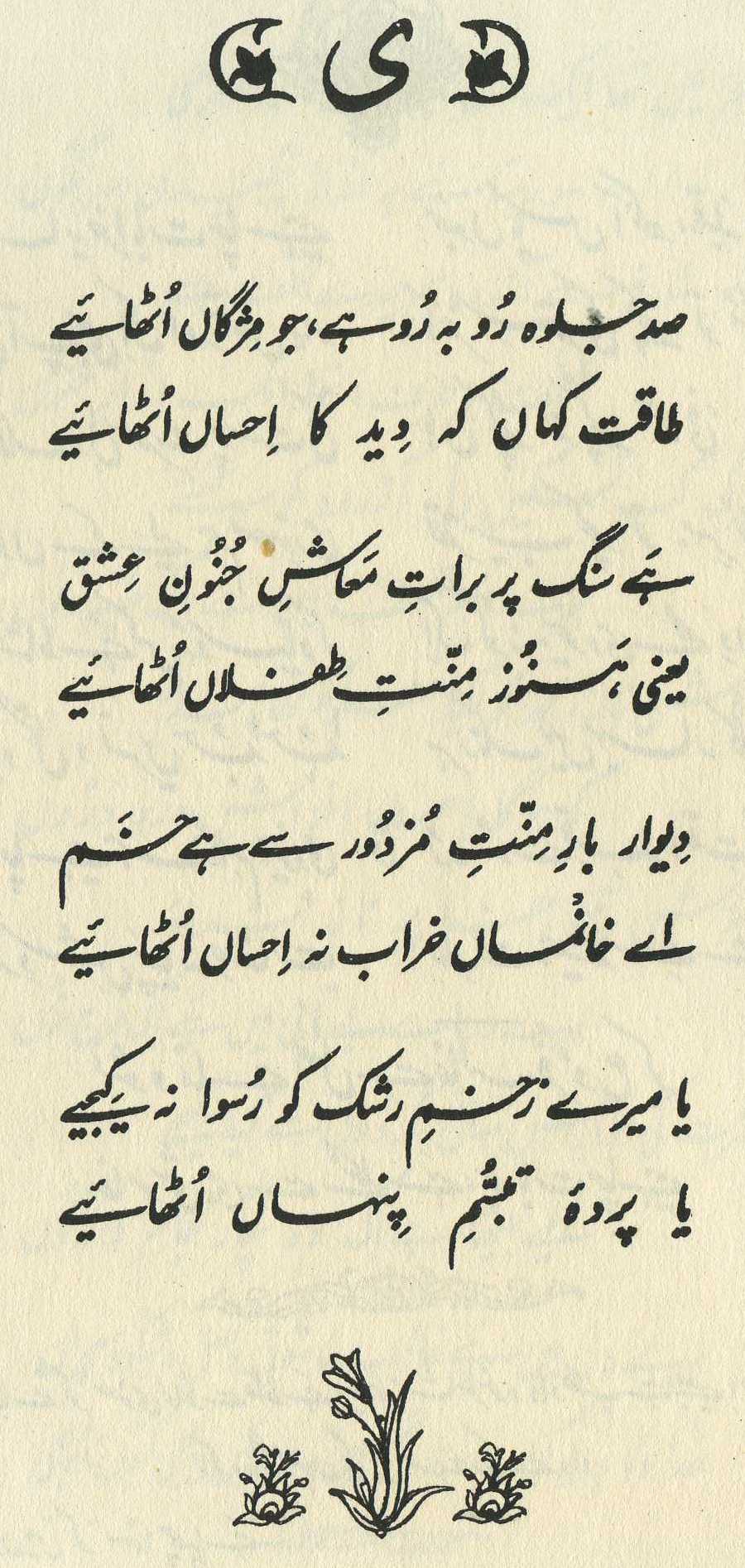
a hundred[-fold] glory/appearance is face-to-face, if one would lift the eyelids
2
where is the strength, that one would 'lift' [the burden of] the benefaction of sight/vision?!
'Manifestation, publicity, conspicuousness; splendour, lustre, effulgence'.
'Seeing, sight, vision; show, spectacle'.
'Beneficence, benefaction, benevolent action, benefit, favour, kindness, good offices, obligation conferred'.
| References | |
|---|---|
| Arshi, Imtiyaz Ali | Ghazal# 130 |
| Raza, Kalidas Gupta | 340 |
| Nuskhah-e-Hamidiyah | 178-179 |
| Asi, Abdul Bari | 215-216 |
| Gyan Chand | 330-331 |
| Hamid Ali Khan | Open Image |
For the poet, a refined/sensitive [] mind and temperament are special traits, and accordingly they always create refined/sensitive theme s. The meaning is that our refined/sensitive mind can't endure to lift [the burden of] the kindness of the gaze. We only enjoy the promenade and spectacle of the world if we keep our eyes closed. (139)
== Nazm page 139

The meaning is that the colorful spectacles of His power are visible. Who has the strength to see all these mood s and understand them? Looking and looking, a man becomes tired, and the marvels of His power are not finished. (194)
That is, what patience do we have for the world's glories/appearances, which appear like mirages, that we should look at them? Having closed our eyes, we are seeing the glory/appearance of the True Beloved in the manifestation-place of the heart.
[Or:] It's an expression merely of temperamentalness []. There's no lack of glories/appearances. It takes only the length of time necessary to lift the eyelashes. But now the heart doesn't have any more strength for the worship of glories/appearances. (259)
This is one of a surprising number of verses enjoining a prickly independence and refusal of all indebtedness; for more on such verses, see 9,1 . In English we have the idea of bearing a 'burden' of gratitude, or being placed under a 'weight' of obligation. Here the metaphor is the same, though the grammar of the verse doesn't spell it out: who has the strength to 'lift' this burden of obligation? The burden is the favor that 'sight' would do for you (a generalized 'you', not a particular addressee); it's a favor for which you could make no return-- so you would remain indebted, which would be humiliating and unacceptable. And of course, the ground of the present ghazal makes this concluding syllable and word pattern very convenient, so it appears again in 130,3 , with the metaphor of lifting a burden spelled out much more explicitly. A similar use of appears in 44,1 : it's a kindness that remains 'on' the eyes like collyrium.
As so often, the relationship between the two lines is left for us to decide. Bekhud Mohani sees in the first line an offer of vain, transitory, worldly temptations, so that it must be refused. Bekhud Dihlavi maintains that the first line evokes the glories of the True Beloved, so that it must be welcomed even though we can't do it justice. Only Nazm takes seriously the actual imagery of the verse: the lack of 'strength' for 'lifting' the burden. On his reading, the nature of the sight in the first line is irrelevant, since the lover will stubbornly keep his eyes closed, for fear of incurring a literally 'unbearable' indebtedness.
The first line speaks of, and apparently recommends, lifting the lightest, easiest thing in the world: one's own eyelids. The second line speaks of 'lifting' a beneficence from 'vision'-- a burden that may be light or heavy, desired or unwanted, divine or this-worldly; we can't tell. All we can tell is that lifting it is beyond one's strength. Unsurprisingly, both lines are : we get two proposed actions (though technically the verbs are polite imperatives) and one question. This makes the verse extremely flexible, and highly responsive to our own reading. It's one of those verses in which tone makes all the difference; and the tone is exactly what we have to supply for ourselves.
graphics/radiance.jpg