Verse 11816aa;Nmeraa
G5
In this meter the first long syllable may be replaced by a short; and the next-to-last long syllable may be replaced by two shorts.
1
I am free collyrium for the sight/gaze, my price/worth is this--
2
that my kindness/favor/obligation would remain 'on the eyes' of the purchaser
'Lead-ore; antimony (reduced to powder); collyrium (of antimony, or lead-ore or sulphuret of lead)'.
'Lamp-black (applied medicinally and as a collyrium to the eyes); soot'.
'Collyrium, antimony (reduced to a fine powder, used for the eyes)'.
'Price, value, worth'.
'Doing that which is good; beneficence, benefaction, benevolent action, benefit, favour, kindness, good offices, obligation conferred'.
| References | |
|---|---|
| Arshi, Imtiyaz Ali | Ghazal# 30 |
| Raza, Kalidas Gupta | 163 |
| Nuskhah-e-Hamidiyah | 81-83 |
| Asi, Abdul Bari | 71 |
| Gyan Chand | 111-115 |
| Hamid Ali Khan | Open Image |
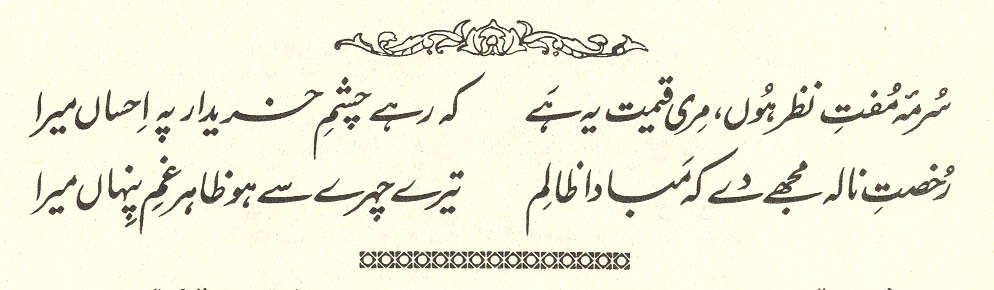
That is, my poetry is of general benefit, and it offers free advantages, the way using the eyes is freely available to every person. He has given for the pleasure of sight the simile of collyrium. (41)
== Nazm page 41

Urdu text: Vajid 1902 {44}
Mirza Sahib has written this verse in praise of the beauty of his own poetry. That is, my poetry is a general benefit, and free advantages can be had from it. And all this for one sole purpose: that my kindness would remain 'on the eyes' of the purchaser. That is, the insight of poetic understanding is obtained from this collyrium. (81)
There is a wordplay among 'collyrium', 'sight', and 'eye'. And in the second line there's a devastating flowingness , ease, and attraction. For this reason this verse has become proverbial. (384)
This present verse is one of the relatively rare ones in which Ghalib speaks of himself as a poet: he says, I am a free gift for the eyesight-- but of course there's a catch, a price. The burden of (gratitude for) my kindness must remain 'on the eyes' of the purchaser. Apart from its wordplay, idiomatically this suggests a particularly humble state of submission and deference in the purchaser. People receive rulers' commands , 'on the head and eyes', since these are the most honorable parts of the body. People also, of course, use their eyes to read poetry.
Such gratitude for favors rendered is a much more significant burden than we might at first realize, for one of the most consistent themes in Ghalib's poetry is a rejection of all forms of indebtedness and borrowing. The will remain 'on' the eyes of the purchaser, like a 'burden' of obligation, gratitude, debt; for a similar use of the same metaphor, see 130,1 .
So what kind of a 'free gift' is it that carries a 'price'? Of course, it's the kind of 'gift' that imposes a debt of gratitude more undischargeable than any mere monetary obligation. Our eyes are beautified, and our eyesight enhanced, by Ghalib's poetry. The obligation laid on us by his kindness will be 'on our eyes' forever. But it's all right, for who would say the game isn't worth the candle?
ABOUT COLLYRIUM: Collyrium [], also called 'kajal' [] and 'kohl' [] (see the definitions above), is a black powder or salve applied around the eyes. It is thought to be attractive, to reduce the sun's glare, to improve vision, and to keep the eyes healthy. In the ghazal world, it can also be considered a cure for blindness. It's usually made by holding up a plate above the smoky flame of a burning lamp, in order to collect the soot.
Collyrium is also, in the ghazal world, a natural enemy of the voice: verses that invoke this idea include: 84,8x ; 109,8x ; 147,1 (in which collyrium is made from the 'smoke of the flame of the voice'); 149,8x // 360x,1 *; 406x,5 ; 435x,7 . The logic may be that eyes dramatized by a dark frame of collyrium look larger, and thus are more eloquent in their silent 'speech'-- but this speech is only effective when the mouth isn't providing competition. (For more on the 'flame of the voice', see Mir's M 472,6 .)
But in discussing 227,1 and 435x,7 , the commentators also generally maintain that 'From eating collyrium the voice is lost, and a person becomes unable to speak'; in 109,8x , Gyan Chand again agrees. This sounds strange; who would actually go around eating collyrium, and why? But it's apparently another convention of the ghazal world. Mir too validates it: he has a verse in which the lover loses his voice, and suspects that, metaphorically speaking, collyrium might have been mixed in with his paan! M 788,8 :
[what can I say-- having seen the excellence of the writing, my voice became closed/bound
so to speak, she gave me collyrium along with paan]
Ghalib's collyrium verses include: 57,5 ; 74,2x ; 84,4x ; 84,8x ; 88,2 ; 109,8x ; 147,1 , 'smoke of the flame of the voice'; 147,4x ; 149,8x ; 162,6 ; 227,1 ; 233,13 // 237x,3 ; 244x,4 ; 254x,1 ; 266x,1 ; 311x,2 ; 315x,2 ; 346x,2 ; 360x,1 ; 366x,3 ; 375x,4 ; 406x,5
graphics/kohl.jpg
Here is some , and a nineteenth-century North Indian :
graphics/collyrium.jpg
graphics/surmahdan.jpg
graphics/surmahdan2.jpg