Verse 11816aanikaltii hai
G9
In this meter the next-to-last long syllable may be replaced by two shorts.
1
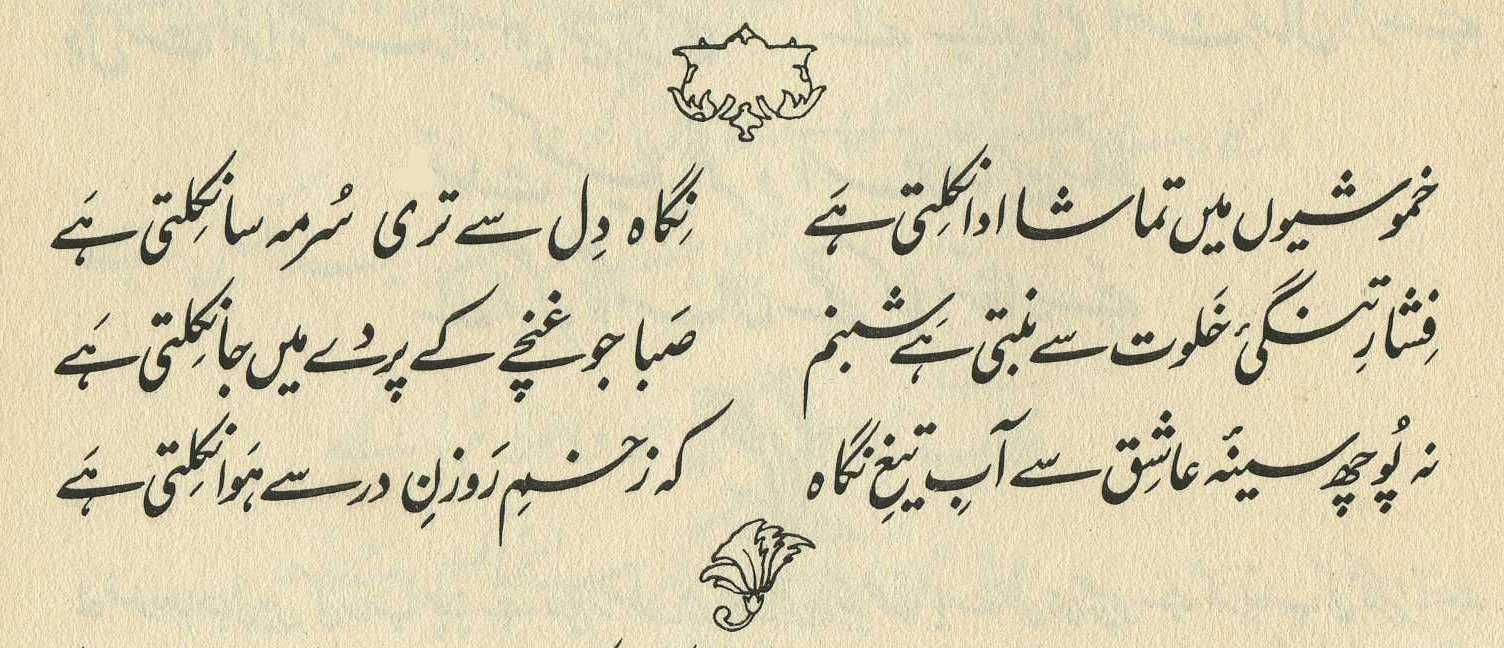
in silences, a spectacle-style emerges
2
from your heart a gaze/glance like collyrium emerges
'Lead-ore; antimony (reduced to powder); collyrium (of antimony, or lead-ore or sulphuret of lead)'.
| References | |
|---|---|
| Arshi, Imtiyaz Ali | Ghazal# 177 |
| Raza, Kalidas Gupta | 234 |
| Nuskhah-e-Hamidiyah | 272 |
| Gyan Chand | 394 |
| Hamid Ali Khan | Open Image |
Between silence and collyrium, a necessary connection has grown up in the poet's mind, since for the collyrium-user silence is necessary, since its speech is only voiceless; its voice cannot emerge. The author has said the mirror image of this: that is, in silence your glance emerges, having been surrounded by collyrium, from your heart itself. That is, your silence itself makes the glance collyrium-surrounded. That is, because of this necessary connection, silence and collyrium are the same thing. (254-55)
== Nazm page 255

From eating collyrium, the voice is lost. He says, 'Even in your silences a style of expression is found. As if the gaze that emerges from the intention of your heart, emerges like collyrium.' That is, the voice is without an aspect. (312)
If anyone would eat collyrium, then his/her voice would gradually be lost. = a style that's worth beholding. = mixed with collyrium; that is, silent.
In your silence too a style that's worth seeing emerges, because your gaze too that emerges in this state, has in it the same thing that's in a collyrium-like gaze [when] the beloved is silent....
That is, you cast a kind of gaze upon me that teaches me about silence (the way a collyrium-eater cannot speak). And your and my sitting in the same place, but sitting in silence, is worth seeing. The point is that she looks in such a way that one doesn't have the courage to speak in her presence: 116,5 . (461)
Many people have read, in the second line, instead of .... Maulana Arshi has read ; I follow him. But it's also true that the verse is so obscure that whether we read or , things aren't much clearer....
So let's think about it afresh. The first point is that is the quality of a gaze; that is, in Persian poetry the gaze has been called ; Ghalib didn't invent this construction....
The Greek philosophers and their followers mostly held the view that when a ray of light emerges from the eye and falls on things, then things are seen. That is, the eye is a giver of light, not a receiver.... Muslim Sufis have generally called the heart 'seeing' and a 'possessor of insight'....
In the light of this analysis it's not hard to see that in the verse under discussion Ghalib is making his beloved the possessor of the quality of 'insight of the heart'. Thus he is assuming that her gaze emerges from the heart. To assume that the beloved is a 'possessor of insight' is common. And it's not at all necessary that this verse should be about the beloved; it can also be about some mystical knower or spiritual preceptor; it can also be about someone who's an object of praise. To suppose that a praised one is a possessor of mystical knowledge and insight is also common.
Thus the interpretation becomes that the gaze is habitually silent; when the beloved or the praised one remains silent, and attends to us people with the eye of the heart, then s/he doesn't simply stop with avoiding words or the voice. Rather, her every glance emerges 'like collyrium'. From eating collyrium the voice is lost, and a person becomes unable to speak. Thus the silence of the 'gaze like collyrium' will be, in comparison to the silence of an ordinary gaze, more intense and profound.
Shaukat Merathi has made a good point: 'With reference to glances and hints, they call the eye a speaker'. But if this be accepted as correct, then one more pleasure is created: that the eye is a speaker, but the beloved or the praised one has such regard for his/her silence that s/he emits even her gaze after having made it like collyrium.
Because the putting on of collyrium is considered a kind of coquetry, to call the 'gaze like collyrium' -- that is, worthy of being seen-- seems full of affinity . If we take to be a quality of , then the meaning will be 'a very interesting style'. That is, in your silence is this interesting style: that even your gaze emerges from the eye like collyrium'. For a 'speaking eye', consider Mir [ 783,6 ]:
[don't cause the deer to meet her speaking eye!
can a rustic ever at all converse with an urbanite?]
== (1989: 352-54) 2006: 380-82
For more on the natural enmity between collyrium and the voice, and on the general qualities of collyrium, see 44,1 . The commentators agree that if you eat collyrium, you lose your voice. This always astonishes me. How would anybody know that? Who would go around eating collyrium and reporting (in writing, no doubt) the results? Let's assume that they are talking about the ghazal world, not the real world (although they don't indicate this). Or perhaps they are all merely picking up the idea from each other. It almost sounds like a back-formation from attempts to interpret verses like this.
I'm willing to go with Faruqi's reading, but I keep asking myself, why ? What is that agreeing with? Not the heart, which is oblique; not the gaze, which is feminine. And the first line doesn't offer any remotely plausible candidates, except the grammatically awkward , which doesn't really commend itself either. If it had been (to go with ) or (in a general adverbial sense) I would have been much more content. Perhaps we have to consider it just a concession to the rhyme .
Note for grammar fans: The noun compound is unnatural in Urdu, but very common in Persian; for more examples see 129,6x .
graphics/heartrays.jpg