Verse 5after 1816aakih yuu;N
G15
1
in the gathering, facing her, why would one not sit silently?
2 a
in her silence, too, is this very same intent/purpose-- 'like this'
2 b
even in her silence is this very same intent/purpose-- 'like this'
The spellings and are permissible variations, governed by the needs of the meter.
'What is claimed, or alleged, or pretended, or meant; desire, wish; suit; meaning, object, view; scope, tenor, drift'.
| References | |
|---|---|
| Arshi, Imtiyaz Ali | Ghazal# 85 |
| Raza, Kalidas Gupta | 294 |
| Nuskhah-e-Hamidiyah | 142-143 |
| Hamid Ali Khan | Open Image |
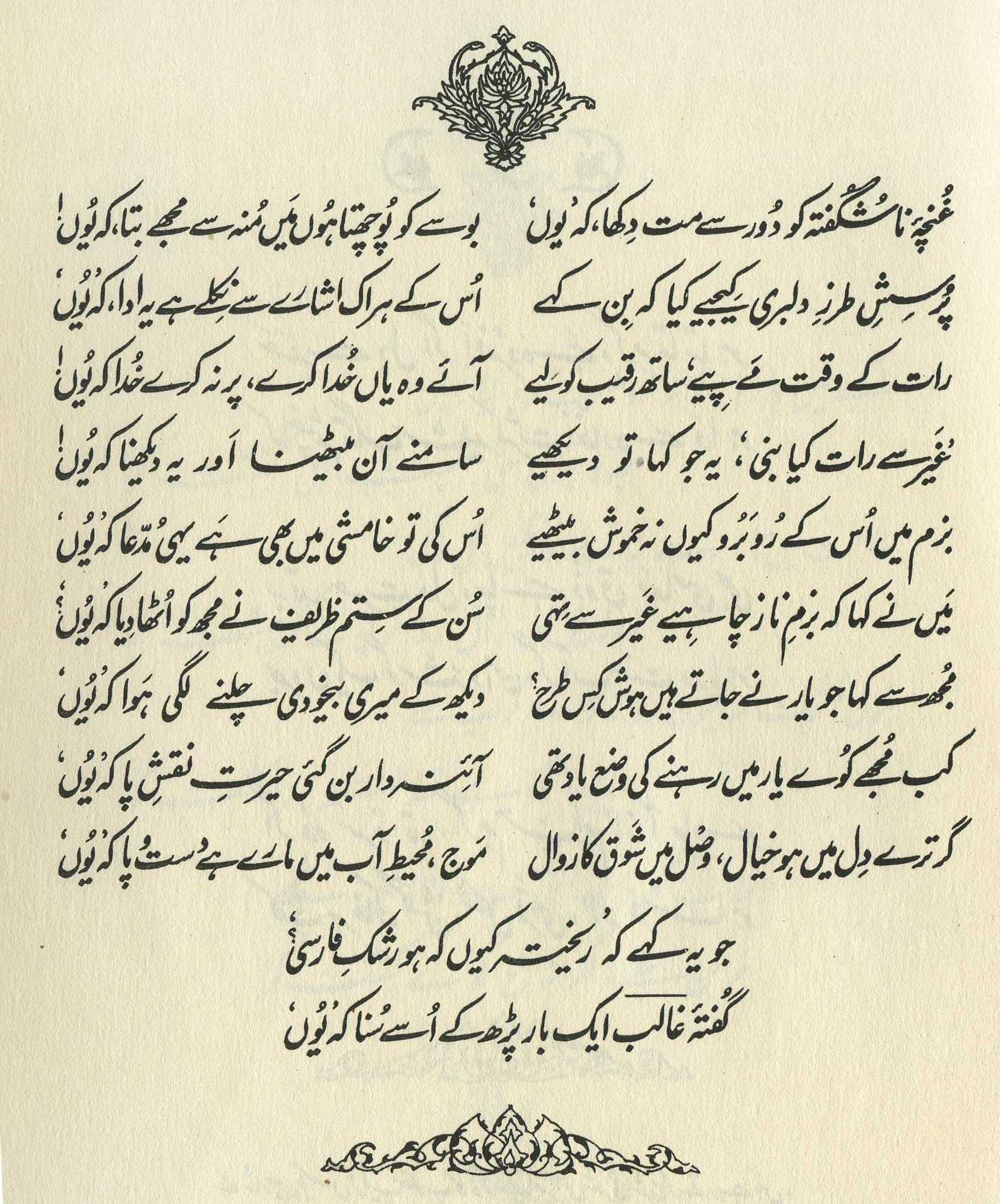
That is, you too should sit silently. (125)
== Nazm page 125

He says, before her, in the gathering, how would one not sit silently? In her silence too the purpose emerges: 'You too should sit silently, as I do'. (177)
For the beloved's gathering, and for a royal court, exactly this is the etiquette []. In her gathering one is compelled to sit silently. Because she herself remains silent. The meaning of which is that no one should open his lips before us, he should remain seated silently, according to etiquette. (235-36)
This is a beautiful verse of mood -- quiet, subtle, thoughtful, evocative. It's the first of three in this ghazal that seem to belong together in their mysterious mood and mystical tone: {116,5}; 116,7 ; 116,8 .
The first line asks a rhetorical question, why wouldn't one sit silently in her presence, facing her? The clear implication is, of course one would. Even this line by itself strongly enforces that sense of sense of necessary behavior, of what Bekhud Mohani calls the 'etiquette' [] of the situation.
The second line plays creatively with that enjoyable little . If we read it as 'too, in addition' (2a), then of course we ask, in addition to what? And here three meanings emerge. First, her silence too, in addition to one's natural sense of etiquette invoked in the first line, enjoins silence. Second, her silence too, in addition to one's own silence as envisioned in the first line, enjoins silence. And third, her silence too, in addition to her spoken command, enjoins silence.
And if we read as 'even' (2b), then we find that her own silence is not just one more item in a series, but a limit case: not to speak of all the other reasons for silence, even her own silence, which perhaps might be expected not to 'speak' at all, enjoins silence on one's part.
Then there's the wonderful flexibility of . Is her silence a command to be silent 'like this'-- that is, the way she herself is silent? Or is it, taking as a speech-introducer, a way of paradoxically, silently, conveying the words 'like this'?
And what is the full subtlety of -- 'this very' intention/purpose, or 'only this' intention/purpose? Does it apply merely to the silence, or does it go deeper? Is there some more intangible form of imitation that is also implicitly demanded?
This verse surely invites a mystical reading, though it doesn't require one. After all, if you ever did have a chance to sit down face to face with God, you'd probably be inclined to keep silent. But the beloved too is fully as awe-inspiring and ineffable in her own way-- she's an 'idol', after all.
Compare the piquant 208,6 , in which the lover is seated facing not a silent 'idol' but an even more provocatively opaque one: an 'idol with a mirror-forehead'.
graphics/silence.jpg