Verse 10after 1816aakih yuu;N
G15
1
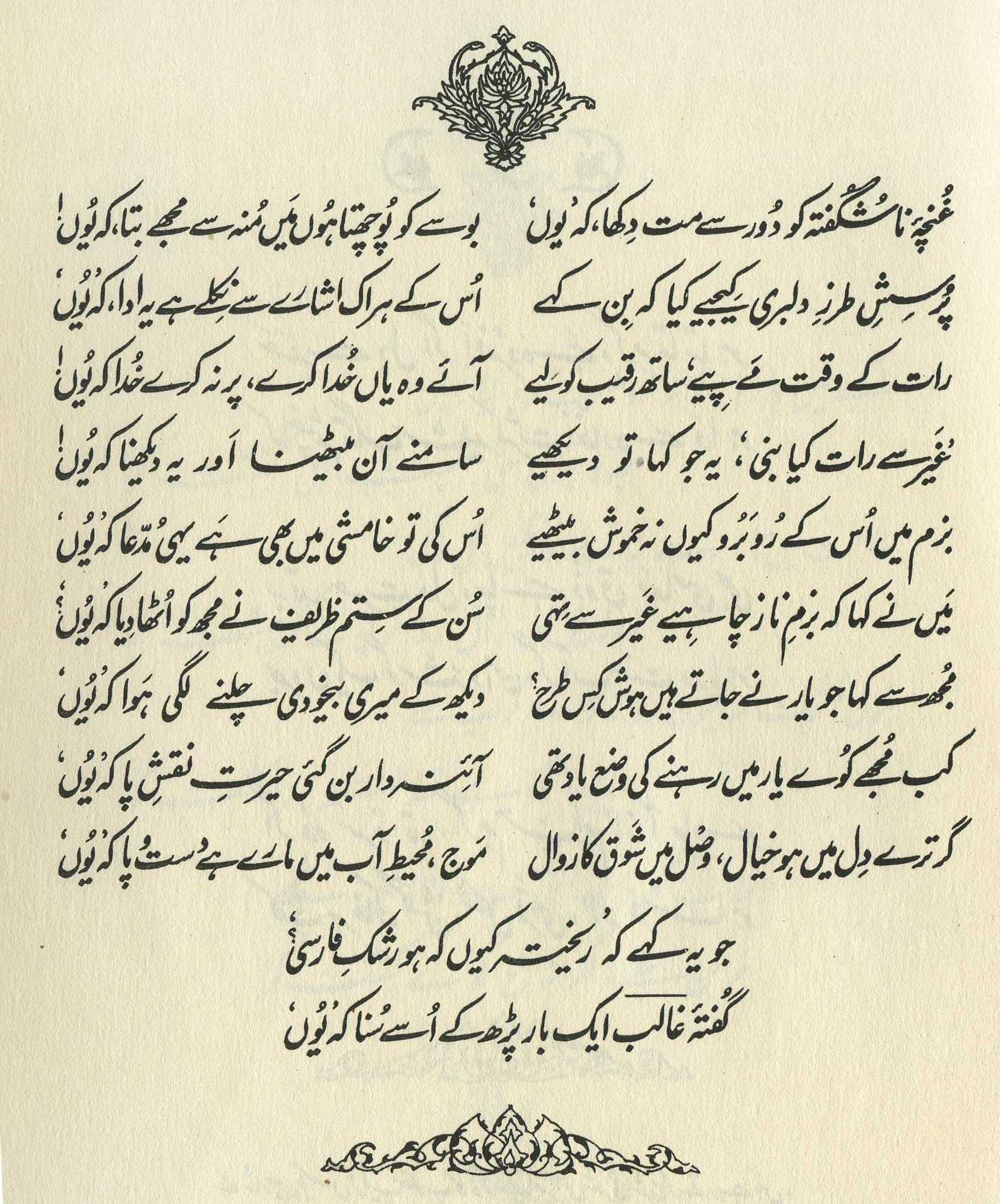
if [anyone] would say this: 'How could/would Rekhtah be the envy of Persian?!'
2
read/recite to him, a single time, the 'speech'/poetry of Ghalib-- 'like this!'
'Said, spoken, told, related'.
| References | |
|---|---|
| Arshi, Imtiyaz Ali | Ghazal# 85 |
| Raza, Kalidas Gupta | 294 |
| Nuskhah-e-Hamidiyah | 142-143 |
| Hamid Ali Khan | Open Image |
The use of in place of has [now] been rejected. (126)
== Nazm page 126

They call verse composition in Urdu 'Rekhtah'. He says, 'If anyone would ask, how could Rekhtah be the envy of Persian, then read them Ghalib's verses a single time: "it's like this"'. (177-78)
Whoever might doubt that Urdu poetry can be better than Persian poetry, recite Ghalib's poetry to him and say, 'look-- it comes out ahead like this!' That is, my Urdu poetry is better than Persian poetry. (237)
This is a handy verse to have on the tip of your tongue if you run into Persian fans who point out snidely that Ghalib valued his Persian poetry more highly than his Urdu. He did, of course. Persian had been until recently the high literary language of his time and place; he wanted to be part of that great tradition, and he was. (And this verse itself was composed in his youth, before the decades when he wrote chiefly in Persian.)
Compared to the long history of Persian poetry, Urdu was still only a young upstart-- but it was a strong one, full of hybrid vigor. If it's easy to show that Ghalib valued his Persian ghazals, it's also easy to show that he valued his Urdu ghazals. (Not surprisingly, since they really aren't very different. Sometimes a change from to or vice versa is all it would take to flip a verse over the linguistic line.)
When Ghalib realized that most of his friends were eager for him to publish his Urdu divan , and were rather less interested in the publication of his Persian divan, he was dismayed and irritated. (He made the same annoying discovery with regard to his Urdu versus his Persian letters.) But over time, he came round-- his later letters show him as increasingly willing, in practice if not always in theory, to accept his friends' high valuation of his Urdu ghazals and letters.
For another explicit boast about his prowess as an Urdu ghazal poet, see 111,1 . And in general, many of the verses in the 'Poetry' set are boastful; since they're in Urdu, it's hard to believe that they're not vaunting (and flaunting) his prowess as an Urdu poet.
For similarly extravagant claims made by Mir , see 1056,7 .
graphics/sherani01.jpg