Verse 4after 1816aakih yuu;N
G15
1
'how did things go with the Other last night?' --when I said this, then just look:
2
[her] coming and seating herself before me-- and {look at this / this looking}-- 'like this'
'Course, way, manner, mode...; natural disposition or temperament; habit, peculiarity; way or manner of a belle or a coquette, gracefulness, grace, elegance, charm, blandishment (= ); affectation; bashfulness, modesty; conceit, pride; will, pleasure, wish; rank, dignity, respectability, reputation, character; proper spirit, self-respect'.
| References | |
|---|---|
| Arshi, Imtiyaz Ali | Ghazal# 85 |
| Raza, Kalidas Gupta | 294 |
| Nuskhah-e-Hamidiyah | 142-143 |
| Hamid Ali Khan | Open Image |
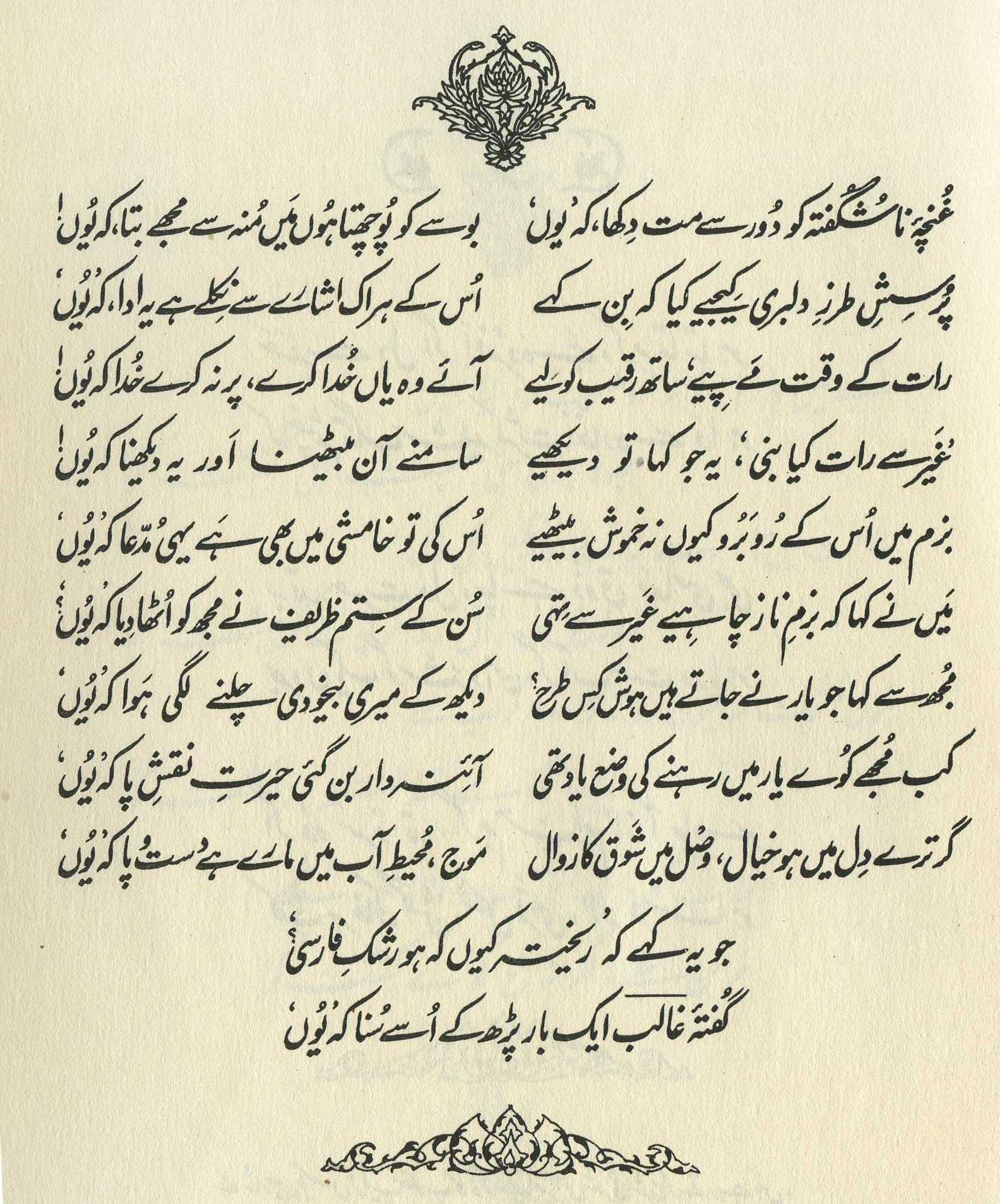
In the word the author has placed two meanings. One is, upon that question of mine, her seating herself before me and looking toward me with a glance of anger: 'Look, you've begun to make mischief like this!' And the other meaning is that upon that question of mine, just please look at her seating herself before me, and just please look at the insolence with which she seated herself before me like this! (125)
== Nazm page 125

He says, I had asked her how things went with the Other last night. In answer to that, she came and sat before me, and with this coquetry she made clear, 'Look-- like this!'. That is, 'I remained seated far from him like this'. (176-77)
When I asked how things went with the Rival last night, that cruel one showed no shame. She seated herself before me-- and seated herself with such insolence! The lover says to his confidant, 'It was the limit! Now she's got not even the slightest hint of shame left'. (235)
This is one of the 'cute' verses discussed in 116,1 . In addition, though, it's really astonishingly complex. Its short phrases are sketchy, half-gestural, and capable of being strung together in a variety of ways. For there are three personae involved in it: the lover, who is speaking; the listener, to whom he is vividly describing the beloved's behavior; and the beloved herself, who may even speak the last word in the verse. Here are some of the possibilities:
'When I asked how things had gone with the Other last night-- you should have seen her elegantly (or in some other of the numerous styles associated with ; see the definition above) seating herself before me,
=and [saying], 'Look at this-- like this!'
=and [her] looking [at me in a way that said], 'Like this!'
=and you should have seen [how she said], 'Like this!'
=and you should have seen [how she acted-- as if to say], 'Like this!'
There may be more permutations, but these seem to be the basic set. Apart from the convenient multivalences of and , the is also a great 'midpoints' complexifier: it could be a parenthetical remark addressed to the listener, parallel to but simply in the neutral rather than the polite imperative; or it could be words spoken or implied by the beloved; or it could be a description of the beloved's looking at the lover ('this looking [of hers]!').
The extra complexities become possible because the lover is trying to evoke a past scene before the listener's eyes, in the present. Thus the lover adjures him to 'please look!', even though the listener can see only a picture in his mind-- or else perhaps a scene that the lover is acting out for him.
And of course, with all this, we still have no idea what the beloved actually meant by whatever she did and/or said. If she flounced into a chair facing him, was she mocking him? Defying him? Tantalizing him? Illustrating her behavior with the Other? Preparing for a major argument? Even though we're onlookers (after a fashion), we're left to invent the rest of the scene for ourselves.
On the colloquially omitted in , see 59,2 .
graphics/suggesting.jpg