Verse 31816aanikaltii hai
G9
In this meter the next-to-last long syllable may be replaced by two shorts.
1
don't ask the lover's breast [about] the temperedness/'water' of the sword of a gaze/glance!
2
for from the wound of the crevice-work of the door, wind/desire emerges
'Water; water or lustre (in gems); temper (of steel, &c.); edge or sharpness (of a sword, &c.); sparkle, lustre; splendour; elegance; dignity, honour, character, reputation'.
'Air, atmosphere, ether, the space between heaven and earth;--air, wind, gentle gale; ... --affection, favour, love, mind, desire, passionate fondness; lust, carnal desire, concupiscence'.
| References | |
|---|---|
| Arshi, Imtiyaz Ali | Ghazal# 177 |
| Raza, Kalidas Gupta | 234 |
| Nuskhah-e-Hamidiyah | 272 |
| Gyan Chand | 394 |
| Hamid Ali Khan | Open Image |
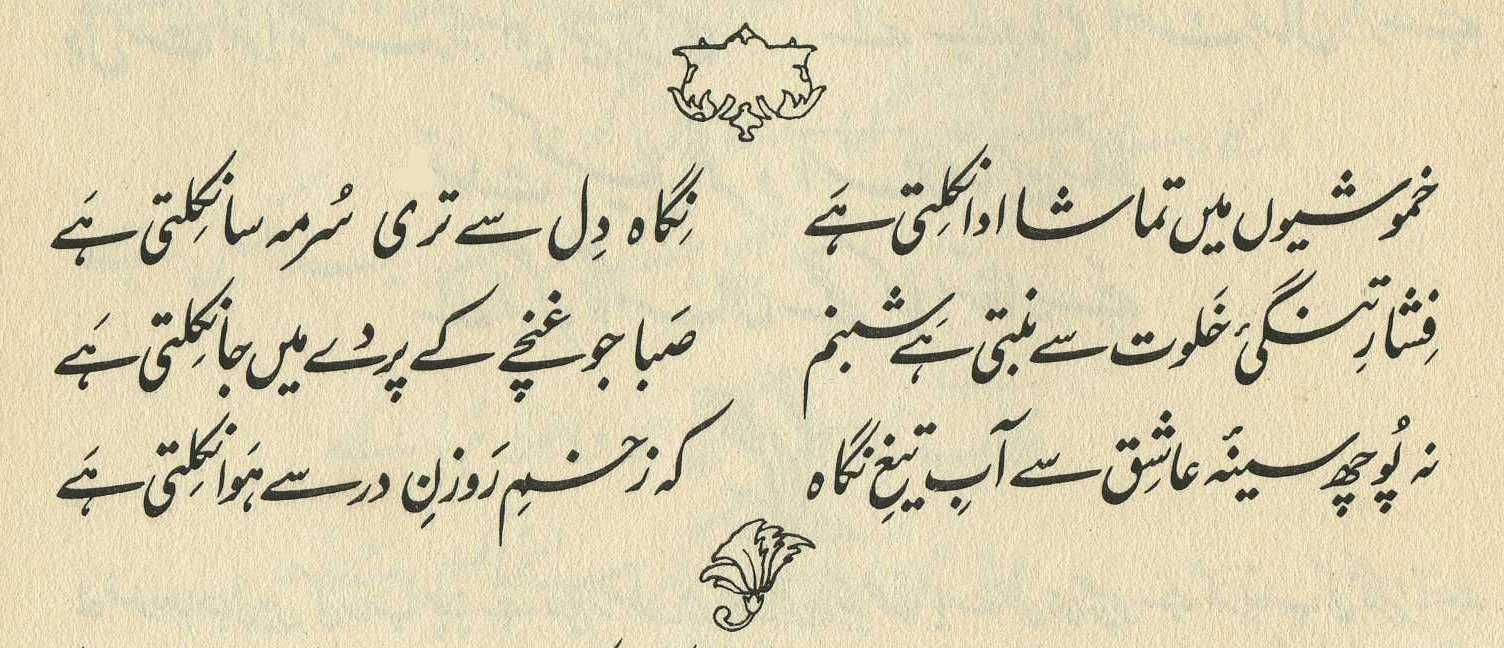
That is, through whichever door she gazes, don't consider it crevice-work-- but rather, that she has wounded it with the sword of her glance, and the wound too is so deep that the wind emerges through it. Then what is the condition of the lover's breast? The wound through which wind would emerge, and which would begin to 'breathe', is certainly deadly. (255)
== Nazm page 255

He says, don't ask the lover's heart about the state of the temperedness of the sword of the glance. Look-- whichever crevice-work in the door she looks through, the sword of the glance has so wounded it that wind begins to emerge. The wound from which wind would emerge is considered very deadly. (312)
By wind, water is always dried up.
Don't ask the breast about the temperedness of the sword of the glance, because the wound is the crevice-work of a door, through which wind emerges. The wound too has begun to 'breathe'. Now the physician is of no use. (462)
The first line sets up a wonderful range of negative possibilities centering on the 'inexpressibility trope'. Here are some of the ways, with different emphases, that it can be read:
=Don't ask the lover's breast (because it's way too deeply wounded and can't talk).
=Don't ask the lover's breast (because it can't find words for anything so inexpressible).
=Don't ask the lover's breast (ask the door's wounded breast instead).
=Don't ask the lover's breast about the 'water' of the sword of the gaze (because not water but 'air, wind' emerges from the wound that this sword makes).
=Don't ask the lover's breast about the sword of the gaze (because you can see that even the crevice-work on the door has received a deadly wound from that sword).
Moreover, this is an 'A,B' verse-- how exactly are we to put the two lines together? Do they both describe the same situation in different words? Do they describe two different but similar situations? Do they describe two different, non-comparable situations? Here are some of the obvious possible readings:
=There was no crevice-work in the door until the beloved's glance created it and made it sigh with passion; not to speak of the lover's heart, even wood responds to her power.
=The crevice-work in the door has been wounded by the sword of the glance that passed through it, and now sighs with passion; not to speak of the lover's heart, even wood responds to her power.
=The crevice-work in the door of the lover's heart has been pierced through by the sword of her glance; now wind/desire flows steadily out it.
=The lover's heart has been fatally wounded by the sword of her glance; the proof is that even the crevice-work of the door has similarly succumbed to her power.
Usually refers to the crevice-work high up in a brick wall, made for ventilation; for discussion and examples of this use, see 64,4 . In the present verse it seems to refer to something like a grill-worked peep-hole in a door.
The commentators seem to take it as a medical truism that when a wound begins to 'breathe' [], then it's probably mortal.
The rich wordplay involved in is one we've often encountered before; see 193,2 for discussion. In addition, the double meaning of as both 'air, wind' and 'desire' works to excellent effect here. And the yoking together of and evokes , 'water and air', which means something like 'climate'-- here, it's the 'climate' of passion itself.
graphics/doorrauzan.jpg