Verse 2after 1821aabto de
G9
In this meter the next-to-last long syllable may be replaced by two shorts.
1
in affection/intimacy, your weeping does murder--
2 a
let a person give temper/sharpness/'water' to the sword of the gaze in your style!
2 b
as if anyone [else] could give temper/sharpness/'water' to the sword of the gaze in your style!
is an archaic form of ( GRAMMAR )
'Water; water or lustre (in gems); temper (of steel, &c.); edge or sharpness (of a sword, &c.); sparkle, lustre; splendour; elegance; dignity, honour, character, reputation'.
'Water; river; ... lustre, splendour; honour, degree, dignity; power, glory, prosperity; grace, elegance; mercy, pity; custom, habit, fashion, mode, rule; quicksilver; (met.) Pearl, jewel, gem; brilliant sword; bashful, abashed; fellow-traveller; perfect soul, universal intellect. This word is much used in forming compounds, and metaphorical expressions'. (Steingass p.3)
| References | |
|---|---|
| Arshi, Imtiyaz Ali | Ghazal# 187 |
| Raza, Kalidas Gupta | 363 |
| Gyan Chand | 491 |
| Hamid Ali Khan | Open Image |
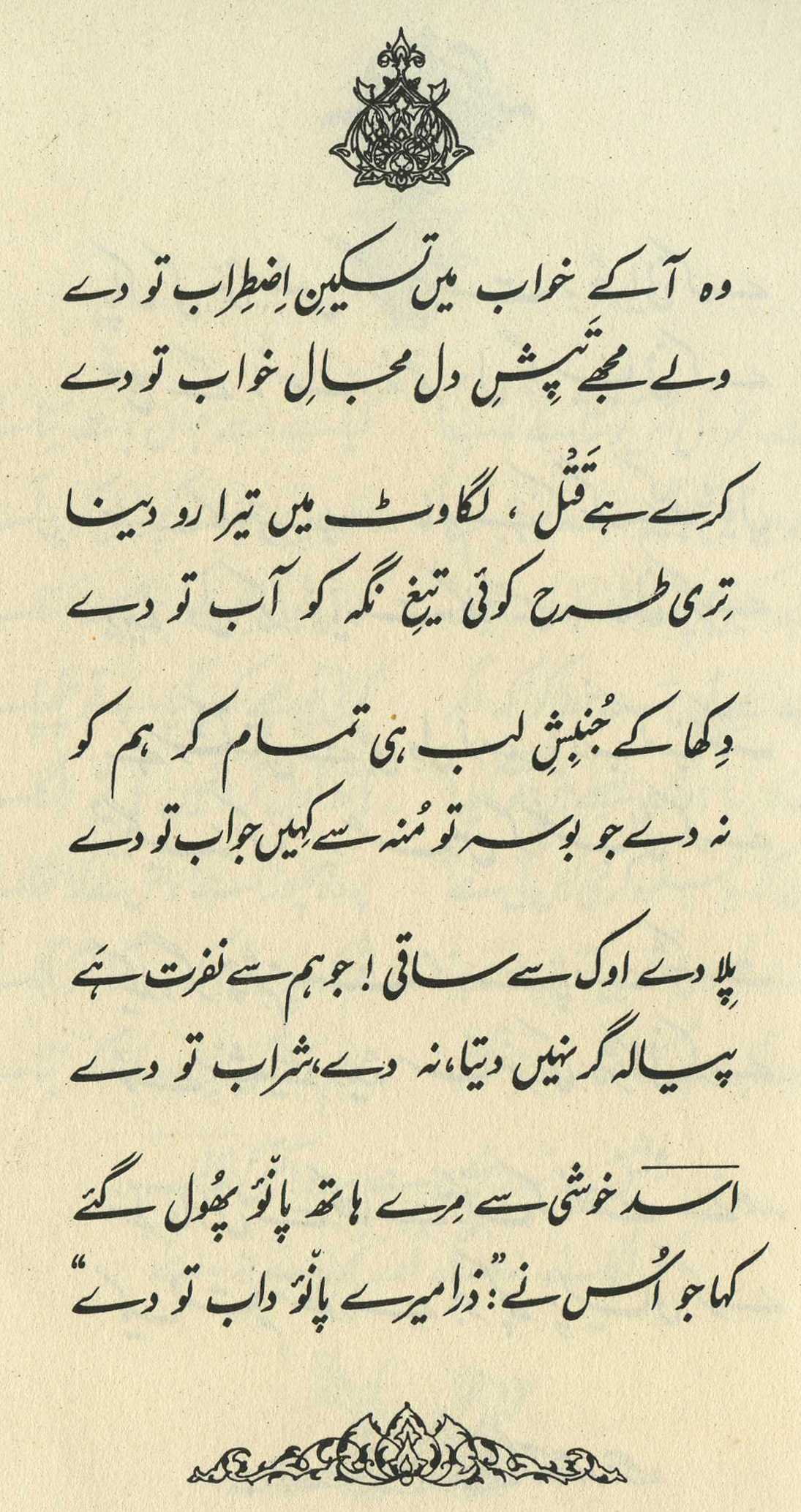
That is, the tears from your eyes create in the sword of the glance such that I am slain. In this verse the meaning of is that no matter how much anyone else might produce attraction in a glance, to give to the sword like this is something that no one else knows. (216-17)
== Nazm page 216 ; Nazm page 217


Here the word creates the meaning that other tyrannical beloveds don't at all know how to give to the sword of the glance as you do. (276)
: for there to be no love, and for the expression of love to be made.... When you, while expressing your false love, weep, then in your glance the effect further increases.... and the lovers fall into your net of deception. (381)
Compare 10,11 . (291)
[See his discussion of Mir's M 1719,1 .]
ABOUT : This verse makes excellent use of the protean (see the definition above): its sense of 'water' has an affinity with 'tears'; its sense of 'temper' (as in steel) and 'sharpness' have affinities with the 'sword' and the 'murder'; its sense of 'sparkle' and 'luster' go well with the 'glance' of the beloved's bright eyes. Other examples of conspicuous wordplay: 12,3x , with similar use of ; 75,1 ; 109,7x ; 193,2 ; 227,3 .
This is a classic mushairah -verse: the whole verse builds up, while remaining uninterpretable, to the final punch-word , which is of course withheld until the last possible moment. And it's also a verse based on what I call 'double activation', since in its various meanings (see the definition and discussion above) becomes the strong-- and the only-- focal point of the verse. Other meanings and affinities radiate out from it like spokes on a wheel.
As Nazm points out, this verse also features another-- and different-- use of the idiomatic ; for more uses, see 193,1 . Here it is a kind of sarcastic sense-- 'Bravo! Everybody should do it the way you do it!' (2a)-- with also a strong suggestion of 'As if anybody else could! Let them just try!' (2b).
Note for grammar fans: The adverbial 'in affection/intimacy' [] is a 'midpoint' phrase that could go two ways: it could describe the doing of murder ('when your lover is in that state']; or it could describe the weeping ('when you are in that state'). In this verse the distinction doesn't seem too significant either way.
Arshi's suggestion of 10,11 as a verse for comparison is an excellent choice.
graphics/sword.jpg