Verse 3after 1821aabto de
G9
In this meter the next-to-last long syllable may be replaced by two shorts.
1
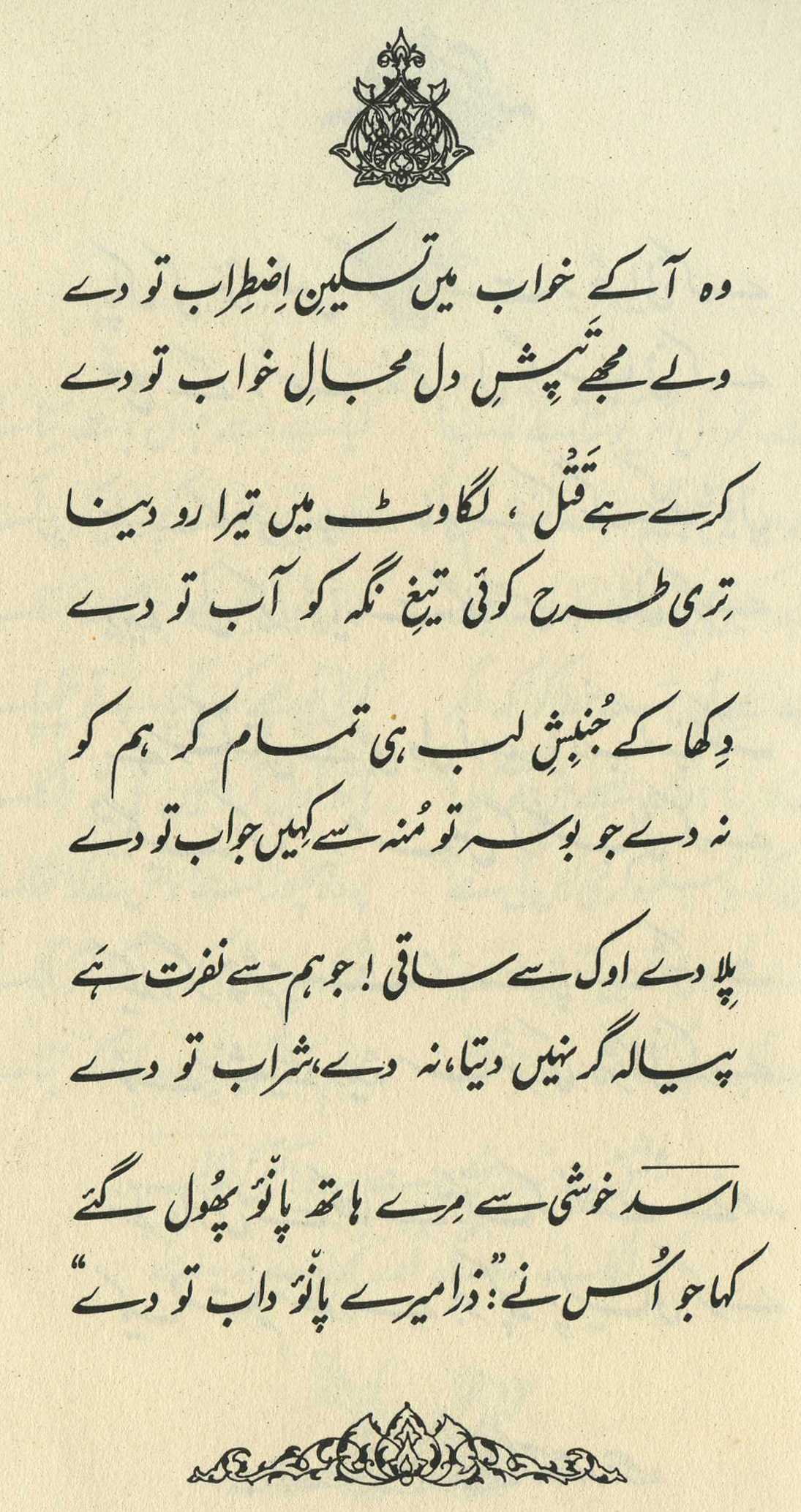
having shown only/emphatically a movement of the lip, finish us off!
2
if you wouldn't give a kiss, then with your mouth do somehow give an answer!
'Somewhere; anywhere; wherever, whithersoever;--ever, anyhow, by any chance; ever-so-much, far, greatly; --may be, perhaps, peradventure'.
| References | |
|---|---|
| Arshi, Imtiyaz Ali | Ghazal# 187 |
| Raza, Kalidas Gupta | 363 |
| Gyan Chand | 491 |
| Hamid Ali Khan | Open Image |
means 'someplace or other', but here it means 'somehow or other', and this too is the idiom. In this verse appears in two places. In the first place it is for the connection of a conditional statement, and in the refrain it is for creating anxiety/concern about the answer. (217)
== Nazm page 217

He says, 'Use only/emphatically the movement of the lips as a sword, and slay us. We are a seeker of a kiss. If you don't agree to give a kiss, then give a clear refusal-- that is, refuse to give a kiss, and we will be slain.' (276)
If you won't give us a kiss, then don't give it-- give only an answer. That is, refuse, and finish us off. 'To finish off' has two aspects. On the one hand, you refused, and our life left us. Second, in a kiss there is great pleasure; if you won't give one, then at least refuse-- in the very movement of your lips we will be finished off; that is, we die over your coquetry. For us the movement of your lipis itself a deadly coquetry. (381)
What is the relationship between the two actions mentioned in the first line? We can tell their internal order (the construction always comes before the finite verb), but there's no way to know whether they are two components of a single action being urged on the beloved ('Come on, move your lips and finish us off!'), or whether they're two separate actions ('You've already started to slay us by moving your lips, so now finish the job [by doing something else]!'). Here are some of the possible scenarios in which the first line could be uttered:
=The beloved has started to give a kiss, but then has stopped.
=The beloved has started to say something, but then has stopped.
=The beloved has closed her lips to show that she won't give the lover a kiss.
=The beloved has made some other gesture, not with her lips, to refuse the lover a kiss.
=The beloved's lips seem to tremble slightly.
=The beloved hasn't yet opened her lips at all.
And in addition to all these possibilities for the beloved's behavior, there are also at least several for the lover's behavior as well:
=The lover will be slain by the sight of the beloved's lips quivering and moving.
=The lover will be slain by the sound of the beloved's voice when she speaks.
=The lover will be slain by the beloved's words when she refuses to give him a kiss.
What a proliferating lot of possibilities, and how many ways there are to make the connection between the lines! We are required (or permitted) to fill in the context for ourselves.
As Nazm points out, the second line contains two occurrences. The first is an official usage in which it introduces the 'then' part of an 'if-then' clause structure. The second marks an urgent appeal, such as also appears in 193,4 (though the same idiomatic use in 193,5 is attenuated into a polite request). In the present verse, the equally idiomatic adds urgency, perhaps almost desperation, to the appeal.
The beloved is here a kind of anti-Jesus figure. In the ghazal tradition, Jesus's special miracle is to breathe or blow on the dying and miraculously restore them to life, as in 9,7 -- while hers is to quiver her lips and at once almost miraculously finish the lover off. But the best verse for comparison is the amusing 116,1 , which is also fixated on the movements of the beloved's lips.
graphics/lips.jpg