Verse 4after 1821aabto de
G9
In this meter the next-to-last long syllable may be replaced by two shorts.
1
serve us drink from [our] cupped hands, Cupbearer , if you despise us
2
if you don't give us a glass, then don't give it-- at least give us wine!
'Draught of water, &c. from the hollow of the hand; the palm hollowed to drink from'.
'Abomination, detestation, horror, abhorrence, aversion, disgust'.
| References | |
|---|---|
| Arshi, Imtiyaz Ali | Ghazal# 187 |
| Raza, Kalidas Gupta | 363 |
| Gyan Chand | 491 |
| Hamid Ali Khan | Open Image |
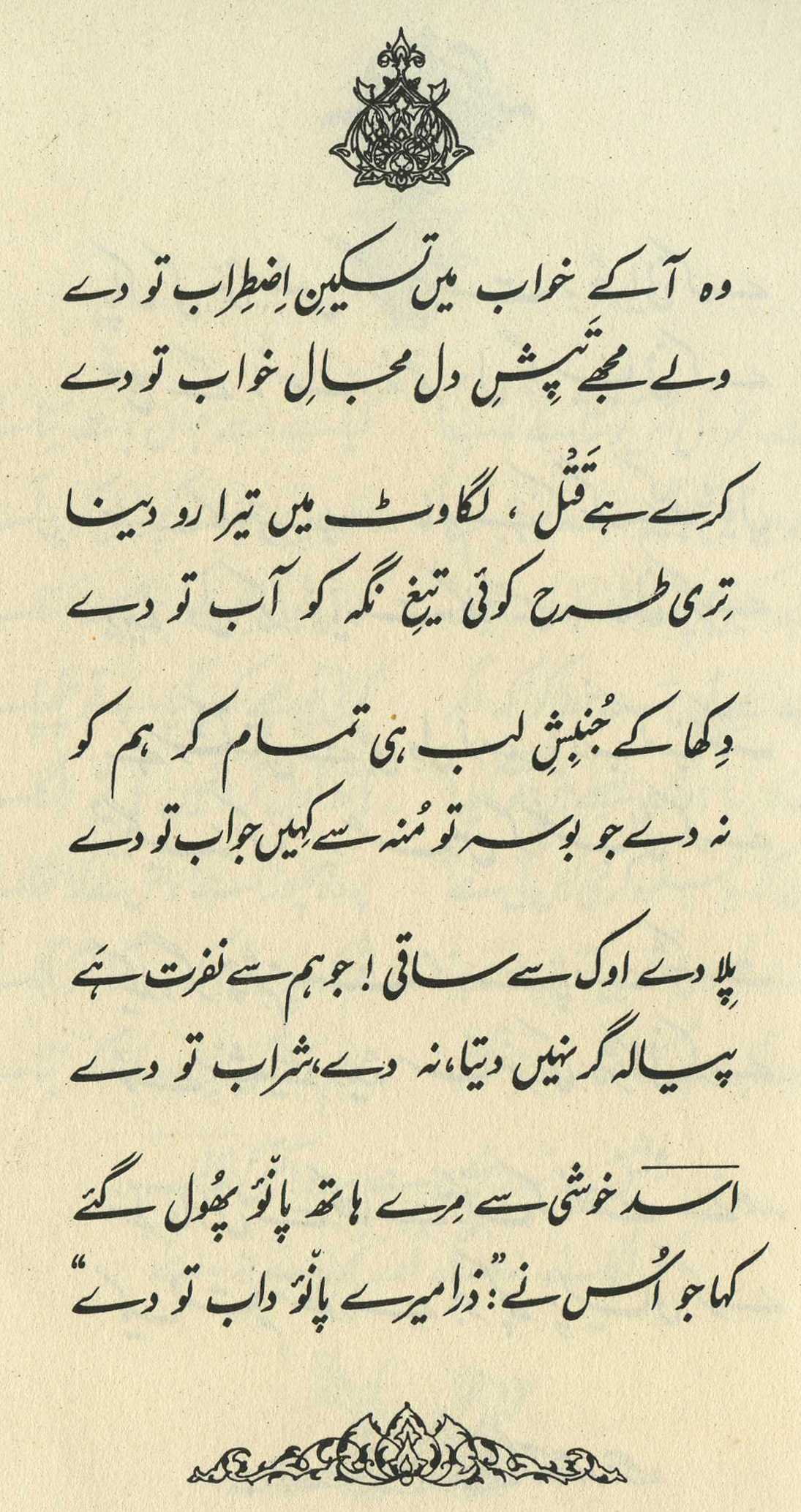
[1862, to Ala'i:] Fifty years ago the late Ilahi Bakhsh Khan devised a new ground . As commanded, I wrote [] a ghazal. The ' high point of the ghazal ' was {193,4}. [For more of the letter, see 193,1 .]
That is, if you consider me a Muslim and a [non-Hindu] 'barbarian' [] and if you are disgusted by serving me drink from your own glass, then serve me only from cupped hands. (217)
== Nazm page 217

He says, 'It's clear that we are a Muslim. If you think that your glass would become polluted, then don't give it to us. We are a seeker of wine. Serve us from cupped hands.' The verse is rakish [], but what a fine one he's composed! (276)
From saying in this way, 'Serve me from cupped hands', the restlessness of a rake [] and a picture of extreme ardor begin to appear before the eyes. And one also learns that the habit of wine-drinking has reached such a limit that now even contempt shown to his religion has no effect on him. (381-82)
It can't be expected from Mirza that among the rhyme s of and , he wouldn't bring in the rhyme of . The theme of the verse is . He says, 'If you might think that from putting the glass to our lips it would become impure and polluted, then serve us from cupped hands. We are interested in the wine, not the glass.' (319)
Ghalib singled out this verse as the ' high point of the ghazal '. It's unusual for us to have such information about his own literary judgment. The verse is an urgent demand: 'It doesn't matter, Cupbearer, if you despise us; if you refuse to give us a glass, then don't give us one. but , at all costs give us wine!' This devotion to wine is what the commentators mean by calling the verse , or 'rakish'. (This isn't the only verse in which Ghalib separates the wine from the wineglass: for other examples see 133,2 and 178,8 .)
The commentators cited above all read this verse in terms of Hindu pollution rules, as does Shadan (p. 436); but a few honorable exceptions avoid such a reading: Baqir (p. 474); Chishti (p. 857); and Mihr (p. 269). In fact the idea isn't very plausible in terms of the ghazal setting-- how could a Cupbearer in a wine-house full of Muslims be imagined to maintain Hindu purity/pollution rules in the first place? And why would such a Cupbearer 'despise' the speaker, with apparently personal intensity, if it was merely a question of generalized religious pollution? It's far more helpful to remember that the beloved can always be imagined as either a literal or a metaphorical Cupbearer (of the wine of passion, etc.), and/or the Cupbearer can be addressed as a beloved.
The Cupbearer's 'loathing' is in any case only assumed-- perhaps for rhetorical effect (compare 66,8 )-- by the speaker. Even if it has some basis in the beloved's behavior, is it real, or simply coquettish? Either way, it fits much better into a relationship of passion than into an implausible fear of ritual pollution.
graphics/handcup.jpg