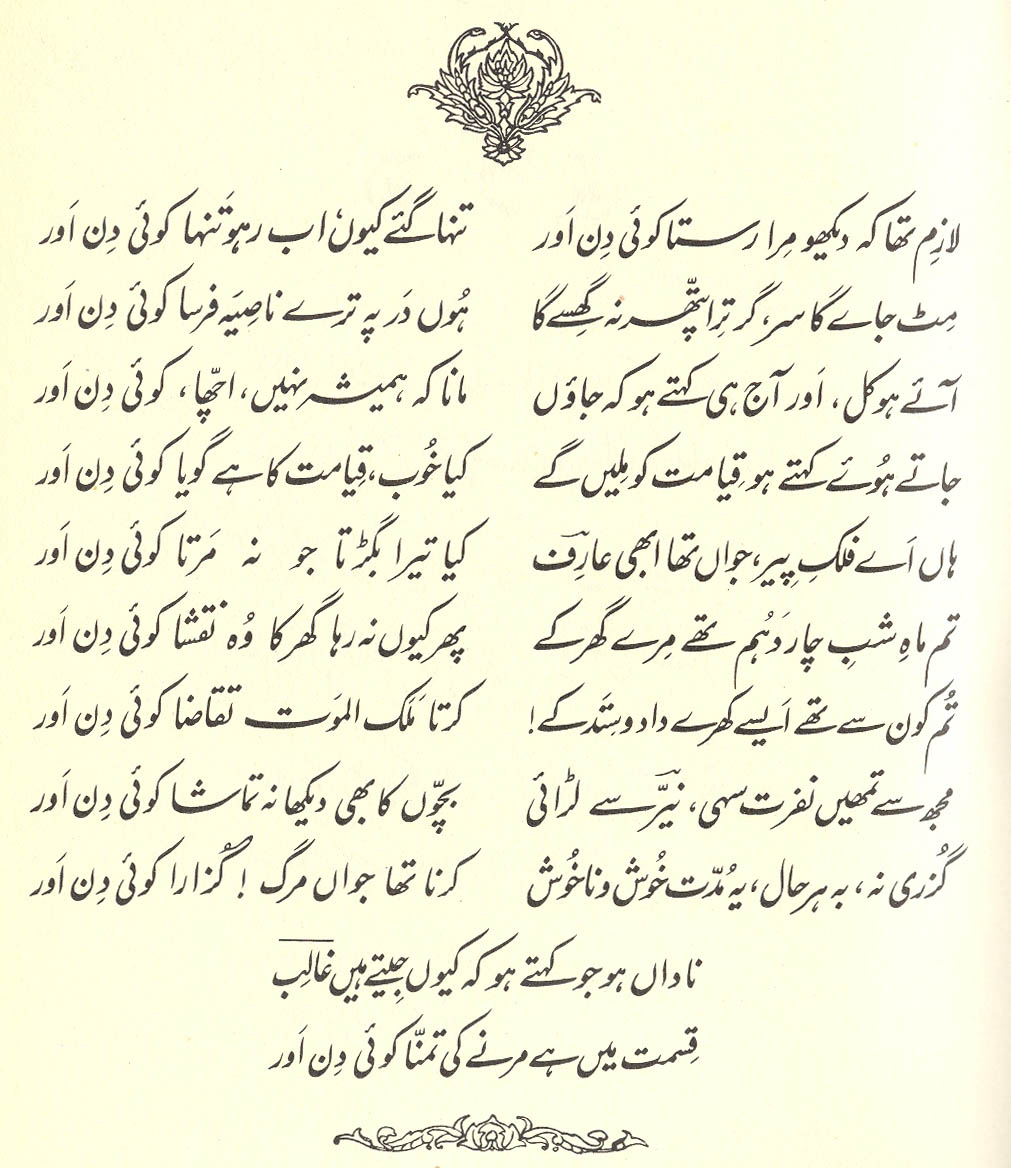
Verse 81852aako))ii din aur
G13
1
all right, you hated me, you quarreled with Naiyar --
2
you didn't even watch the spectacle/show of the children, a few days more?!
| References | |
|---|---|
| Arshi, Imtiyaz Ali | Ghazal# 66 |
| Raza, Kalidas Gupta | 425 |
| Hamid Ali Khan | Open Image |
[to Taftah, June 1852:] Listen, Sahib! You know that the late Zain ul-Abidin Khan ['Arif'] was my son, and now both his sons, who are my grandsons, have come to stay with me, and with every breath/moment they pester me, and I put up with it. The Lord is my witness-- I consider you in the place of a son to me. Thus the offspring/results of your temperament [i.e., your verses] have become my mental [] grandsons. When I don't get annoyed with these physical grandsons-- who don't let me eat my food, who don't let me sleep in the afternoon, who put their bare [and thus dirty] feet all over my bed-- here they overturn the water, there they stir up the dust-- then how will I become annoyed with these mental grandsons, who do none of these things? Please send them off to me quickly by post, so that I can look at them. I promise that then I'll send them back to you quickly by post.
==another trans.: Russell and Islam pp. 91-92
==Urdu text: Khaliq Anjum vol. 1, pp. 244-245 ../nazm/nazm066.jpg
See his account of the 'two handcuffs' in a letter from 1861: 62,1 .

See his account of the 'two handcuffs' in a letter from 1861: 62,1 .
Naiyar is the writer's devoted pupil . From this verse it is clear that his special intimacy with the writer displeased Arif. (66)
== Nazm page 66
Here, 'Naiyar' refers to Navab Ziya ud-Din Ahmad Khan Bahadur, with the pen-names 'Naiyar' and 'Rakhshan'. He was a noble from Loharu who cherished the late Arif even more than he did Mirza Sahib. The rest of the verse is clear. (115)
The meaning of the first line is absolutely not that Arif hated Ghalib or would have quarreled with Naiyar. This has only created scope in the second line for affinity of situation.... 'Even if that impossible thing should be supposed, at least your little innocent children had committed no sin. You could not hate them, nor was there any possibility of a quarrel with them. So why didn't you watch them playing, a few days more?' (228)
For general comments on this most unusual ghazal, see 66,1 .
The colloquial is hard to translate; 'all right' is not ideal, and I'll try to think of something better. For more on , see 9,4 .
As to the interpretation, Nazm surely misunderstands this one, and Mihr gets it right. The point of supposedly 'granting' that Arif may have hated Ghalib himself and quarreled with Naiyar ('Naiyar' was the pen-name of Navab Ziya ul-Din Ahmad Khan of Loharu, Ghalib's distant relative and close friend) is to emphasize that even these two extreme improbabilities could be imagined as possible motives that might cause Arif to think of leaving his loved ones.
Thus the second line begins with an invisible but strongly rhetorically present 'but'. 'But' even these powerful motives for going would be so quickly outweighed by a much stronger motive for staying. 'Even if you would leave us, Arif, how is it possible that you would leave your young children? It's inconceivable that you wouldn't-- that you didn't-- linger a while, to enjoy the sight of your children at play!' We are back to the bitterness and irremediableness of grief-- the reproaches that endlessly well up, even with no one present any longer to receive them.
A note about the 'children': Arif's wife Zainab had died a few months before he did, also from an illness, so that Arif's death in early 1852 left their two young sons orphaned. Ghalib and his wife initially took both boys into their care (see the letter above). Then the younger boy, Husain Ali Khan (aged two) remained with them, while the older boy, Baqir Ali Khan (aged five) went to live with his grandmother. She died in 1855, and from then on Ghalib and his wife undertook the full care of both boys. Ghalib loved them dearly and often spoke of them in his letters. For a good account of this period in Ghalib's life, see Russell and Islam , pp. 104-08.
graphics/childrenplaying.jpg