Verse 91852aako))ii din aur
G13
1
didn't this time-interval pass in any case, the happy and the unhappy?
2
you who died young-- you should have passed/'gotten through' a few days more
is really , with spelling changed to reflect the rhyme . This is a variant spelling of , just as (source of in line one) is a common variant spelling of .
'A passing, passing over, crossing; a passage; passing of time or of life; living, subsisting.... -- : To effect a passage, to cross over; to get through or across; — to live, to subsist (on, - ); to drag out (one's) days ... to subsist with difficulty'.
| References | |
|---|---|
| Arshi, Imtiyaz Ali | Ghazal# 66 |
| Raza, Kalidas Gupta | 425 |
| Hamid Ali Khan | Open Image |
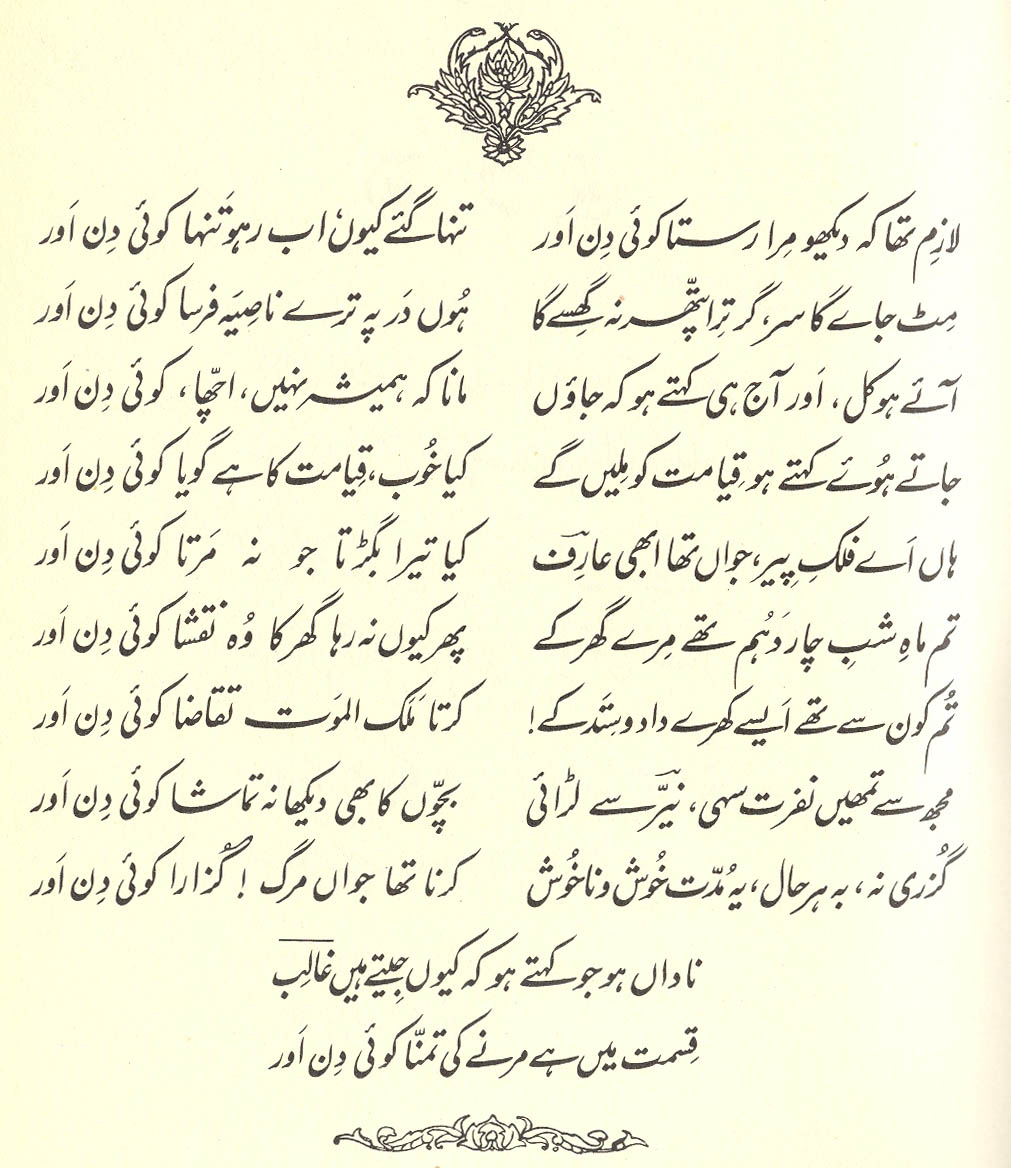
== Nazm page 66

He says, 'The way up to now you spent your portion of life in the happiness and grief of the times, in the same way you should have spent more days in the world. Why did you die in your youthfulness?' (115)
SETS == OPPOSITES; REPETITION
For general comments on this most unusual ghazal, see 66,1 .
There's a word/meaning play between in the first line, and in the second line. In the first line it is the 'time-interval' [] that is the subject, as usual: 'time passes' in Urdu just as it does in English. But in the second line, is an active, transitive verb: it is something Arif had a duty to do, yet he failed to do it, and Ghalib reproaches him for it. So what was it his duty to do? Literally, to 'pass' more days of life. But colloquially, something like to 'get through' life. The idiomatic uses of have to do with earning a livelihood, managing to live, 'making it' from day to day, 'carrying on', 'getting by'.
The difference in tone is that the first line presents life passively (not in the literally grammatical sense, of course, since is intransitive rather than passive), as something that just happens to you, willy-nilly, with repetitive alternations of happiness and 'non-happiness'. The second line requires you to think of actively accepting your life, 'making it happen'. You ought to do this, for after all, we aren't talking about forever, but only of 'some days more'.
It is this commitment to life, in all its awkward multifarious 'life'ness, that Ghalib accuses Arif of not making. Of course, it's an unfair accusation, since there's no reason to believe that Arif didn't want to live. He certainly didn't commit suicide. But the reproaches in this whole ghazal ring so true to the mood of loss and mourning. Since when is deep grief reasonable?
graphics/lifespan.jpg