Verse 21852aako))ii din aur
G13
1
the head will be erased, if your stone will not be worn away
2
on your door, I am forehead-rubbing a few days more
'Forelock over the forehead; — the forehead'.
'Wearing, rubbing; obliterating, effacing; worn, obliterated, old (used as last member of compounds)'.
| References | |
|---|---|
| Arshi, Imtiyaz Ali | Ghazal# 66 |
| Raza, Kalidas Gupta | 425 |
| Hamid Ali Khan | Open Image |
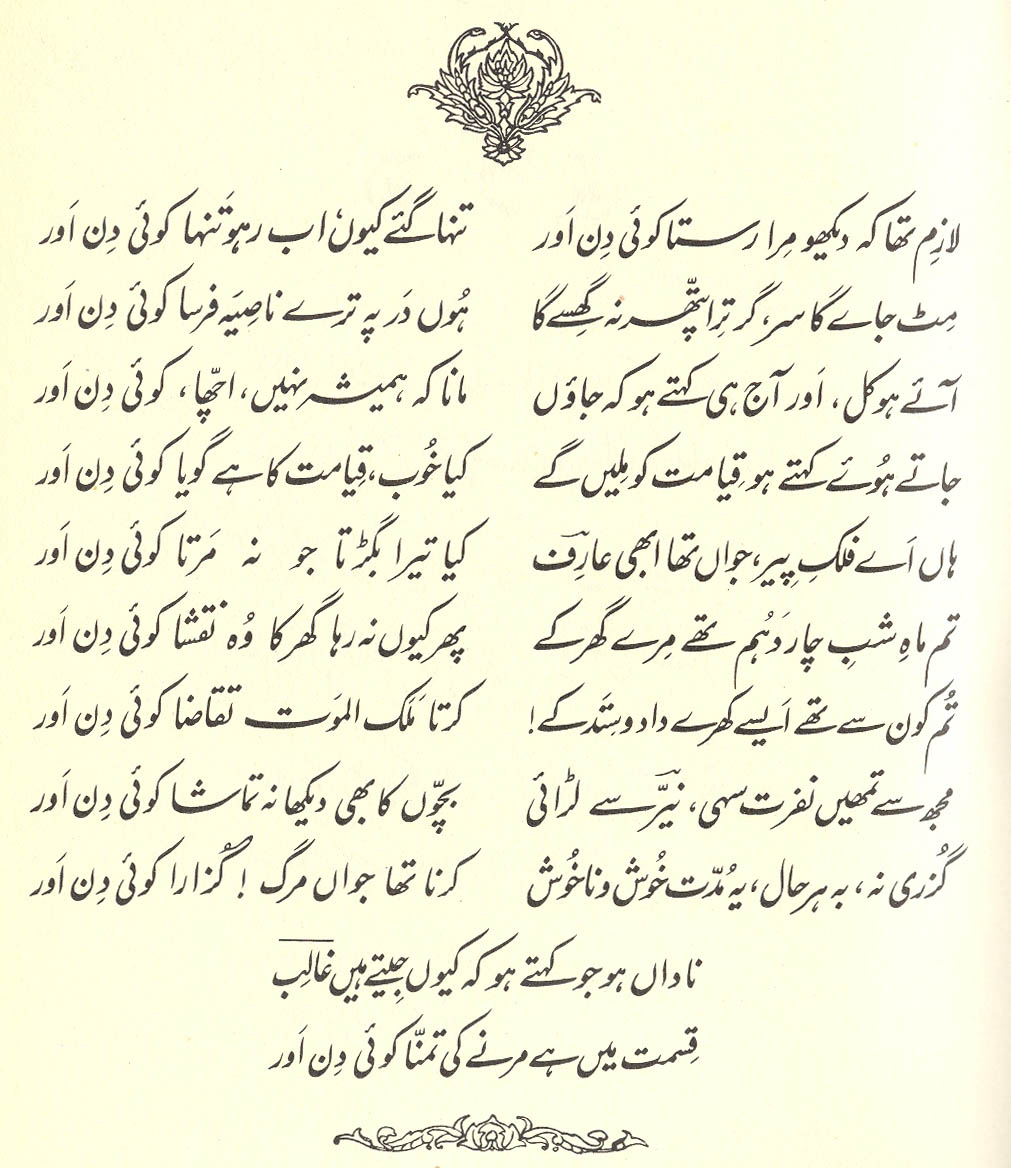
That is, my forehead-wearing-away at your door is not for always. In a few days either the stone will wear away, or there won't be a head left at all. And 'door' refers to Arif's tomb. (65)
== Nazm page 65

He says, if the stone of your tomb doesn't wear away, then my head certainly will wear away. (114)
That is, in grieving for you my bitterness of mind [] is such that I constantly keep beating my head on your tomb; and I am confident that if the stone of the tomb doesn't wear away, then I won't remain alive. That is, this grief won't permit me to live. (147)
For general comments on this most unusual ghazal, see 66,1 .
The first line evokes the ghazal convention that the lover prostrates himself before the beloved's door, repeatedly pressing his forehead to the doorsill in passionate submission. But in this case, the 'stone' is not the doorsill, but the stone of a tomb. And while the lover counts on his persistence to wear away the doorsill (for an example, see 43,6 ), in this case Ghalib considers the outcome of the contest uncertain. Which will be worn away first, the 'doorsill' of the tomb, or his forehead? In either case, it's the finiteness of the process that provides his only consolation.
graphics/stonedoorsill.jpg