Verse 11852aako))ii din aur
G13
1
it was necessary/proper that you would {wait for me / 'watch my road'} a few days more
2
why did you go alone? --now remain alone, a few days more!
is , with the first syllable contracted for metrical reasons, and the spelling of the second syllable adjusted for the sake of the rhyme .
| References | |
|---|---|
| Arshi, Imtiyaz Ali | Ghazal# 66 |
| Raza, Kalidas Gupta | 425 |
| Hamid Ali Khan | Open Image |
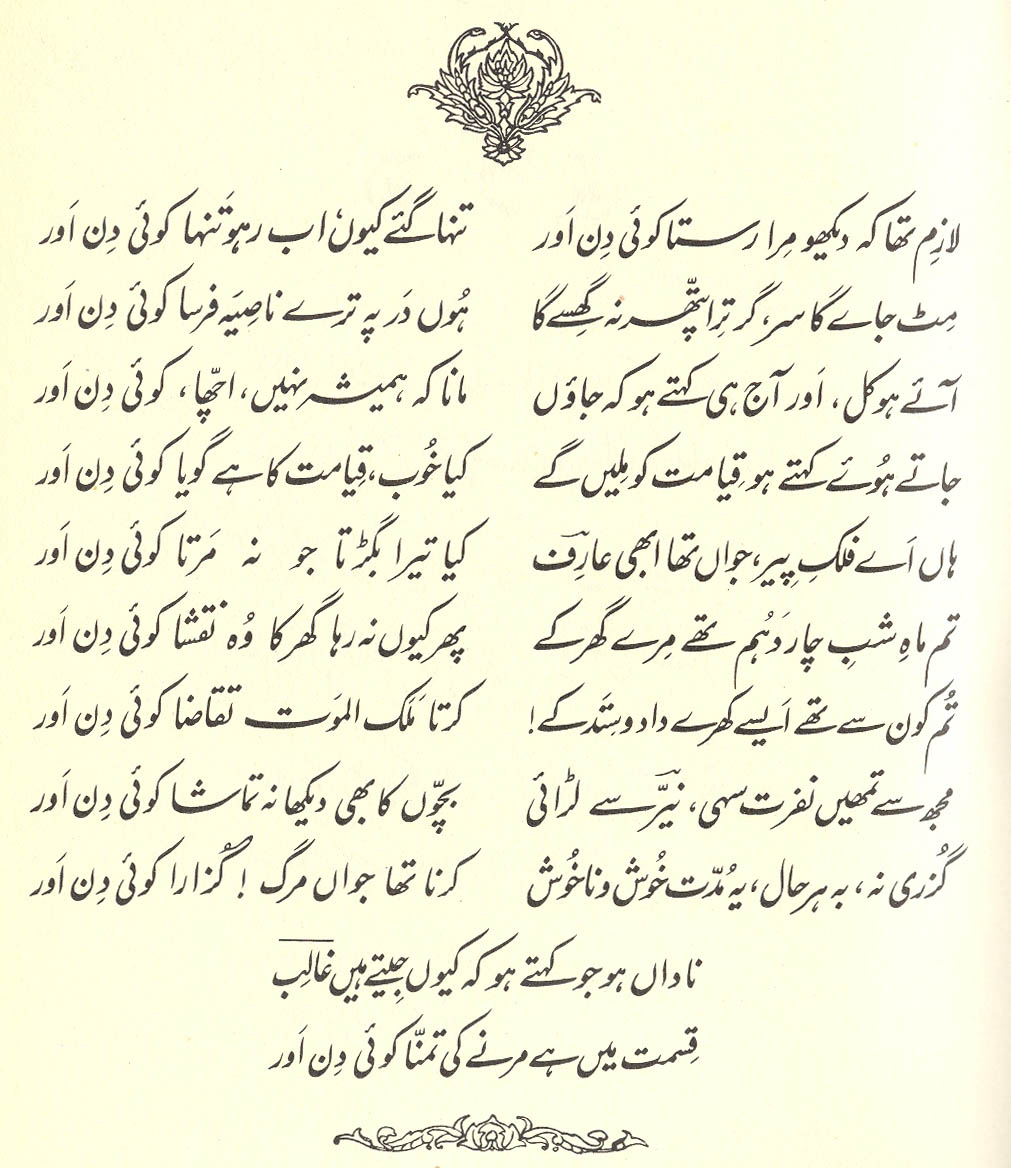
With Zain ul-Abidin Khan 'Arif' [], Mirza Sahib had an extremely close relationship. Partly because of their kinship, and mostly because he had an extremely inventive and creative temperament, and despite his loquaciousness was an extremely fine speaker, Mirza cherished him beyond all limits. For this reason, when he died as a young man it was a heavy blow to Mirza and his wife. Mirza wrote a ghazal about his death, by way of a lament [], which is extremely eloquent and pain-evoking.
==Urdu text: Yadgar-e Ghalib , p. 37
In this verse the author has addressed Arif: you should have died with us-- since you made such haste, now remain alone. All the verses of this ghazal are an elegy for Arif. Arif was Mirza Sahib's wife's brother; his name was Zain ul-Abidin Khan. He was creative [], and died young. (65)
== Nazm page 65

In truth, this ghazal is an elegy for Arif who died young. But everyone is constrained by his own nature. Thus even in an elegy, the mood of sarcasm and mischief is present-- for example, in the second lines of 66,4 , 66,5 , 66,7 . (447)
The idiomatic is used most commonly to mean 'for a few days more', as in this verse and most of the others. But it can also mean 'some other day', as in 66,4 and 66,7 . The use of the nominative rather than the oblique or is the particularly idiomatic part of it. Other examples of this idiom, used in its most common 'for a few days more' sense: 62,9 , 160,1 , 179,4 .
This is the one ghazal in the whole published divan that can be linked directly and legitimately to a major event in Ghalib's own life: it's a lament for a beloved nephew-in-law who died young, probably of tuberculosis. As a lament, it 'works' because it has the power to move us: the sorrow in it comes through all too clearly. As Chishti points out, however, it's still a ghazal by Ghalib, and thus inevitably makes use of literary devices and provides literary pleasures. It's one of his simplest ghazals, technically speaking. But it's also unified and energized by a powerful human emotion that we all know.
In the present verse, the imagery of travelers setting out on a journey is emphasized by the verb used for 'wait': not but , 'to watch the road'. Travelers are safer as well as happier if they make their journeys together. Ghalib, being older, is expressing a kind of pique: you should have waited for me; since you wouldn't, well-- you'll just have to go on alone, and it serves you right! But of course, the loneliness will be only for 'a few days more', he says, and promises to join Arif soon on the last great journey.
This is the only ghazal for which I'll speak of the protagonist not as 'the lover' but in a strong sense as 'Ghalib', since I think the poet himself wants to inhabit this poem, and is not invoking the usual stylized lover-persona. All the verses except 66,5 and 66,10 are vocative, addressed directly to Arif. In all of them he is , except for 66,2 where he becomes .
Compare Mir 's much chillier use of the imagery of extravagant grief in M 722,10 , and his brilliant use of in M 1163,4 .
A personal note: Since this 'desertful of roses' is proving to be an all-purpose companion over the years, with room for some of my own thoughts and feelings, I want to record that on Aug. 29, 2009, on the sad occasion of a memorial service for my dear friend and colleague Aditya Behl, I recited, and then roughly translated, verses 3, 4, 7, and 5 (in that order). A gifted scholar, Aditya too had 'an extremely inventive and creative temperament', and he too died suddenly and unexpectedly and so painfully young (he was only 43). These verses expressed the bleak mood of mourning with such artistry, and such a power to move the heart, that they ended up almost feeling like a consolation.
Ghalib's 'natural poetry' verses:
This is the one ghazal out of the 234 ghazals in the whole published divan that is truly grist for the mill of the 'natural poetry' [] school. (In ' Nets of Awareness ' I have discussed the historical origin of such views; in 191,8 I give an amusingly extreme example.) As we have seen, this ghazal can be linked directly and legitimately to a major event in Ghalib's own life. I invite all 'natural poetry' fans to enjoy it. What other examples of such verses might we also consider? I rule out verses that explicitly name and praise patrons; they may be connected to Ghalib's life in a practical, direct sense (by offering flattery to rich patrons), but they certainly aren't in any real sense 'natural'; instead, they are generally wildly hyperbolic. So what else is there?
=There's a poignant single verse, 202,9 , about his brother Yusuf.
=Then there's 110,8 , with its second line that might seem to drip with bitterness (though actually the tone is unspecified).
=One other verse that feels personally expressive (and has nothing else going for it) is the unpublished 123,13x . In the same ghazal is a verse-set , starting with 123,9 , that conveys a general disdain for Lucknow; it adopts the point of view of a traveler-- and was composed around the time when Ghalib spent several months in Lucknow. Compare the last verse of this verse-set, 123,11 , which is also the closing-verse of the divan ghazal, with 123,14x , which was surely the original form of the verse, for an example of the practicalities of patron-flattering.
=There's also 139 , the 'fair cruel Domni' one, which is a sort of false (as I argue) counterpart to this present ghazal-- though it really doesn't resemble it much at all; for discussion see 139,1 .
=A rare example: 216,3 , a verse that seems to complain of the exhaustion of old age and approaching death-- and was in fact composed in the poet's old age.
=There are also occasional verses that deal with religious ideas. Some express reverence for the Prophet, like 14,10 , or for Hazrat Ali, like 216,1 ; there are other verses that give voice to what might seem to be religious doubts, like 208,9 , or even overt irreligiosity, like 161,4 ; and there are a number of verses that make snide remarks about Paradise (for a list see 35,9 ). There are also a few religious verses that are (surely deliberately) uninterpretable, like 111,14 . Out of this mutually contradictory patchwork one could try to extract Ghalib's religious views-- but only by means of selective cherry-picking.
=There's also a 'natural-poetry'-like use that Ghalib sometimes makes of his verses in letters. One striking example is 208,12 . Such later contextually appropriate quotation of course doesn't make the verse itself an example of 'natural poetry'.
=We might also throw in the unpublished 421x,6 , which seems to disdain and/or lament the state of kingship in Delhi around 1816.
While we're on the subject, let's also notice some conspicuous counter-evidence to any 'natural poetry' views:
==The biggest single item of counter-evidence is that the lover very often and quite matter-of-factly goes right on speaking after he is dead: for many examples, see the 'dead lover speaks' verses listed in 57,1 .
==A related case: verses in which the lover speaks unambiguously, in the first person, as a bird; for examples, see the 'lover is a bird' verses listed in 126,5 .
==There are also verses based on impossibly cosmic grandiosity: see the examples listed in 5,3 .
==There are also many verses of bizarre and often distasteful ' grotesquerie '.
==There's also 85,8 , a lament about the infirmities of old age-- composed when the poet was in his mid-twenties. The elegiac 63,4x , and the still-gallant 172,6x , were both composed in his late teens. Compare Mir 's M 52,5 .
==Then there's 159,4 , in which Ghalib himself explicitly equates 'the poet' with 'the lover', and speaks of them markedly in the third person; he makes it clear that the verse is based on a particular poetic ' theme ', not on a particular event in his own life.
==Then 208,12 with its roiling 'Red Sea of blood' seems so much like a reaction to the horrors of 1857-- but it was composed in 1853.
graphics/roadbeyond.jpg