Verse 51852aako))ii din aur
G13
1
indeed, oh ancient/venerable Sky, Arif was still young
2
what harm would it have done you, if he hadn't died for a few days more?
'An old man; a saint; a spiritual guide or father; a priest; founder or head of a religious order'.
'Knowing, wise, sagacious, ingenious; skilled in divine matters, possessing knowledge of God and of his kingdom and of the way of dealing well with him; pious, devout.'
'To be changed for the worse, to become worse; to be impaired, deteriorated, defaced, disfigured, distorted; to take harm, be damaged, injured, marred, spoiled, corrupted, vitiated, ruined, destroyed; to fall off; to fail, miscarry; to break down; to go or turn bad; to get out of order'.
| References | |
|---|---|
| Arshi, Imtiyaz Ali | Ghazal# 66 |
| Raza, Kalidas Gupta | 425 |
| Hamid Ali Khan | Open Image |
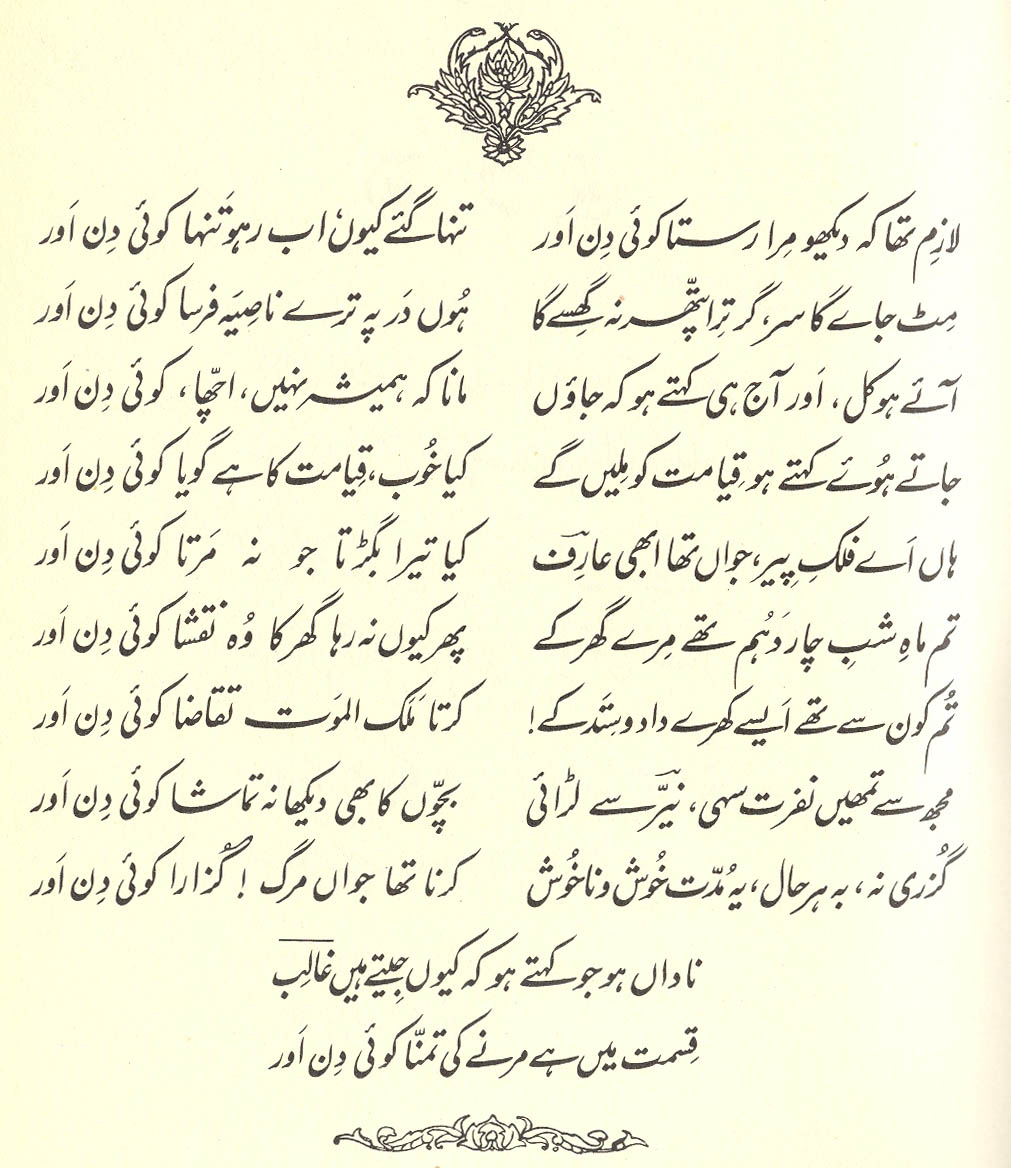
In this verse is not in its own place-- it's the place of . (66)
== Nazm page 66

In this verse the word has been used by way of an attention-getter, before addressing the Sky. This has no connection with affirmation; that is, it's not the opposite of . He wanted to make to the Sky the complaint that the one dying was young, he hadn't reached his natural lifespan. 'If he had remained alive for some days more, what harm would it have done you?' (114)
[Contrary to Nazm's assertion,] in this verse has been used in its own place. From it, sir, we learn the absorption and immersion in mourning. As though some people would be seated, and the master of the house would be absorbed in some thought. When his absorption lessened, he would begin his speech with .... It also sometimes happens that if sophisticated people complain to someone of some important matter, then they don't begin all at once; first they speak of this and that, then often they begin the complaint with . (147)
For general comments on this most unusual ghazal, see 66,1 .
This is one of the very rare times in the whole divan that a 'real person' (rather than a literary or symbolic figure) is mentioned by name. A few verses later, in 66,8 , we find another such reference, to Arif's friend Naiyar.
The Sky's ancientness and Arif's youth are juxtaposed as forcefully as possible: in the first line, we find the cleverly framed sequence 'ancient young' []. The term also has associations of venerableness and mystic insight. It is the proper role of a to teach and guide the young, not to cut them off in their prime. These associations are further emphasized through the name Arif; an is a possessor of (mystical) knowledge.
The idiomatic charms the commentators, though they struggle to express its exact nuances. I was taught to consider it as something like 'indeed'-- a way of introducing a new subject, or a new aspect of a previous subject, such that it feels like another stage of an ongoing discussion. Thus this introductory turns the verse into part of a continuing dialogue between Ghalib and the Sky; it gives the air of pressing home with an additional argument some other point that has already been urged.
Note for grammar fans: is an idiomatic expression that seems to have a missing masculine noun, like or . Compare 100,1 , in which appears; and also 36,8 , in which is used without an object.
graphics/ancientsky.jpg