Verse 101852aako))ii din aur
G13
1
you are ignorant/foolish if you say, 'why does Ghalib live?'
2
in [my] destiny is the longing to die, for a few days more
| References | |
|---|---|
| Arshi, Imtiyaz Ali | Ghazal# 66 |
| Raza, Kalidas Gupta | 425 |
| Hamid Ali Khan | Open Image |
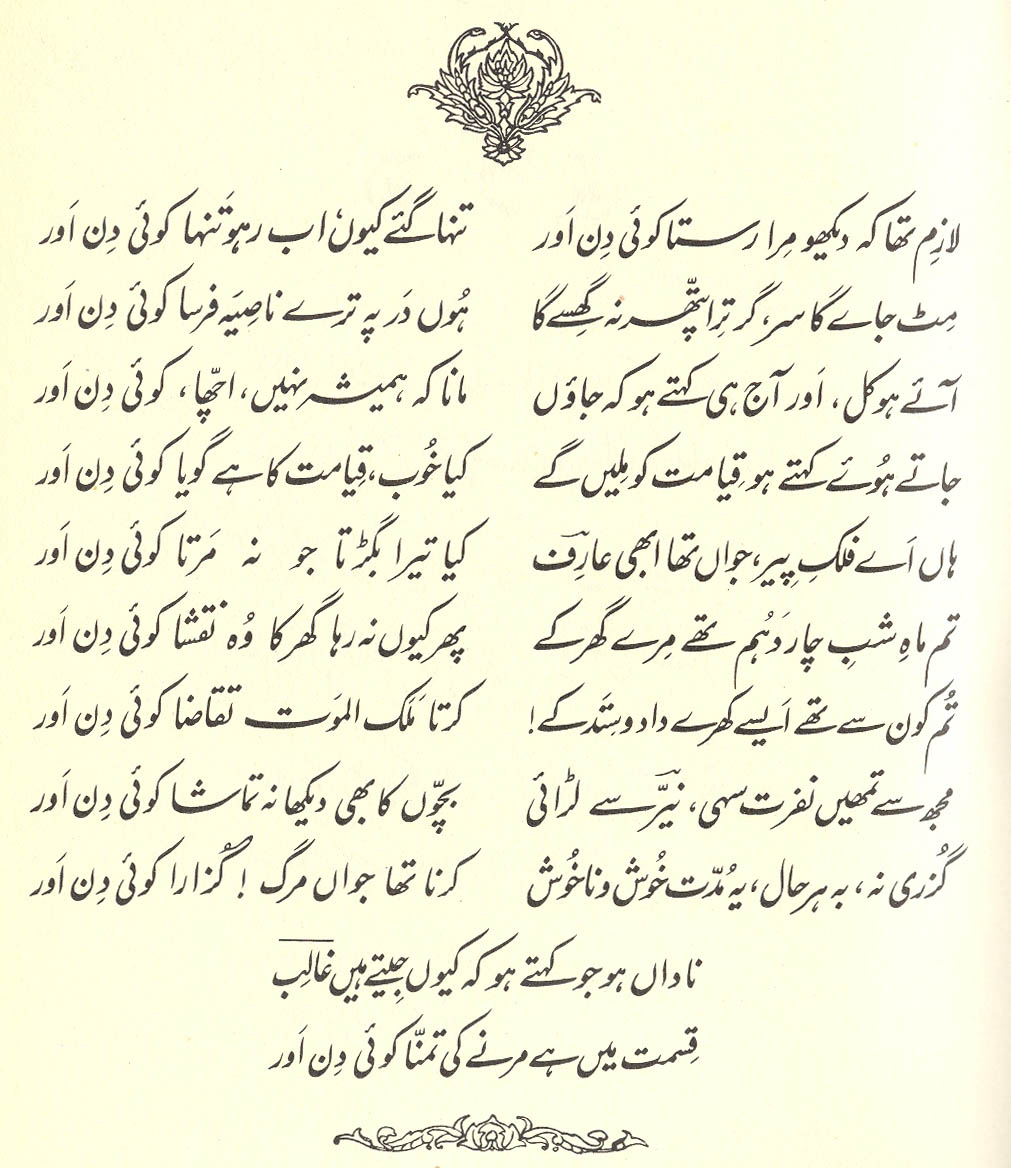
You people are surprised that after sustaining the wound of Arif's early death, Ghalib lives on-- but you're very foolish. To keep longing for death for a few days more is written in my fortune-- how could I die prematurely? (66)
== Nazm page 66

For general comments on this most unusual ghazal, see 66,1 .
Throughout the ghazal, has been Arif. Now, suddenly, it's not. It's some man or group of men (or mixed group), who is/are apparently close enough for familiarity and anger on Ghalib's part. (After all, it could have been and without affecting the meter; but then the implied subject would have been the usual 'they', as in 'they say', and the second-person sense of engagement would be gone.)
What is written in Ghalib's destiny is not life, or a desire for life, but a longing []-- a longing for death, a longing that, because of the mighty power of destiny, can't yet be satisfied. Though it will soon be so, of course-- in only 'a few days more'. Arif suffered death, and Ghalib suffers the longing for death. As he says in 66,9 , one simply has to 'get through' life as one's destiny requires. (In his letters, Ghalib always lamented his domestic responsibilities; in his life, he always strove to fulfill them.) But 'living' shouldn't be equated with enjoying life, or callously or shallowly choosing to live on-- especially when that life has lost so much of its meaning. Only a 'foolish' person would make any such supposition, and thus incur Ghalib's disdain.
graphics/mourning.jpg