Verse 9after 1826amhai ham ko
G5
In this meter the first long syllable may be replaced by a short; and the next-to-last long syllable may be replaced by two shorts.
1
the reason for coming to Lucknow does not {reveal itself / 'open out'}; that is
2 a
a desire for touring and spectacle-- there's little of that in us
2 b
a desire for touring and spectacle-- that's a small thing, to us
| References | |
|---|---|
| Arshi, Imtiyaz Ali | Ghazal# 119 |
| Raza, Kalidas Gupta | 372-373 |
| Gyan Chand | 492 |
| Hamid Ali Khan | Open Image |
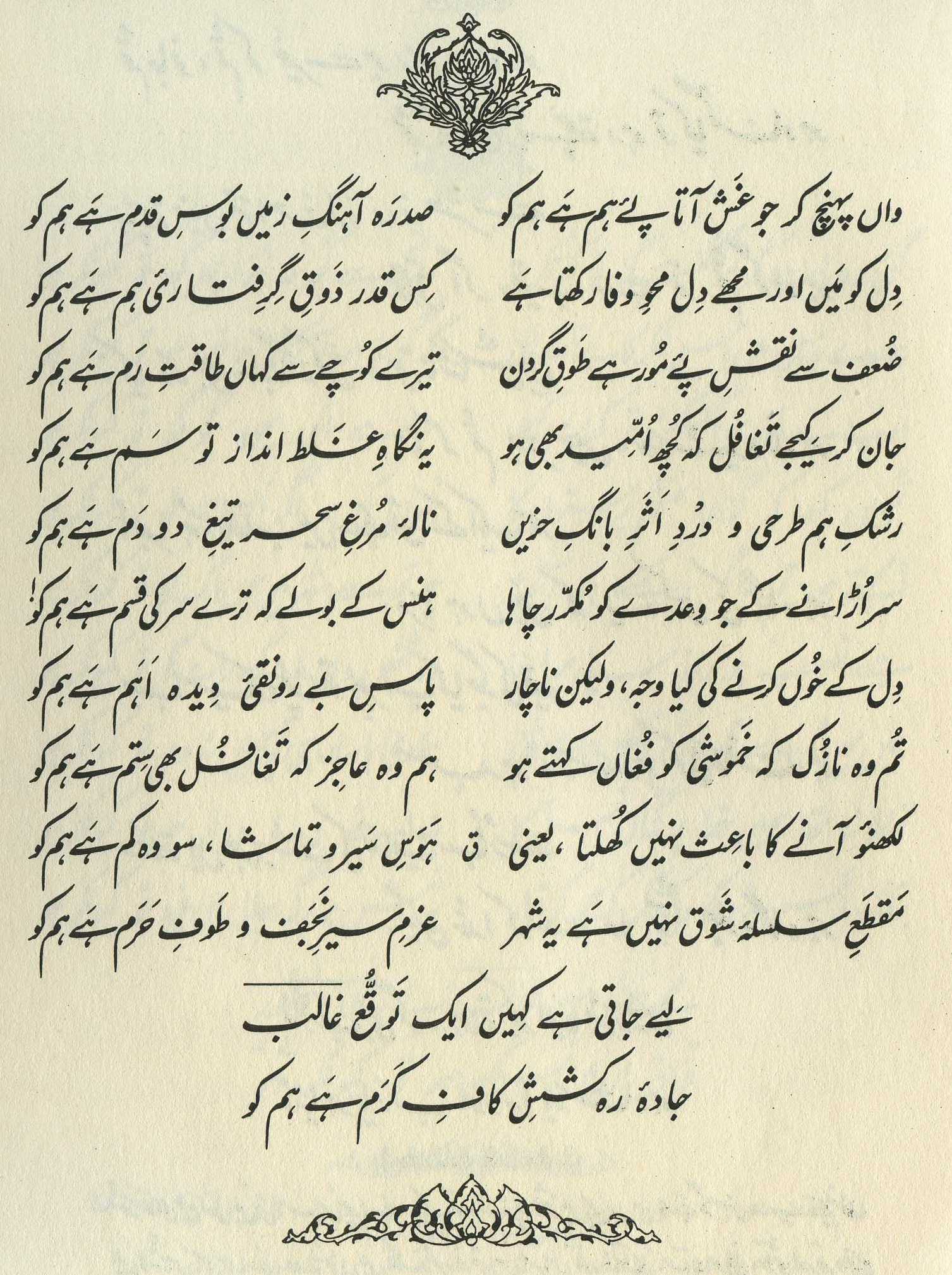
[Commenting on {123,9-11}:] From the final line [of {123,11}], the meaning of this verse-set is clear: that he was going somewhere with some hope, and on the way he stopped in Lucknow as well, and composed this ghazal. It's surprising that a person like Ghalib should come to a city like Lucknow, and nothing should be heard about it from anybody there-- when he came, and where he visited, and what happened. (132)
== Nazm page 132

He says, no reason for coming to Lucknow is apparent. That is, people always take trips for touring and spectacle, and those two things are not applicable. (186)
[Commenting on {123,9-11}:] Mirza Sahib says, 'Why did we come to Lucknow? We can't understand the reason for it. If it be said that we came for a tour, then not even this is true.' So having reflected, he says, 'Yes, yes, now we remember! The sequence of ardor isn't ended in this city.' That is, we didn't come only this far; rather, we intend to make a pious visit to Najaf the Noble and circumambulate the Ka'bah. The truth is that a hope is bearing us along somewhere (Najaf, Ka'bah). And this is the reason that on the road the path becomes a sign of the . He has given for 'path' the simile of . (250)
For the one and (so far) only time, I've failed to follow Arshi: he has a verse-set marked to start with {123,7}, but common sense, and the consensus of the other commentators and editors, make it clear that that's an error (probably just a typographical one of misplacing the verse-set marker), and the verse-set is really a three-verse one that begins with the present verse. Fortunately the situation is unusually clear in this case, so the error can be recognized and corrected without difficulty.
This verse is not very complimentary to Lucknow; it clearly implies that the only reason to visit the city would be for casual tourism-- a mere stroll around the city to give a once-over to the sights, with maybe a few fairs or festivals ('spectacles') thrown in. If the speaker isn't interested in these trifling things-- which he's not-- then why come here in the first place?
In Ghalib's case, the reason for his Lucknow visit was clear, and it's surprising that Nazm doesn't seem aware of it. Ghalib was passing through in 1827, on his great trip from Delhi to Calcutta to try to get the amount of his East India Company pension adjusted in his favor. For a brief account of his several months in Lucknow, see Russell and Islam , pp. 46-47. Although he became friends with the leading Lakhnavi Urdu poet Nasikh , and made other useful contacts, on the whole he was dissatisfied with his visit.
The wordplay, though not flashy, works nicely: the reason for coming doesn't 'open' or 'reveal itself' [], which resonate excellently with the idea of a stroll or tour in the 'open' air, or the self-revealing presentation of a spectacle.
And since this verse is the first of a verse-set, it's of course meant to be read in juxtaposition to the next two verses.
Compare Mir 's disaffection with Lucknow, as discussed by Faruqi in M 1337,2 (with several additional illustrative verses).
graphics/sitaram1814.jpg