Verse 6after 1826amhai ham ko
G5
In this meter the first long syllable may be replaced by a short; and the next-to-last long syllable may be replaced by two shorts.
1
when I wanted the repetition of the vow of striking off [my] head
2
laughingly she said that, 'We {swear by / swear off} your head!'
| References | |
|---|---|
| Arshi, Imtiyaz Ali | Ghazal# 119 |
| Raza, Kalidas Gupta | 372-373 |
| Gyan Chand | 492 |
| Hamid Ali Khan | Open Image |
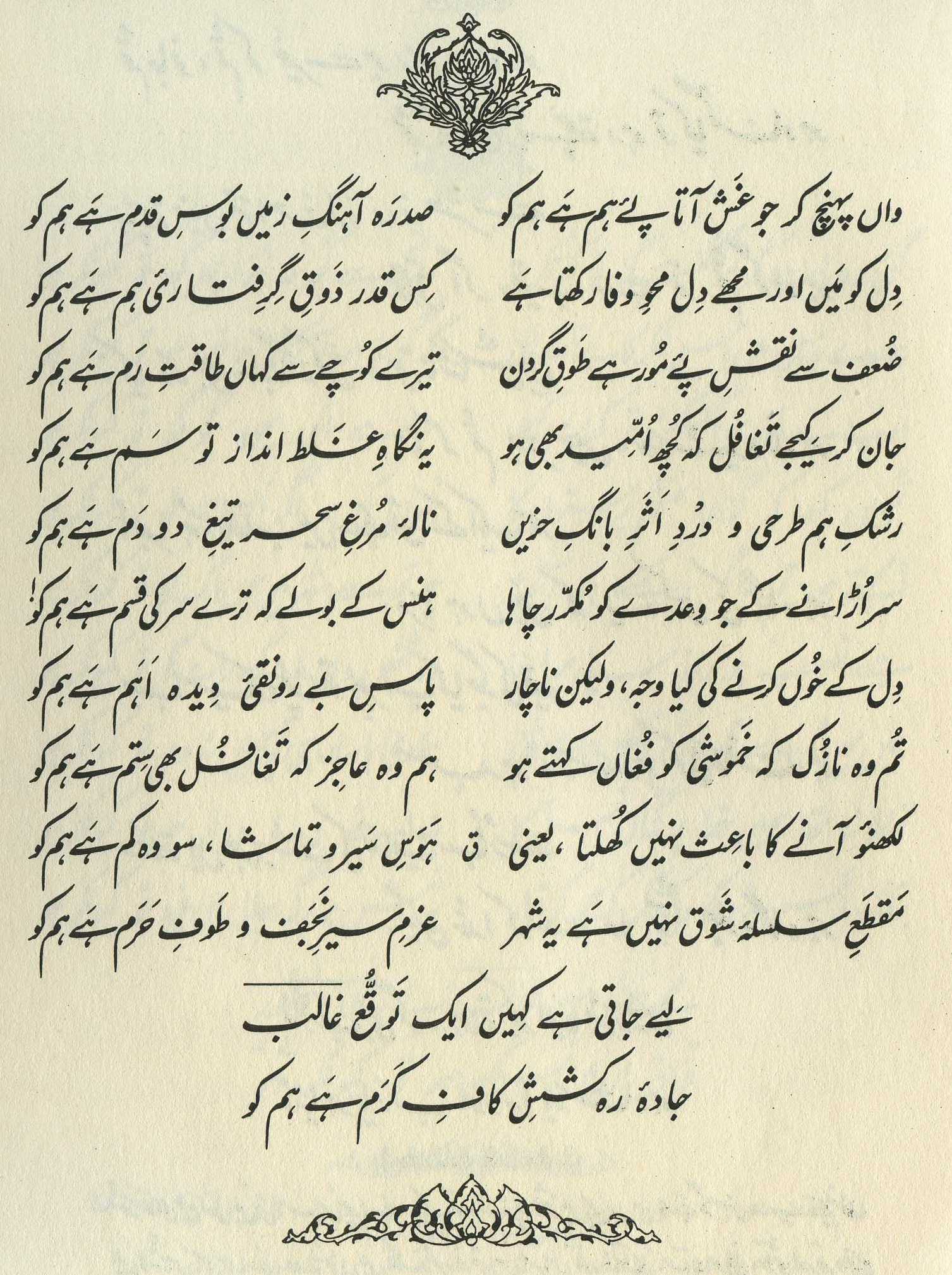
In this verse the phrase 'We swear by your head' has two meanings: one, 'We swear by your head that we will certainly cut off your head'; and the other, 'We swear off your head'--that is, 'We will never cut off your head'. As when they say, 'You've sworn off coming to dinner at our place'-- that is, 'You never have dinner with us'.
==Urdu text: Yadgar-e Ghalib , p. 132
That is, 'We swear on your head, we'll cut your head off!' Or else consider it like this: that 'We've sworn off cutting off your head-- we won't cut your head off'. (132)
== Nazm page 132

When she promised to cut off my head, I wanted the promise to be firm. So I asked, please just say it again. Then, laughingly, what does she say but 'Yes, yes, we swear by your head, it will be exactly so'. [Or:] 'We've sworn off cutting off your head'-- that is, 'We absolutely won't cut it off'. (249)
This is a classic one-big-trick mushairah verse, so of course the one big trick is withheld till the last possible moment. The commentators explain the trick well. The effect hinges on the fact that 'to take an oath of/about doing something' [] means, idiomatically, to swear off doing that thing, as in Hali's example. And people often confirm especially binding oaths by swearing by the head of some loved one (as people swear by someone's life in English). So when the two idioms are conflated, the result is the deliciously radical ambiguity created here. For more on the possibilities of , see 89,3 .
This verse reminds me a bit of 116,6 , which also hinges on dialogue, and on the beloved's deliberately irritating way of pretending to accept the lover's importunities, while actually thwarting them. The poor lover is helpless, and we are invited to enjoy his haplessness.
graphics/sword.jpg