Verse 2after 1826amhai ham ko
G5
In this meter the first long syllable may be replaced by a short; and the next-to-last long syllable may be replaced by two shorts.
1
I keep the heart, and the heart keeps me, absorbed/engrossed in faithfulness
2
to what extent have we a taste/relish for the captivity of mutuality/anxiety?!
'Overpowered (by), struck or astonished, thunder-struck; fascinated, charmed, captivated; mad (from love), distracted (with terror or grief); —engrossed, absorbed'.
'Together, with, both, one another, other; mutual'.
'Turning (a thing) anxiously in the mind; meditating, purposing; — anxious thought, anxiety, solicitude, grief, care; — purpose, design'.
[Arabic] 'Melting (fat); causing (one) to melt or waste away (as disease); hushing (an infant) to sleep; grief, care, solicitude; purpose, design'. (Steingass, p.1507) [retrievable under ]
| References | |
|---|---|
| Arshi, Imtiyaz Ali | Ghazal# 119 |
| Raza, Kalidas Gupta | 372-373 |
| Gyan Chand | 492 |
| Hamid Ali Khan | Open Image |
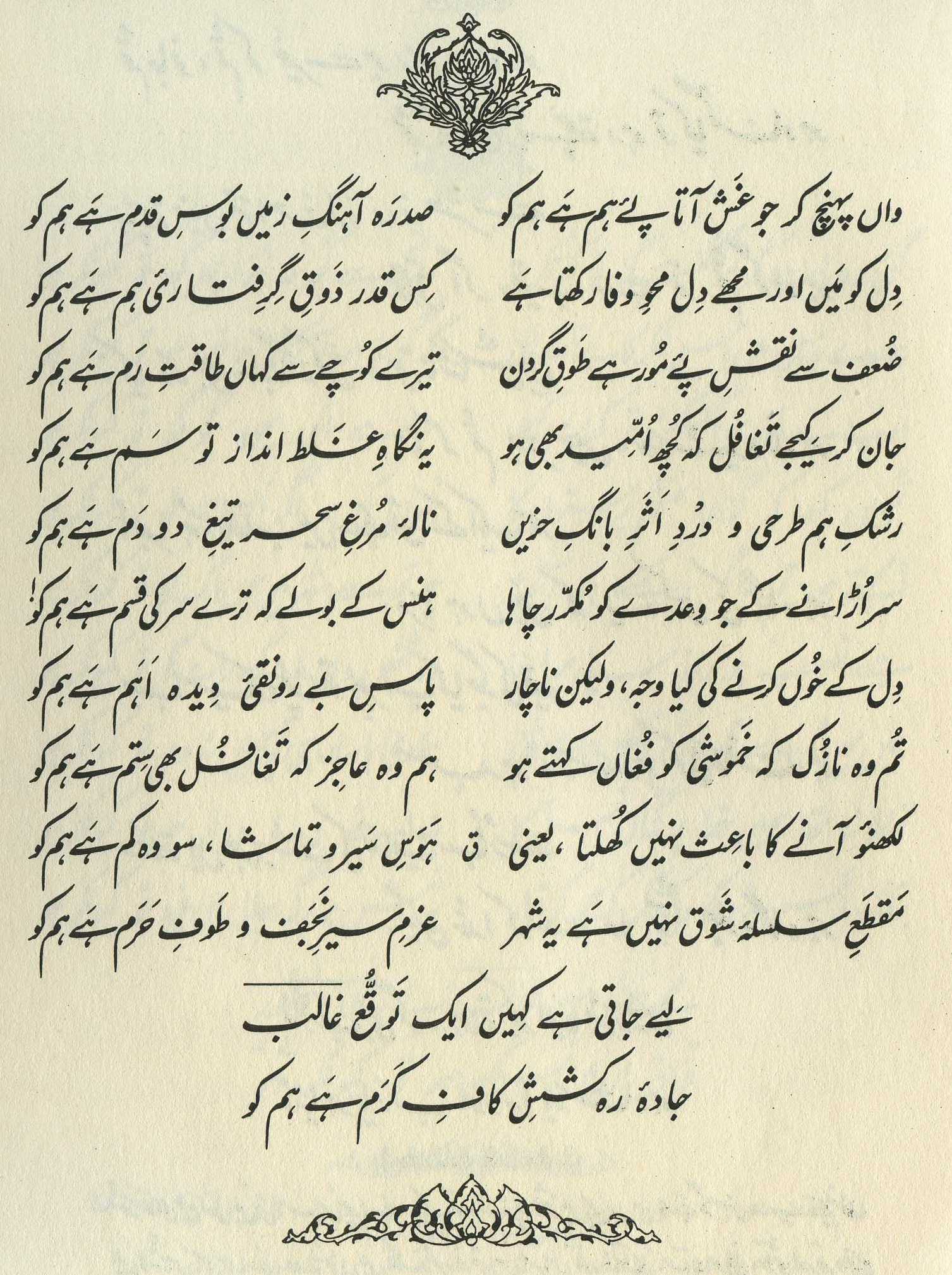
That is, the heart desires me, and I desire the heart, {so that it is / which is} [] a captive of faithfulness. (131)
== Nazm page 131

He says, 'I keep the heart absorbed in faithfulness, and the heart keeps me absorbed in faithfulness. We both want to keep each other captives of faithfulness.' (185)
That is, when I fall short in some way, then the heart encourages me; when the heart begins to feel a lack of courage [], then I say, 'You ought not to be like this'. (248)
The first line sets up a sentimental-sounding reciprocity of behavior between the speaker and his heart: each keeps the other on the strait and narrow path, 'absorbed in faithfulness'. A factual report, a closed system of irreproachably lover-like behavior. Under mushairah performance conditions, we'd of course be made to wait in anticipation before we were allowed to hear the second line.
Then when we hear the second line, the 'punch-word' is reserved for the last possible moment. Only in retrospect do we realize that its two quite different meanings (see the definitions above) have both been set up in the first line: the Persian 'mutual' has been explicitly invoked by the account of how the speaker and his heart keep each other committed; while the Arabic 'anxiety, grief' can be seen (though not so explicitly) as a result of being constantly absorbed in faithfulness. (Discussing 123,1 , Faruqi criticizes the commentators specifically for ignoring the latter, Arabic meaning.)
The verse also profits from the excellent multivalence of (in its oblique form ). Thus the second line can be read as an affirmative exclamation: 'What a relish we have for -captivity!' (The heart and I do this together as a deliberate joint project, in order to encourage each other.) Alternatively, it can be read as a question: 'To what extent do we (really) have a relish for -captivity? (If we weren't patrolling and spying on each other all the time, would we perhaps both be tempted to sneak away for a break?)
And yet of course the two captives are 'I' and my 'heart'. How different are they really? When the lover reproaches the heart, perhaps he's merely, at one metaphorical remove, reproaching himself. But perhaps his heart is wilful and headstrong and does what it pleases, so that it's a separate, uncontrollable moral agent (as in 31,2 ). As so often, Ghalib leaves us to decide for ourselves.
graphics/captiveheart.jpg