Verse 5after 1826amhai ham ko
G5
In this meter the first long syllable may be replaced by a short; and the next-to-last long syllable may be replaced by two shorts.
1
envy/jealousy of pattern -sharing; and pain of the effect of a melancholy call/cry--
2
the lament of the dawn-bird is a two-edged sword, to us
'Voice, sound, noise, cry, shout; the call to prayer... ; crowing (of a cock)'.
'The morning bird, the cock; —the nightingale'.
| References | |
|---|---|
| Arshi, Imtiyaz Ali | Ghazal# 119 |
| Raza, Kalidas Gupta | 372-373 |
| Gyan Chand | 492 |
| Hamid Ali Khan | Open Image |
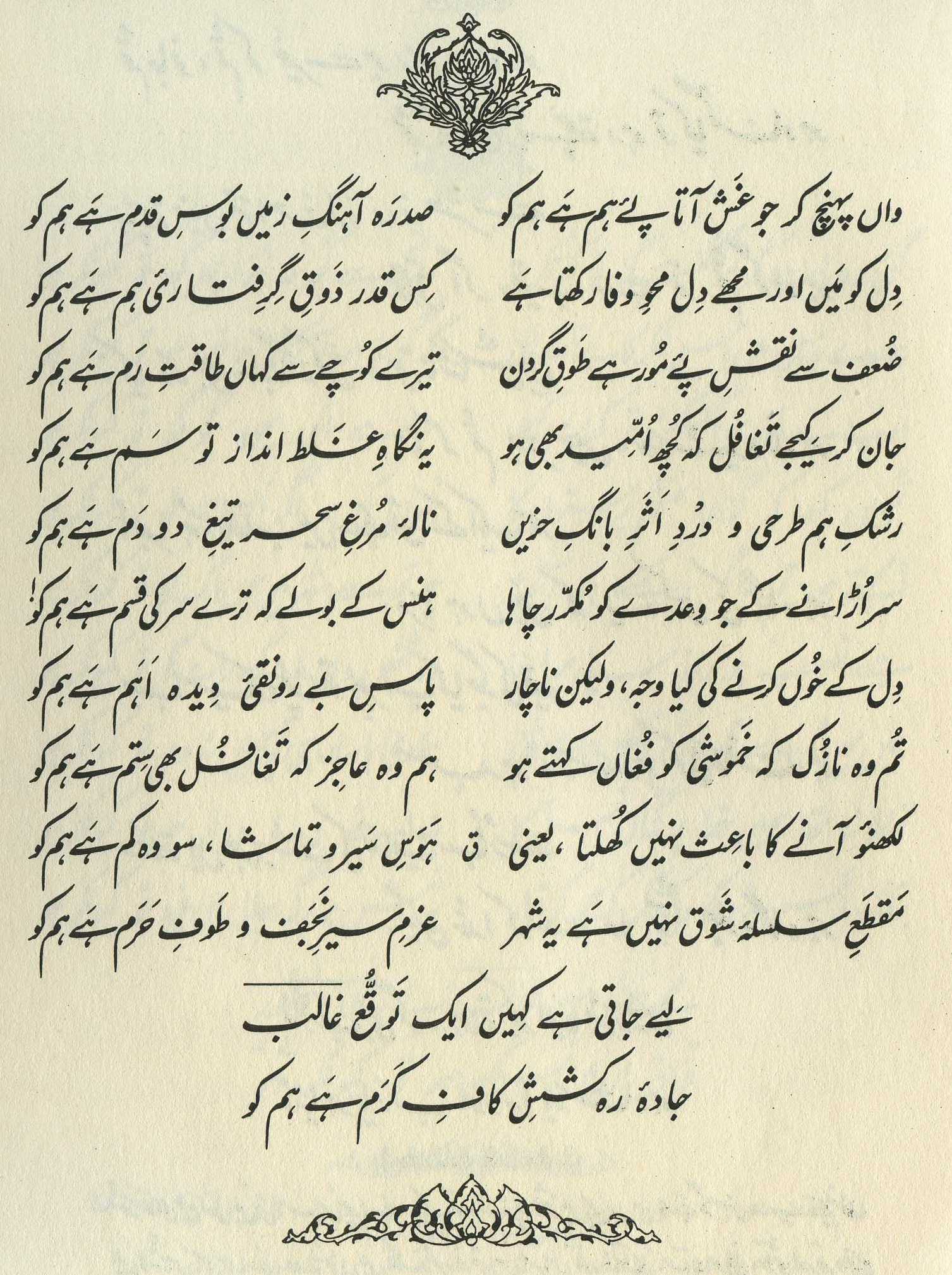
One edge on that sword is envy/jealousy at language-sharing []; and the other edge is the pain of the lament itself. (132)
== Nazm page 132

He says: first, the envy/jealousy of fellow-singing []; second, the effect of the pain of the lament. Both things have made the lament of the bird of dawn a double-bladed sword for me. (185)
The lament of the nightingale is for me a double-edged sword. One blade is its complaining the way I do. The other blade is the pain of its voice. (249)
In classic mushairah style, the first line piques our curiosity: it consists only of a 'list' of two items, so that it remains opaque until-- after some delay, under mushairah performance conditions-- we are allowed to hear the second line. And then we learn that a mushairah style is highly appropriate, because it seems as if the poet and the bird are rival poets at the same mushairah. The poet is envious or jealous of the bird's sharing the same 'pattern' that he himself uses. Since a ' pattern ' (that is, a particular meter-rhyme-refrain combination) was normally set for each mushairah, and all the verses prepared for that mushairah were to be in the stipulated pattern, the use of such a specific term locates the bird not just as a general competitor but as a direct rival, a kind of peer who is invited into the same competitive arena.
The poet finds one kind of pain in encountering such a rival. Another kind of pain is, thanks to the creative ambivalence of the i.zaafat , either 'from' or 'at' the effect of a sad voice. If 'from', then the poet feels in himself the pain that the bird's voice seeks to evoke. If 'at', the poet may suffer at the realization that the bird's sad voice is indeed very effective, which makes the bird a much more powerful rival. (On the complexities of , see 53,4 .)
And then, there are several beautifully apposite meanings of (see the definition above). It can mean (1) any call or cry (so that the 'bird of dawn', that melancholy singer, remains a mystery); (2) the call to prayer (so that the wakeful 'bird of dawn' seems to be issuing a call to the dawn prayer); or (3) the crowing of a rooster (who is of course the obvious 'bird of dawn'). But why would the bird's call to prayer, or the rooster's crowing, share a 'pattern' with the poet? Partly, no doubt, because they can both sound melancholy, and are both powerfully able to evoke human responses. But also, perhaps, because they steal their technical material and skills from the poet himself. Let's not forget the 'singing school' of 111,9 .
graphics/rooster.jpg