Verse 91852aa;Nho ga))ii;N
G1
1
I had hardly gone into the garden-- [when,] {so to speak / speaking}, a school opened
2
the Nightingale s, having heard my laments, became ghazal -{reciting/reciters}
'A school'.
'Reading, reciting, singing, chanting; —reader, reciter; chanter, &c. (used in comp.)'.
| References | |
|---|---|
| Arshi, Imtiyaz Ali | Ghazal# 114 |
| Raza, Kalidas Gupta | 426 |
| Hamid Ali Khan | Open Image |
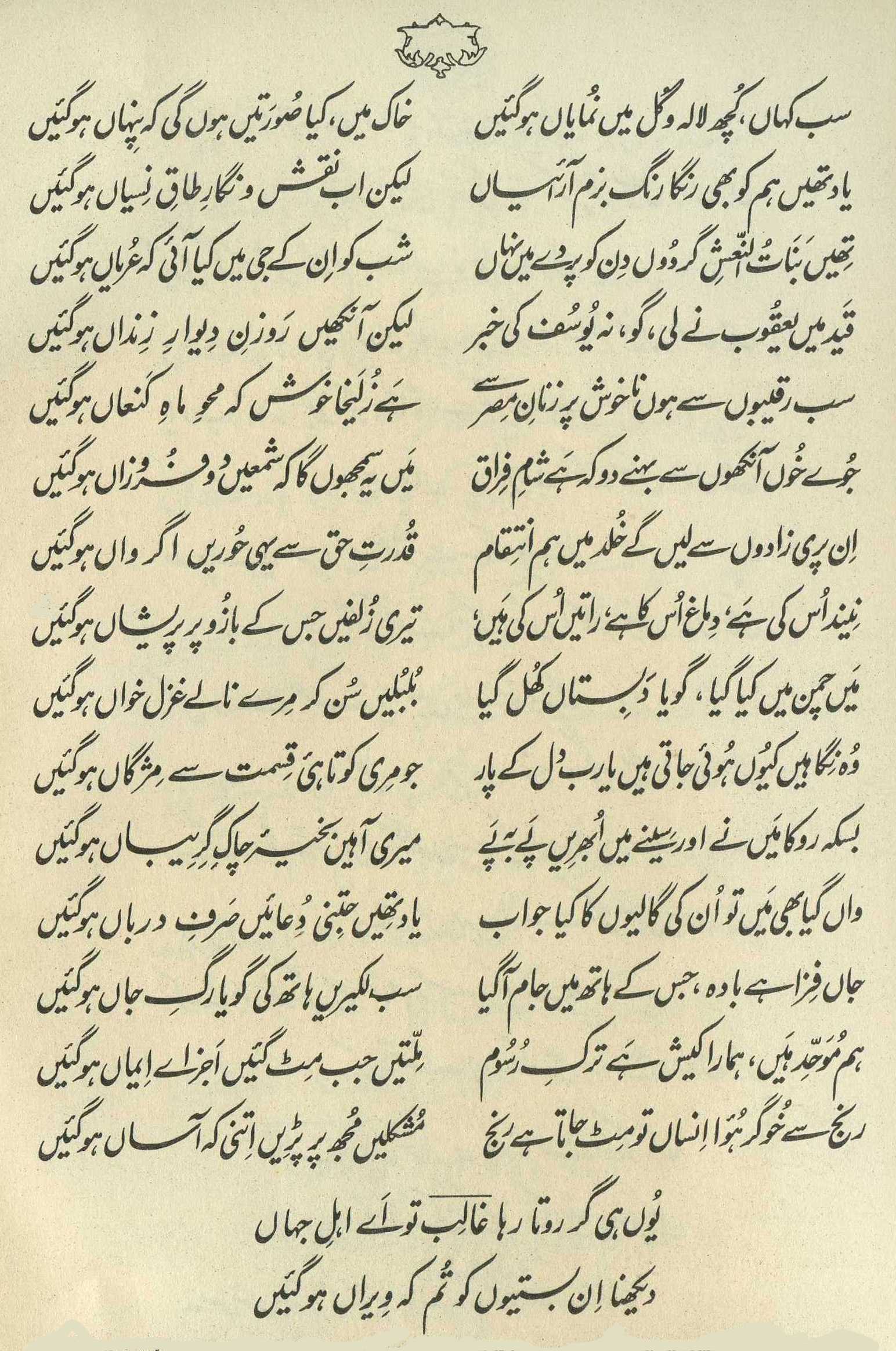
That is, the Nightingales began to recite ghazals in the way that [pupils] recite lessons in a school. It's the Nightingale's habit, when he hears a fine voice, to imitate it. (119)
== Nazm page 119

He says, when I went into the garden, the Nightingales began reciting ghazals the way pupils in a school recite lessons. (168)
The moment I went into the garden, the Nightingales began to recite, the way the moment the Ustad arrives, the pupils begin to recite their lessons. By 'garden' the gathering of poets can be intended; and by Nightingales, the poets; that is, the mushairah doesn't begin until I arrive. (221)
[The commentators are correct about the 'school', but there's more to be said.] If we juxtapose the word to the word 'ghazal-reciters', then the thought irresistibly occurs that in reality is short for ; and does not literally mean 'school'; rather, this meaning is suppositional. The verse is certainly on the theme of self-glorification. But this self-glorification is more about poetic stature than about lamentation. I went, lamenting into the garden. My lamenting too was so beautiful and melodious that in response to it, the Nightingales were compelled to become ghazal-reciters. Thus the meaning of became 'place of '-- that is, a place for discussion of poetry and literature. My lament-singing was so beautiful and melodious that thanks to it, or in imitation of it, or from envy of it, the Nightingales were compelled to become ghazal-reciters. Here the word has special importance, because the Nightingale sings laments, or melodies, anyway. Now when he heard my rhythmic [] lament, he felt that in reply to it ordinary tune-singing is not enough; rather, 'ghazal-recitation' was required.
In one place [in an unpublished verse] Ghalib gave to laments that arise from the heart, preference over metrical compositions and music: 361x,4 .
In the verse under discussion, he is giving preference to his own lament not only over the Nightingale's lament, but over the Nightingale's ghazal-recitation as well....
Indeed, Nasikh too, in his own special style, has composed an enjoyable verse on this theme :
[the Nightingales say, having heard the scratching of the reed-pen of thought,
now we would rend our beaks at the pen-point/'beak' of that scar/wound].
== (1989: 173-74) [2006: 194-96
[See also his comments on Mir's M 602,1 .]
As we head into the first line, what an enjoyable little shock it is to run up against the striking juxtaposition ; then just to round things out, the line ends with another . (In Urdu script, and not only sound fairly similar but also look almost alike.) The possibilities of , which literally means 'speaking' and thus by extension has come to mean 'so to speak', are beautifully exploited; for more on this, see 5,1 . The verse thus offers us speaking [], hearing [], and reciting []. What more does poetry require? In fact the verse describes not merely a school but-- as Faruqi notes-- a poetic forum, a metaphorical . And as in any school or literary gathering, the entry of a master, an Ustad , immediately evokes a reaction.
In this case, as Faruqi observes, the speaker doesn't even provide the finished product, but only offers some raw material: it's his laments themselves that inspire or instruct or goad-- we can't determine the exact mechanism-- the Nightingales into producing, 'reciting', ghazals. Our inability to tell exactly what's going on between the teacher and the pupils is also lovely in its way. Isn't that what learning is like in the real world-- and poetic inspiration as well? Inspiring and instructing and goading-- who can really tease them apart?
Compare 123,5 , in which a bird becomes a professional rival in poetry.
graphics/bulbul.jpg