Verse 161852aa;Nho ga))ii;N
G1
1
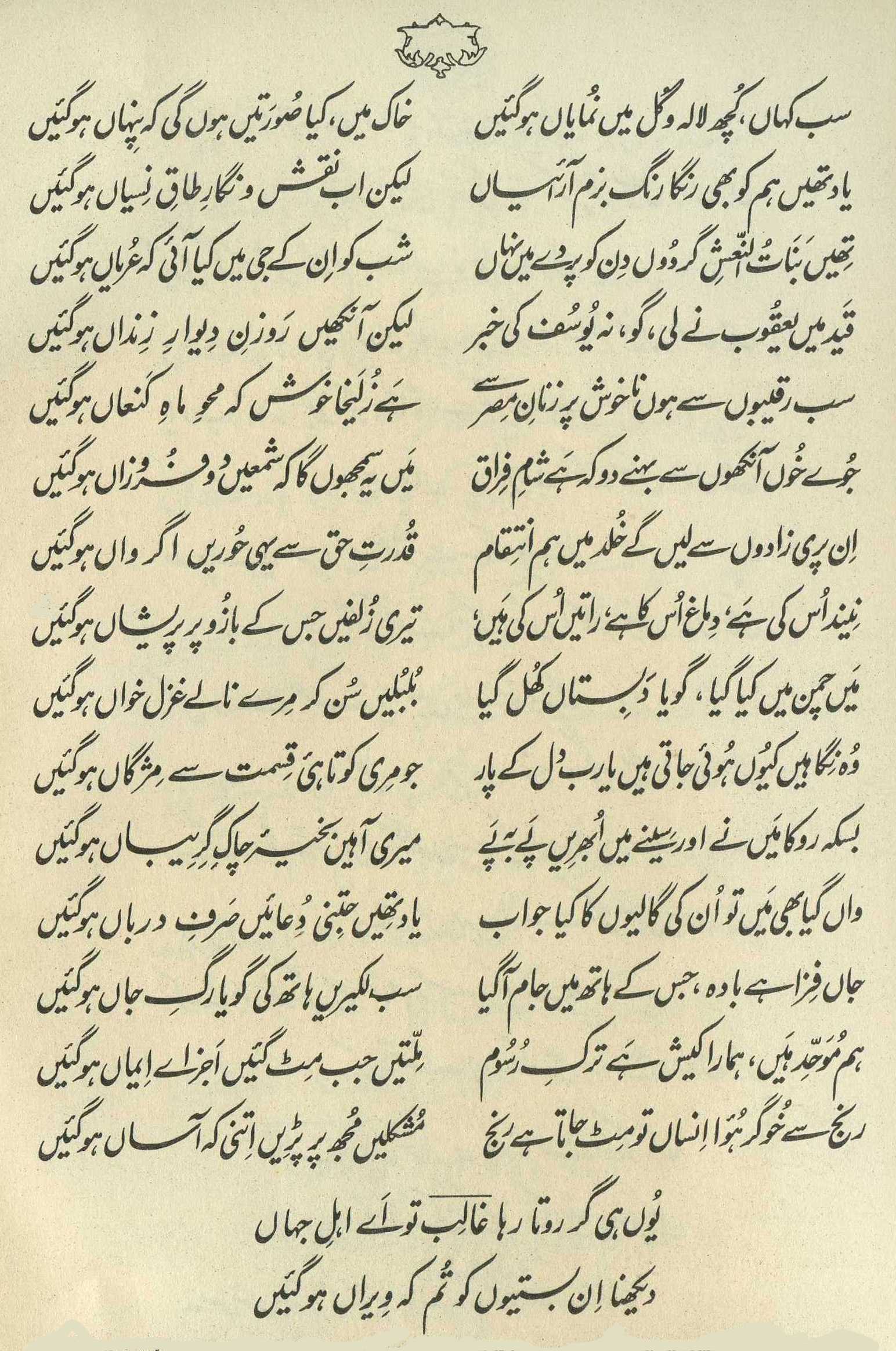
if Ghalib would keep on weeping {like this / for no reason}, then, oh people of the world
2
you just look at these towns-- that they would become desolate
'In this very manner, exactly thus; --without any apparent cause or reason, causelessly, &c'.
the infinitive, is used as a neutral imperative.
| References | |
|---|---|
| Arshi, Imtiyaz Ali | Ghazal# 114 |
| Raza, Kalidas Gupta | 426 |
| Hamid Ali Khan | Open Image |
Either consider that from the [emotional] effect [] of weeping desolation happened, or consider that the flood of tears made them desolate. But this second aspect is a limited theme , and is commonplace. (120)
== Nazm page 120

In this closing-verse two meanings have been created. One is that from the effect of weeping, populated areas will be destroyed; and the other meaning is that the flood of tears, destroying houses, will make towns desolate. (169)
The reason for eloquence []: in alone are so many interpretations. (1) That the pain, the intensity with which he is now weeping-- in this is the subtle aspect too that a person can't weep like this for very long. (2) People can't hear him. (3) also means in a commonplace way, or in the way that the neighbors have given him leave to weep. In the interpretation of 'people of the world' there's a great scope. That is, the effect of this weeping will be world-conquering. By 'towns' is meant the towns of the whole world. (225)
Bekhud Mohani is right on target-- the idiomatic multivalence of provides the central pleasure of the verse. For more on , see 30,1 . The phrase can of course mean 'exactly like this', so that we know that the speaker (who can be 'Ghalib' himself, or an observer) is right at this moment shedding an ominous torrent of tears.
More enjoyably, however, the phrase can also mean 'casually, for no special reason, by happenstance'; or, as Platts proposes, 'causelessly' (see the definition above). And its clever placement at the beginning of the first line opens two possibilities for its application. It might describe the nature of his 'going on' weeping: 'if Ghalib just happens, for no particular reason, to go on weeping'. Alternatively, it might describe the nature of his weeping itself: 'if Ghalib goes on weeping in a casual way, for no particular reason'. (Compare the use of in 161,5 .) For another, even more elegant use of , see 168,3 .
Bekhud suggests other possible nuances as well: that his present weeping might be so intense as to be unsustainable; and/or that his weeping might be unheard or ignored by his neighbors, so that he has to warn them specifically about its effects.
In short, we have a wide range of possibilities about the nature, cause, and future prospects of the weeping. We don't know whether the Ghalib-persona's weeping is caused by some special thing that the 'people of the world' are being warned to fix before their towns are destroyed; or whether it's completely causeless, and they are simply being warned to evacuate their houses because of the high risk of uncontrollable flooding or other disasters. If the weeping is causeless, we don't know whether it's due to his own whim (such that he can control it if he happens to choose to do so); or to the devastating effects of passion (such that weeping may overpower him at any time against his will).
This verse reminds me of 233,17 , which plays more directly with the various possibilities of control versus lack of control over weeping. In that verse, the lover doesn't want to be teased, because 'again', through the turmoil of tears, he has 'prepared a typhoon'. It's impossible to tell whether he's threatening to unleash it, or warning that any stress might cause it to burst out beyond his control.
On the use of the perfect verb form as a subjunctive, see 35,9 .
Compare Mir 's threat to the city-- it risks being burnt with his fiery breath: M 21,2 .
graphics/streamoftears.jpg
graphics/floodedcity.jpg