Verse 101852aa;Nho ga))ii;N
G1
1
why do those glances, oh Lord , keep going through/beyond the heart?
2
[those glances] that, through my shortfall of fortune, became eyelashes
'(gov. gen. with - , if the postp. is expressed), Further bank, or opposite shore or side (of a river, lake, &c.); the other side, concluding bound; the end or limit of anything, termination, conclusion; utmost limit or extent or reach; bottom, innermost depth, inmost recess; ... —over, across, on or to the other or further side, through, beyond'.
'Smallness, shortness; brevity, deficiency, failure... narrowness.... (), To fail, fall short (of)'. (Platts p.858
| References | |
|---|---|
| Arshi, Imtiyaz Ali | Ghazal# 114 |
| Raza, Kalidas Gupta | 426 |
| Hamid Ali Khan | Open Image |
By the glances becoming eyelashes is meant that through shame and modesty they are not lifted up; rather, like eyelashes, they remain constantly bowed downwards.
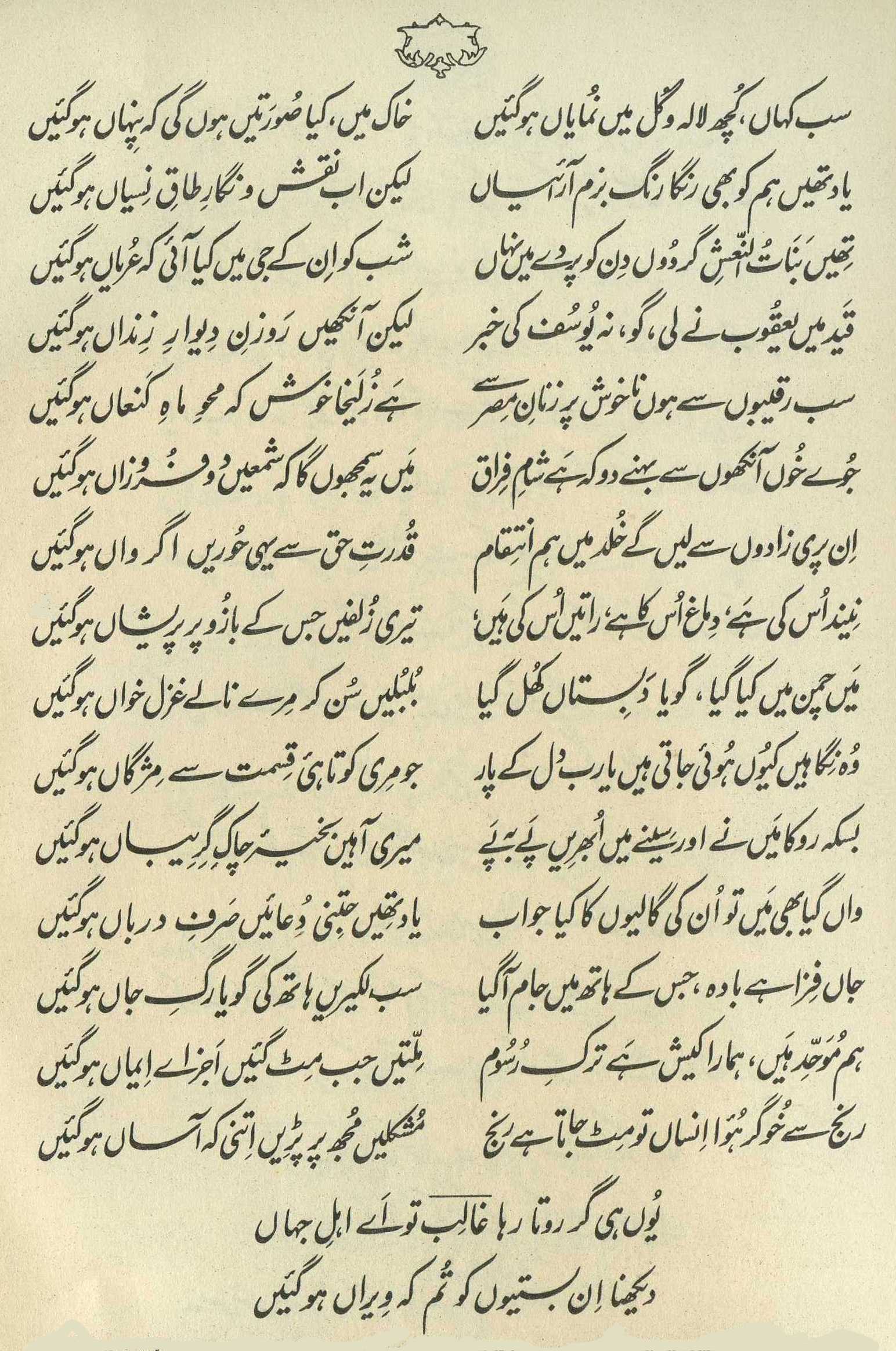
==Urdu text: Yadgar-e Ghalib , p. 152
By 'becoming eyelashes' is meant that her glances in my direction are short/brief to such an extent that it's as if they'd become eyelashes. But despite this shortness, they still go through/beyond the heart. (119)
== Nazm page 119

Oh Provider, those glances that because of my ill-fortune have become eyelashes-- that is, that reach only up to the screen of the eyelashes, or that view me only in sidelong glances, that never shamelessly fall on me-- why do they overpower the heart? Why do fragments of my heart fly all around? The gist is that she never looked fully at me, the way she looks at others; but still, my heart is in this state! If she had ever looked me in the eye, then what state would the heart be in?
Mirza Dagh says,
[out of shame, she was unable to meet my eyes
how did her glances reach beyond the liver?] (222)
In surprise he asks, 'Those glances that, because of the shortness of my fortune, have out of shame turned into eyelashes and remained so-- despite so much smallness and shortness, how are they reaching beyond my heart?' (211)
In this verse there's apparently no convolutedness. Bekhud Mohani has to a large extent written correctly about it. [So has Asi.] But both erroneously think that when the glances became small, then they turned into eyelashes. Although according to the verse the 'smallness' is related to the 'shortfall of fortune', not the glances. For the sentence means 'I was unfortunate'. The dictionary meaning is that 'my fate/fortune was small'. By a 'small fate/fortune' is meant that its reach was limited... The point is that the fate/fortune was so small that her 'glances turned into eyelashes'-- that is, whereas ordinarily glances are used (that is, glances are sent out from the eye), there the beloved made use of eyelashes....
The point of the glances' becoming eyelashes is that the glances retained no existence at all. A glance emerges from the eye. The quality of a glance is length. But my fate/fortune is so small (and 'non-reaching' []) that in proportion to it the beloved's glance too remained small-- so small that it didn't leave the eye. In its place only the action of eyelashes came into play. That is, when she turned her face toward me, then she didn't see me; I received only the attention of her eyelashes, not her glances.
Ghalib has taken this theme from Mir [M 549,6 ]:
[they do not advance from the eyelashes, so that they would reach to us too
those glances wander in the shade of the eyelashes]
== (1989: 175-76) 2006: 197-98
[See also his discussion of Mir's similar verse M 1548,9 .]
Because the lover's fate/fortune falls short, its deficiencies cause the beloved's glances too to fall short. They remain so truncated and averted that they are (in some sense) eyelashes. That being so, then, why is their penetrating power, their flight, so long? Why do they pass through, and even beyond, the heart? Why, in short, do they behave like arrows?
If we actually envision these glances-turned-to-eyelashes as arrows, an awkward side-effect is apparent: if the beloved shot very many of them, she'd end up with no eyelashes, or maybe only a few little runty ones not fit for shooting. And there's also the bizarre vision of numerous tiny little eyelashes flying through the air and penetrating the lover's heart. But after all, this is the ghazal world. The lover's own eyelashes can just as well become numerous tiny pens with blood for ink, as in 233,6 ; and the beloved's eyelashes can also dine festively on liver-fragments, as in 233,2 . So there's really no reason to start being too literal-minded about it.
But in any case, we can save ourselves from all such concerns by close attention to the actual structure of the verse: 'A behaves like B / A becomes C' (glances act like arrows; glances become eyelashes). The idea of glances as arrows is the primary one, and that of eyelashes as arrows is a secondary spin-off from it. Her glances 'became eyelashes' in the sense that they were short and downward-directed. Perhaps, as Faruqi argues, they didn't leave her eyes at all (which explains why the lover marvels at their paradoxical power to penetrate through and beyond the heart).
But how does the lover actually feel about these miraculous, paradoxical, short-and-long arrow-glances? He invokes the Lord, thus showing a strong degree of emotion, but his utterance is a question-- more of Ghalib's famous speech. There are at least two possible feeling-tones for his question. The lover might marvel delightedly at the arrows' deadliness, since against all odds, and despite his ill-fortune about her glances, he's not missing out on the mysteriously potent experience of passion.
Or alternatively, the lover might ruefully exclaim at his own talent for ending up with the worst of all worlds: he doesn't get a single real glance from the beloved's beautiful eyes, and yet his heart is repeatedly lacerated by deadly, impossible glance-arrows-- or, even worse, overshot by them as they sail past it and land uselessly somewhere on the far side. (Could it even be that the beloved is aiming them at someone else?)
graphics/eyelashes.jpg