Verse 31821aanii
G6
1
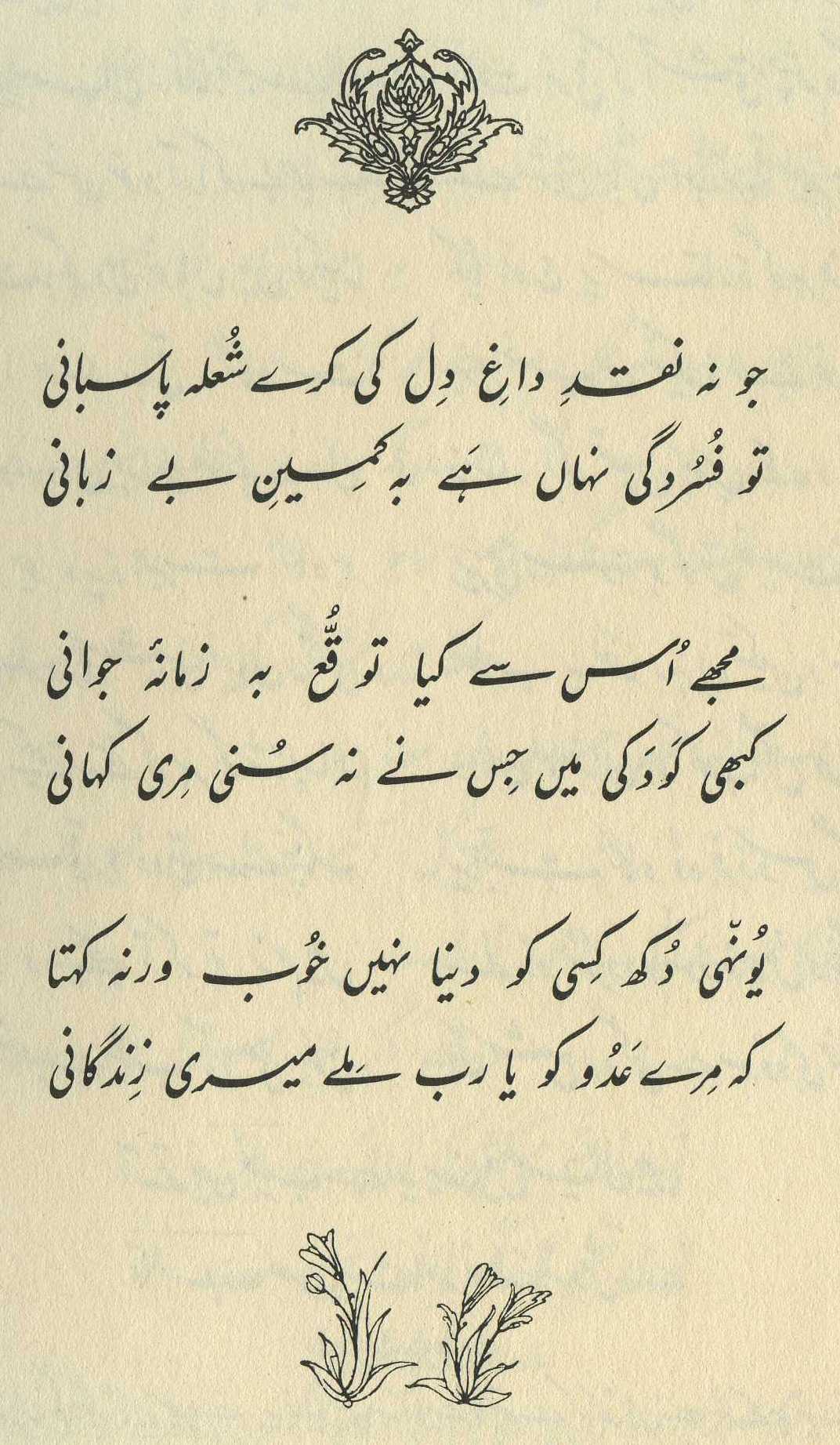
casually/causelessly/'like this' to give someone pain is not well; otherwise, I would have said
2
'let my enemy, oh Lord , receive my life'
'In this very manner, exactly thus; --without any apparent cause or reason, causelessly, &c'.
| References | |
|---|---|
| Arshi, Imtiyaz Ali | Ghazal# 144 |
| Raza, Kalidas Gupta | 348 |
| Nuskhah-e-Hamidiyah | 257 |
| Hamid Ali Khan | Open Image |
The word in place of 'without reason' [] is in the idiom. (189)
== Nazm page 189

He says, to give someone trouble without reason is not a good thing; otherwise I would certainly have made the prayer, oh God, may my difficulties go to the enemy who, having seen my sorrow and grief, is happy. (243)
The second line tells us that he is passing his life with such difficulty, and he is forced to confront so many disasters, that he's disaffected with life. (329)
First an irritating verse, then a minor verse-- and finally a striking verse, to wrap up the ghazal and remind us what kind of poet we're dealing with. The commentators pay no attention to the multivalence of (see the definition above)-- and yet, how unobtrusively and perfectly it performs! Any and all of the meanings of work perfectly, one by one or all together. For more on , see 30,1 .
The first line thus provides us with three kinds of scruples: it's not good to cause pain casually; or, for no good reason; or, 'just like this (pain)'. In classic mushairah -verse style, the first line tantalizes us-- with all these heavy moral scruples, what dire words are being contemplated?-- and then leaves us dangling. Of course, under oral-performance conditions, we are left to dangle for as long as is conveniently possible.
Then even when we hear the second line, we don't really 'get' it until the very end; the 'punch-word' is withheld until the last possible moment, so that the wit and trickiness of the verse are perceived all at once. It's a wry and wonderful expression of a kind of doubled misery. In Urdu, wishing bad things on one's enemies is a commonplace of colloquial expression. Here, the speaker virtuously hesitates to do so-- alas, he says wistfully, he can't even do that. He wouldn't wish a life like his, with anything like his kind of pain, on even his worst enemy (who perhaps couldn't endure it for a moment). This final, 'just-like-mine' sense of is only apparent after we hear the end of the second line, so that it comes with an extra jolt.
And if we also take his words literally, then his wishing that his own life may be given away to an enemy would also be a form of wishing for death; for the enemy is proverbially 'in search of' the victim's life.
graphics/job.jpg