Verse 3after 1826amhai ham ko
G5
In this meter the first long syllable may be replaced by a short; and the next-to-last long syllable may be replaced by two shorts.
1
from weakness, the footprint of an ant is a neck-collar
2
from your street, how/'where' do we have the strength for flight?!
'Terror, scare; flight, elopement; concealment'.
| References | |
|---|---|
| Arshi, Imtiyaz Ali | Ghazal# 119 |
| Raza, Kalidas Gupta | 372-373 |
| Gyan Chand | 492 |
| Hamid Ali Khan | Open Image |
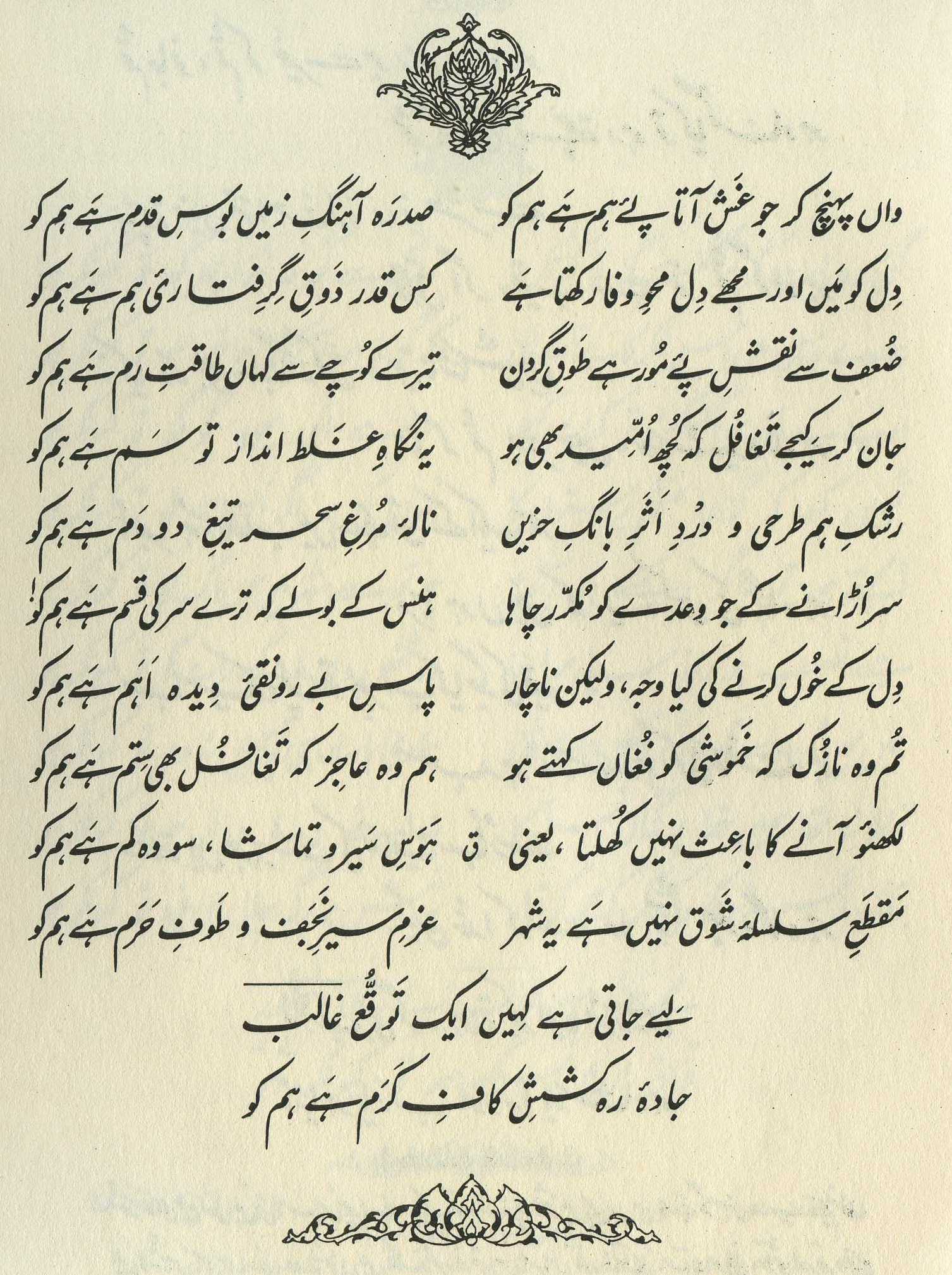
That weak one around whose neck such a heavy collar would be fallen-- how can he move from his place? (131)
== Nazm page 131

He says, 'The footprint of an ant has the effect of a neck-collar for a weak person like us. Carrying such a heavy burden, how can we flee from your street?' (185)
'I have become weak to such an extent that even the footprint of an ant has become a neck-collar for me. When this is the situation, if I leave your street where can I go?' (248)
Anyone for whom an ant's footprint is a neck-collar is of course in a terminal stage of emaciation and weakness. In addition, he's probably lying collapsed on the ground, where his neck could at least in some sense come into contact with the ant's footprint-- enough, anyway, to find it a barrier to further movement. (If we don't locate him on the ground, then we're forced to try to imagine an ant's footprint being somehow lifted up and secured around his neck to hold him captive, which as an 'objective correlative' is even more awkward.)
'From your street, where...?' [] sets up an expectation of something about going ('where would we go?', 'where could we go?', or the like). But that expectation is abruptly cancelled for us, just as all prospect of flight is blocked for the speaker, by the next phrase: it turns out that the 'where' is really a marker for the indignant negative rhetorical question 'where is the strength for flight?!' ('It's nowhere, of course-- no such strength could possibly exist!') But the question still lingers on, like a phantom limb, because of the perfect positioning of the right between the two phrases.
For another (and far more fascinating) verse in which the ant provides a limit case of smallness, see 138,1 .
Note for meter fans: Shortening to doesn't really commend itself. It's not one of the normal variations that poets commonly adopt for metrical convenience. But then, what's the point of scolding Ghalib?
graphics/ant.jpg