Verse 7after 1826amhai ham ko
G5
In this meter the first long syllable may be replaced by a short; and the next-to-last long syllable may be replaced by two shorts.
1
what reason is there to turn the heart into blood? --but helplessly
2
respect/regard for the lightlessness of the gaze is important to us
'Watching, guarding, taking care (of), observing; observance, consideration, attention (to), regard, respect'.
'Lustre ... brightness, splendour, beauty, elegance, grace, ornament; freshness, prime; colour, complexion; flourishing state or condition'.
'More, most, or very important; momentous'.
| References | |
|---|---|
| Arshi, Imtiyaz Ali | Ghazal# 119 |
| Raza, Kalidas Gupta | 372-373 |
| Gyan Chand | 492 |
| Hamid Ali Khan | Open Image |
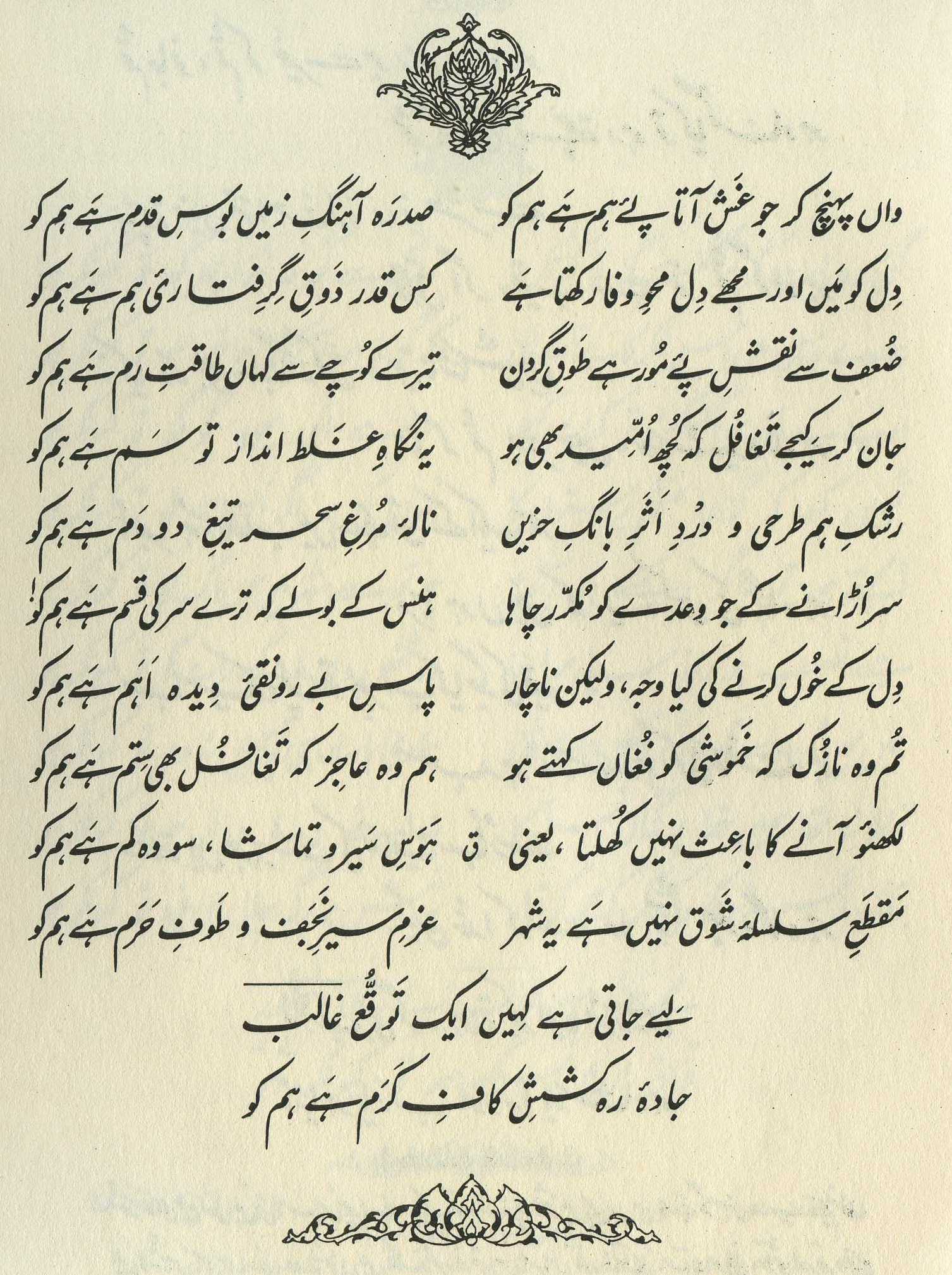
That is, without tears of blood, the eyes remain lightless. If it were not for this thought, then there would be no other reason to turn the heart to blood. (132)
== Nazm page 132

He says, 'There's no special reason to turn the heart into blood. We only turn the heart to blood out of this compulsion: that without bloody tears, the eyes seem a bit lightless.' (186)
Does anyone turn his heart to blood? But what can we do? We're compelled. If they don't weep tears of blood, the eyes gradually become lightless. And we can't stand to see this. That is, in passion it's necessary to weep tears of blood, whether the heart is healthy or not, whether the liver remains or not. (249)
The lover could indeed be 'turning the heart into blood' (an idiomatic expression for worrying, fretting, grieving) so as to keep his eyes bright with fresh blood and save them from a state of , as the commentators maintain. This implies that his turning his heart into blood will be efficacious and will actually accomplish something, so that the sacrifice of the heart will at least be meaningful.
But he could also be helplessly 'turning the heart into blood' out of grief at the eyes' -- even though (or else precisely because) he knows that it's too late, that the heart and liver are by now too destroyed to be able to keep the eyes bright with fresh blood. This then becomes almost a catch-22 situation: he weeps blood because he no longer has enough available blood to weep.
Nazm also points to a broader suggestion: there's no other reason to 'turn the heart into blood' with fretting and longing and grieving except for an internal one-- consideration of the welfare of the eyes. There's not the smallest possibility that such longing or grieving could soften the beloved's impermeably stony heart.
graphics/heartblood.jpg