Verse 8after 1826amhai ham ko
G5
In this meter the first long syllable may be replaced by a short; and the next-to-last long syllable may be replaced by two shorts.
1
you-- so/'that' sensitive/touchy, that you call silence a sigh
2
we-- so/'that' weak, that even/also neglect/heedlessness is tyranny to us
'Delicate, tender, fragile; fine; light; brittle; nice; neat; elegant; genteel; subtle; --facetious; gracious; keen; sensitive, touchy, testy'.
'Lacking strength or power, or ability, powerless, impotent, unable (to do), unequal (to); weak, feeble, helpless; brought low, overcome; lowly, humble; exhausted; dejected; in despair, hopeless; baffled, frustrated'.
| References | |
|---|---|
| Arshi, Imtiyaz Ali | Ghazal# 119 |
| Raza, Kalidas Gupta | 372-373 |
| Gyan Chand | 492 |
| Hamid Ali Khan | Open Image |
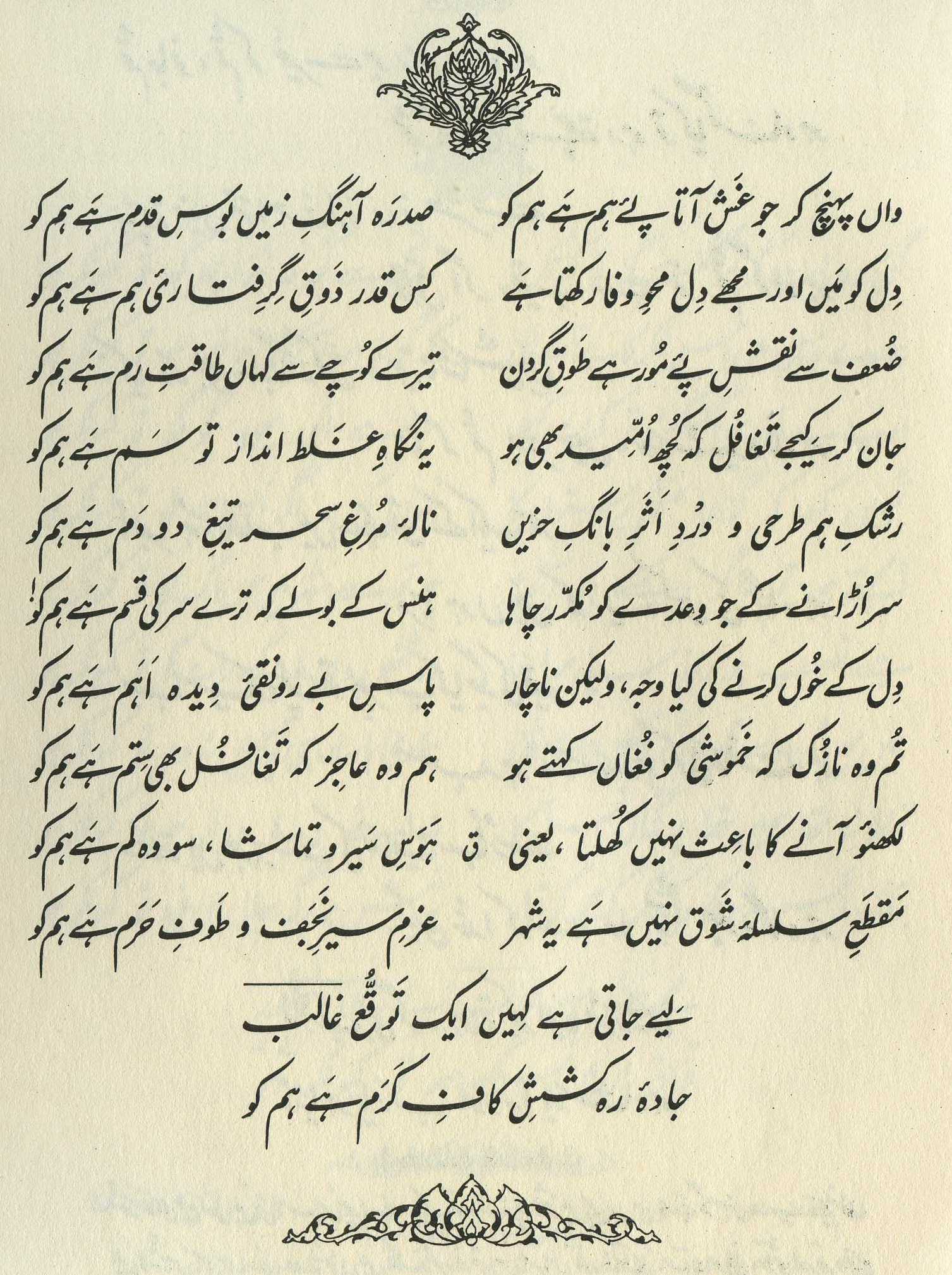
That is, I am so strengthless that when you ceased to practice tyranny, and practiced neglect, I considered it too to be tyranny. And you are so delicate that if I stop my tongue from uttering complaints, and remain silent, then you consider that too to be a complaint. (132)
== Nazm page 132

He says, 'You are so delicate that after my renunciation of sighs, you call even my silence a sigh. And we are so feeble that when you gave up tyranny and adopted neglect, then that too did the work of tyranny toward me.' (186)
You are so delicate that if we remain silent at your cruelties, then you become angry at this and sit with a sulky expression, and through your attitude complain about us. And we are so helpless that even your neglect is, for us, cruelty. (249)
Like so many of the 'you and I' verses, this one operates through mood and implication . The whole background and set of arguments that give rise to the two simple, parallel lines can only be inferred from our knowledge of the ghazal world (and of course the real world, and the kind of quarrels that lovers have). The commentators have a plausible background to offer, and I don't disagree with it.
But the real charm of the verse is in its tone, and in its open-endedness. It calls attention to the similarities between the delicacy (or sensitiveness, or touchiness) of the beloved and the weakness of the lover-- and also to the radical differences in their positions. Her 'delicacy' has the effect of making her hyper-critical; his 'weakness' has the effect of making him hyper-vulnerable. After all, in their own way they're perfectly matched. The balance between similarity (both are sensitive) and difference (she attacks, he suffers) must return to a sort of equilibrium: she's the ideal type of the beloved, he's the ideal type of the lover.
graphics/loversquarrel.jpg