Verse 31833aabhii nah sakuu;N
G5
In this meter the first long syllable may be replaced by a short; and the next-to-last long syllable may be replaced by two shorts.
1
I can't even manage to get poison, oh tyrant-- otherwise
2
is it a vow against/'of' meeting you, that I couldn't even/also take/'eat' it?
'To take an oath, to swear (by); to make a solemn declaration, to asseverate'.
| References | |
|---|---|
| Arshi, Imtiyaz Ali | Ghazal# 105 |
| Raza, Kalidas Gupta | 381 |
| Hamid Ali Khan | Open Image |
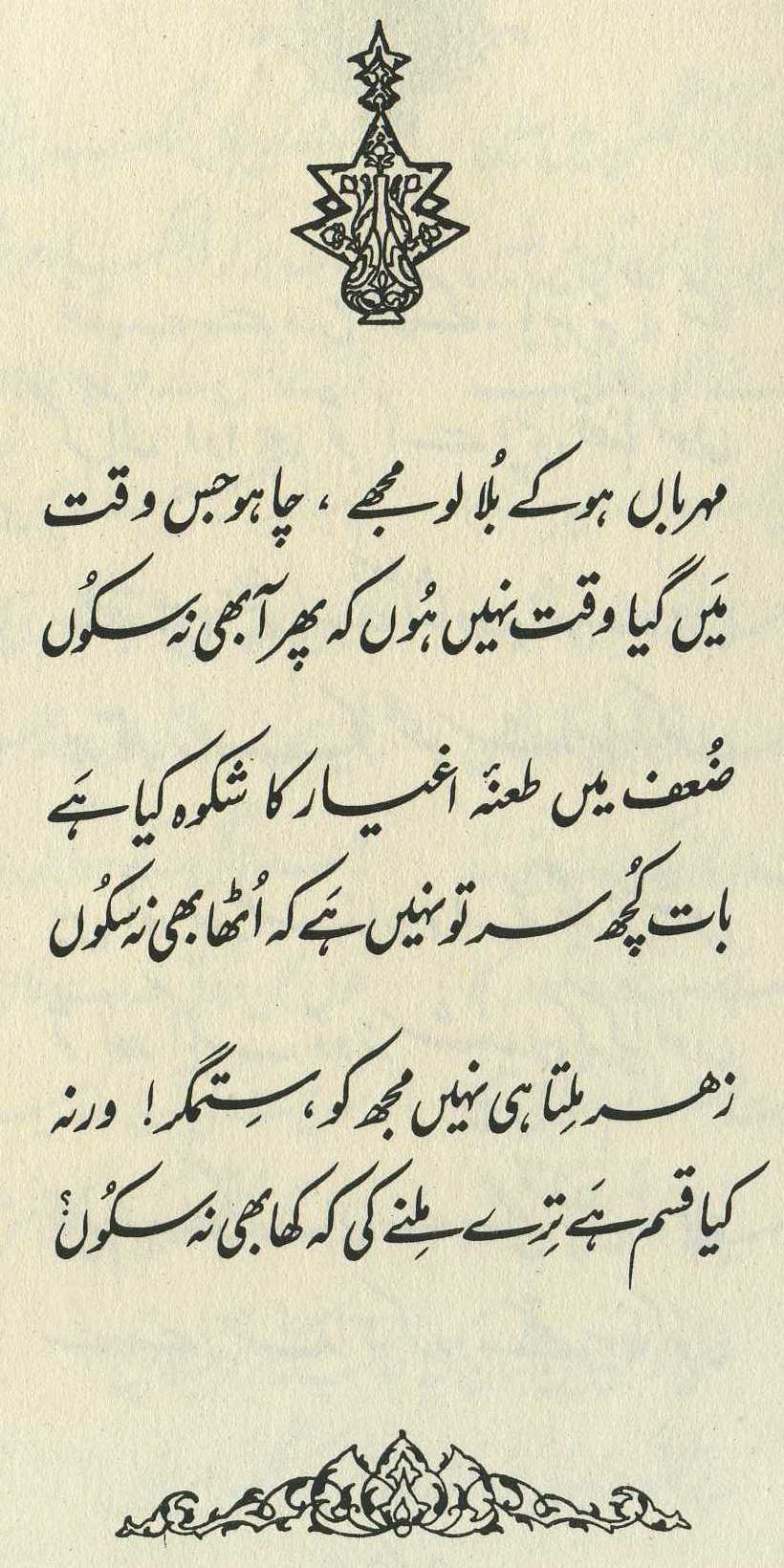
When they say someone has taken a vow about doing something, it means that he refuses to do that thing. So how could the lover take a vow about meeting the beloved? Thus he says that poison is not a vow about meeting you, that I can’t take it; but because I can’t get it, for that reason I can’t take it.
==Urdu text: Yadgar-e Ghalib , p. 146
In the last line there is a remarkable violation of decorum []-- three occurrences have been run right up against each other. (88)
== Nazm page 88

It's clear that the beloved's tyranny and the lover's oppressedness have reached such a limit that he wants to take poison and give up his life. And at the same time it's also clear that despite this state, it's impossible for him to take a vow about meeting the beloved.
[As for Nazm's complaint about the three k's:] Undoubtedly. But no Ustad is safe from this. (183)
[In view of the flaw pointed out by Nazm,] in this way this defect can be removed: .
In the refrain of all three verses, there are two meanings. The of a person, and of time; the of words, and of a head; the of poison, and of an oath. (258)
The meaning of the verse is, oh cruel one, you've kept me always deprived of a meeting, and thus encouraged me to die and take poison. I can't even get poison, otherwise-- it's not a vow about meeting you, that I won't be able to take it. That is, I don't get to meet you-- as though you've taken a vow about meeting me. (179)
ABOUT : To take (literally, to 'eat', ) a vow 'of' something can mean either to swear off it (showing that one renounces it), or to swear by it (showing that one greatly values it). (For vowing in an affirmative way-- to do something, rather than not to do something-- is used.) How could Ghalib not make use of a nice multivalent little tool like this? For other clever exploitations of the possibilities of , see 123,6 *; 136,2 ; 167,3 ; 170,7 ; 176,7 // 407x,4 . And for an even greater similarity, take a look at 20,3 , which plays with in the same literal vs. metaphorical way that the present verse plays with .
Some general comments about this ghazal appear in 89,1 .
This final verse is, to my mind, the cleverest of the three, though all three work along the same lines. The second line gives us parenthetical knowledge as well as overt information: 'Is it [=poison] a vow about meeting you (which I could never take), that I can’t take [it]?'
Although in English we don't 'eat' vows or poison, we luckily 'take' both of them, so the effect of the shared verb can be pretty well recreated. And although in English a 'vow of meeting you' [] has an affirmative feel, in Urdu in this case it's definitely to be taken negatively, as something like 'swearing off' an action.
The presence of means that the second line can be read either in the future subjunctive (which seems to be the primary meaning), or as a kind of implicit contrafactual (an explanation not of future possibilities, but of past actions).
The so-called 'flaw' [] in the second line, of having three sounds in a row [] could have easily been remedied, as Shadan notes. And when you realize that the first consonant in the line, and the last, are also both , and that that the second is the closely allied -- well, it's hard to believe that Ghalib isn't setting up this effect on purpose. The effect is not pretty, but rather seems bumpy and abrupt. Could we say that this is an effect appropriate to the harsh nature of the line?
Josh points out an additional bit of cleverness-- that perhaps the tyrant's tyranny consists in refusing to meet the lover. The proper revenge would of course be for him to swear not to meet her either. But this he can't do-- just as he can't even 'meet with' or get (using the same verb, ) the poison that would rescue him from his suffering.
Note for grammar fans: Normally we'd expectto mean 'of getting/obtaining you', while would mean 'of meeting (with) you'. But metrical constraints are operative; and in the context of this verse only the 'meeting with' reading makes semantic sense.
graphics/cleopatrapoison.jpg