Verse 71821aarnahii;N hai
G17
1
you've taken/'eaten' a vow against/about wine-drinking, Ghalib--
2
there's no trusting your vow!
'To take an oath, to swear (by); to make a solemn declaration'.
| References | |
|---|---|
| Arshi, Imtiyaz Ali | Ghazal# 145 |
| Raza, Kalidas Gupta | 348-49 |
| Nuskhah-e-Hamidiyah | 207 |
| Hamid Ali Khan | Open Image |
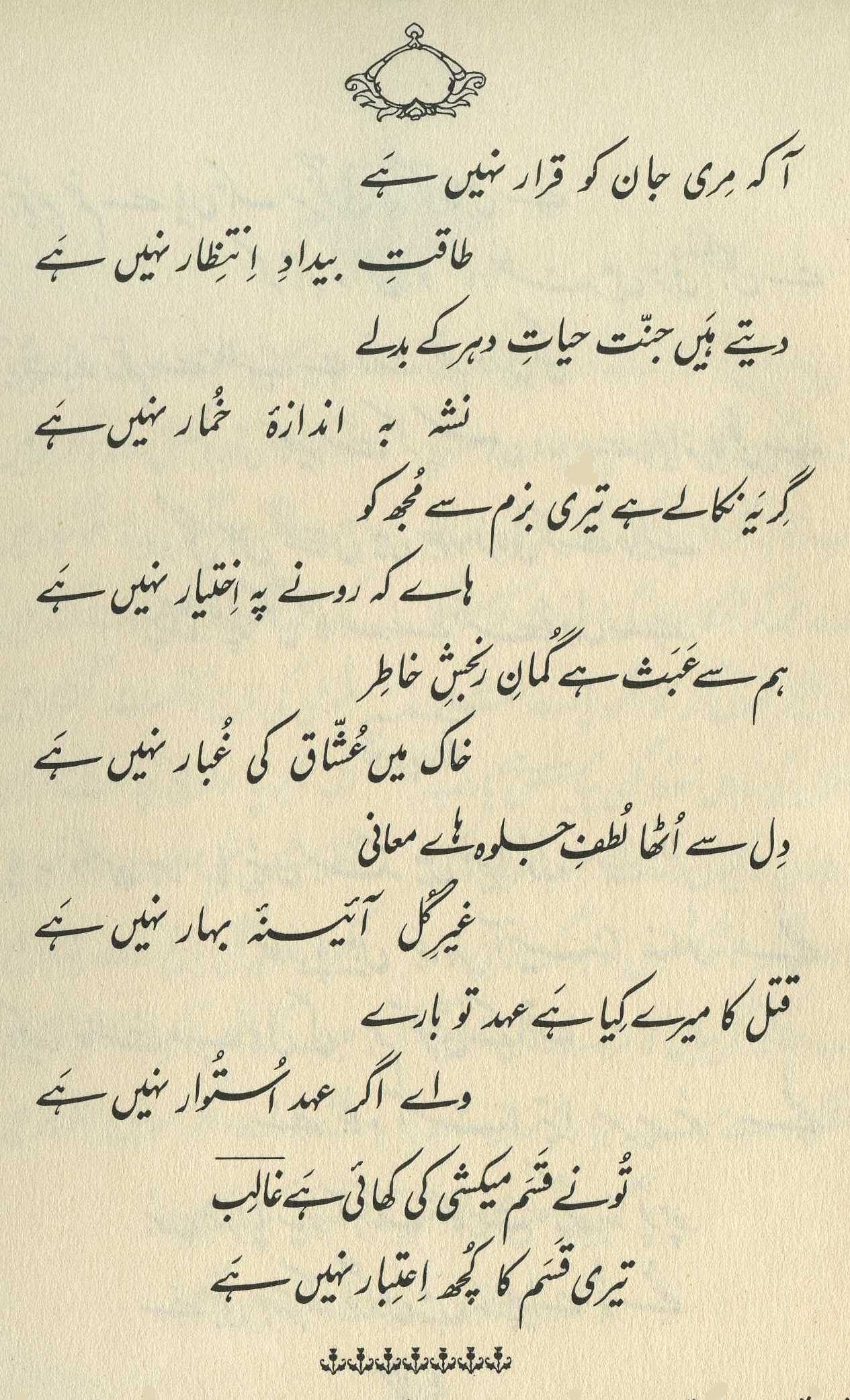
It's surprising-- you, and a vow against wine-drinking? To 'eat' [] an oath about anything is an idiom, and to swear off it is what is intended. (192)
== Nazm page 192

He says, 'Oh Ghalib, you've taken a vow about wine-drinking. Your vow doesn't prove that you've sworn off wine-drinking, or adopted wine-drinking. And when both these aspects are shining forth in your vow, then we absolutely don't trust your vow.' (247)
He says, 'You've taken a vow to renounce wine-drinking. But how would we believe that you would remain firm in your resolve?' For a number of times you have taken a vow, and then were not able to remain true to your vow. (335)
Literally what has been taken is a vow 'of' or 'about' [] wine-drinking; thus Bekhud Dihlavi insists on the ambiguity of whether the vow is to reject or to adopt it. Platts agrees with him, and also adds the possibility of 'swear by'. On any of these readings, the humor lies in taking the second line as a generalized put-down: we don't care whether you swear for or against wine-drinking, or swear by it-- your word is no good, we just don't trust it at all, no matter what vows you take!
But most commentators interpret as to 'swear off' the thing in question, and certainly that's the normal, idiomatic way it's used. And with that we have available a much funnier reading of the verse, one that's truly sarcastic and wicked. The implied situation is that Ghalib has just offered to take some kind of vow about something. The speaker replies scornfully, 'Hah! Why, you actually swore off wine-drinking-- that's how reliable your vows are!' The speaker is mocking Ghalib with a notorious, flagrant example of a foolish, soon-broken vow that is now legendary among his friends. The making and breaking of that vow were so egregious that he'll never be allowed to live it down. Anybody who actually swore off wine-drinking-- well, his oath is no good forever. Perhaps because he didn't in fact keep the vow; or else because he was inherently unable to keep the vow; or else because nobody in the ghazal world could possibly keep such a vow; or else because such a vow is foolish, appalling, or incomprehensible in the first place.
There's also the nice resonance between 'drinking' wine and 'eating' the vow. For an even cleverer play on the 'eating' of a vow, see 89,3 .
graphics/wineglass.jpg