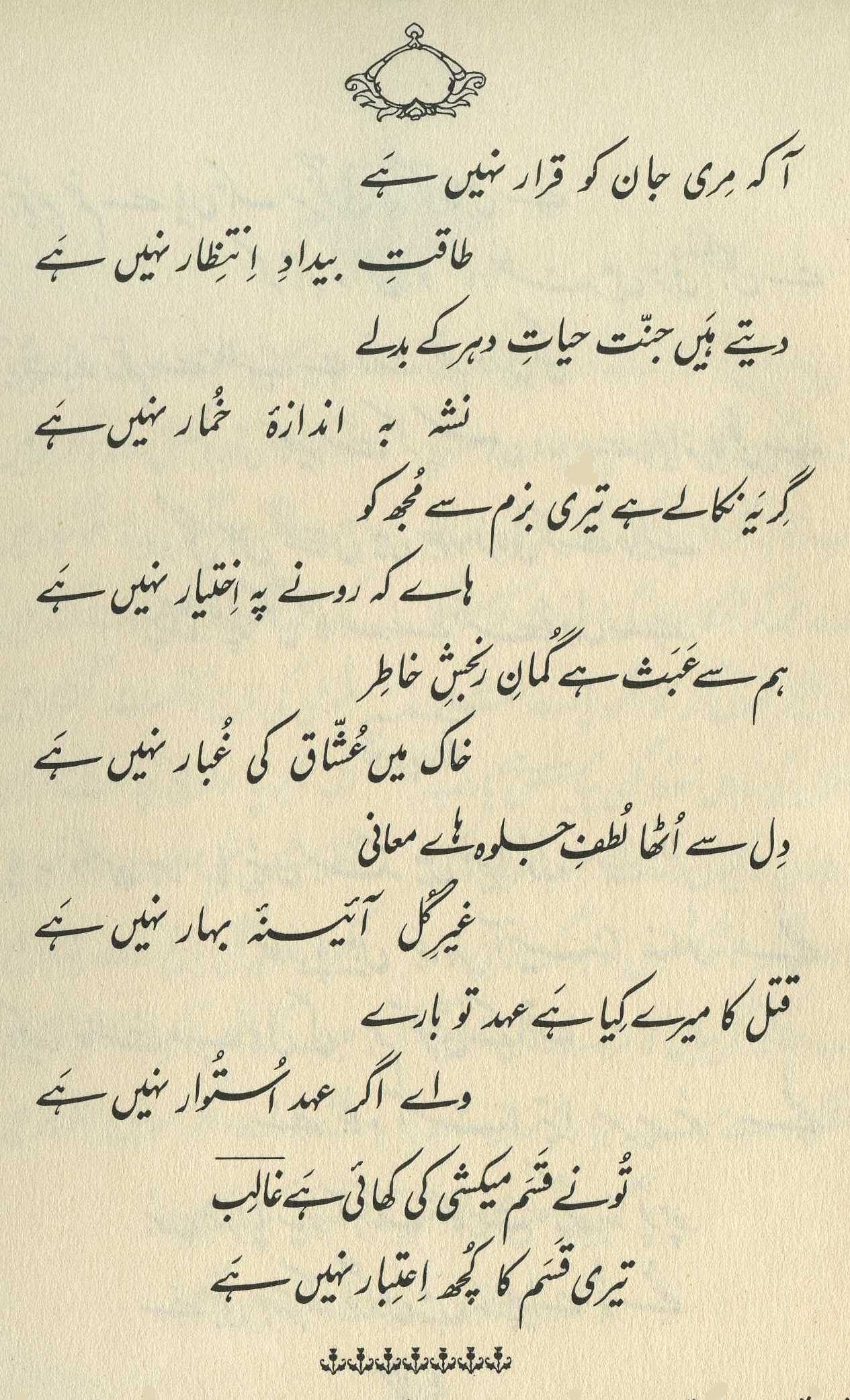
Verse 61821aarnahii;N hai
G17
1
she's made a vow to slay me, finally
2
alas-- if the vow is not firm!
| References | |
|---|---|
| Arshi, Imtiyaz Ali | Ghazal# 145 |
| Raza, Kalidas Gupta | 348-49 |
| Nuskhah-e-Hamidiyah | 207 |
| Hamid Ali Khan | Open Image |
That is, the beloved has made a vow. (192)
== Nazm page 192

He says, somehow or other, with great difficulty, she has made a vow of slaying me-- that is, she has said, 'We will certainly slay you'. Alas-- if this vow is not strong, then it will be a great cruelty! (247)
The beloved has indeed taken a vow to slay me (to kill me with airs and graces). But alas-- if she doesn't fulfill the vow, then what? That is, in this verse two mood s can be seen. (334)
Bekhud Mohani calls this a verse of 'two moods', but they're so complex and convoluted that there could be one, or three, or some permutation thereof. For the lover's wishing the beloved to slay him and finish off his wretched life is itself profoundly despairing (he has nothing to live for, since she'll never be his, so he might as well get it over with, as in 20,1 )-- and also profoundly hopeful (what could be more ecstatically and mystically blissful than not only to die, but to die for her, and at her behest, and even by her own hand?). Thus her vow is, on the whole, an excellent thing-- something obtained 'finally', probably not as a favor, perhaps just as a caprice, but still long-desired and valuable.
And the poor lover-- the very moment he registers this seemingly auspicious vow, he at once sees the cloud outside the silver lining. Instantly it occurs to him that she might not fulfill her vow-- and instantly he's lamenting, he's miserable. From that one fact, the power of implication enables us to flesh out the circumstances of his life. First, it shows that he knows the beloved, and he knows her utter unreliability when it comes to promise-keeping, so that to hear her is to disbelieve her. Second, it shows that his life is so miserable that even the thought of losing his escape-hatch plunges him into grief. Third, it shows that bleakness and despair is his habitual mental climate-- even when he gets good news, he at once assumes that it can't be true. Fourth, it shows how worn-down and passive he is-- if she won't slay him, he seems quite unable to think of any other way to get the job done. All this, in scarcely more than a dozen very simple words-- but Ghalib manages to charge them, through the clever use of speech, with complex and contradictory emotions.
For a continuation of the discussion of oaths and trustworthiness, see the next verse, 170,7 . For a more famous (and much wittier) use of vows and their 'firmness', see 20,3 .
graphics/sword.jpg