Verse 31821aarnahii;N hai
G17
1
weeping sends me out of your gathering
2
alas, that there's no control over tears!
is an archaic variant of ( GRAMMAR )
| References | |
|---|---|
| Arshi, Imtiyaz Ali | Ghazal# 145 |
| Raza, Kalidas Gupta | 348-49 |
| Nuskhah-e-Hamidiyah | 207 |
| Hamid Ali Khan | Open Image |
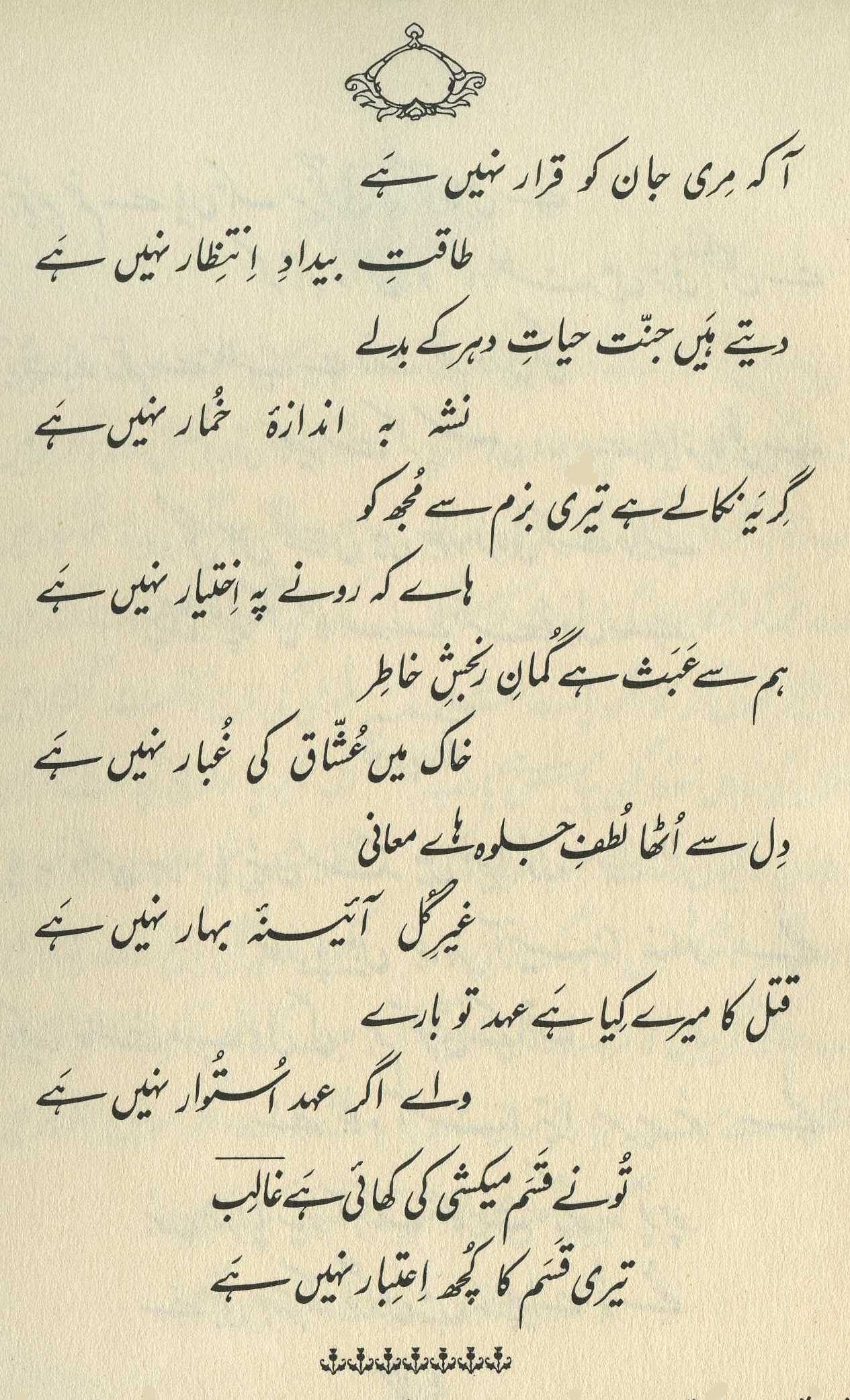
This meter [] is not among the familiar ones. For this reason, the calligrapher has drawn the first line into a familiar meter, and in all the manuscripts has written . But in this there's the problem that the second foot should have been ; instead, it becomes . It's necessary that the author would have written . And in this case the meter remains established, so that the final would be shortened, and the medial one would remain long. (191)
== Nazm page 191

My weeping sends me out of your gathering. Alas, that I don't have control over the turbulence of the weeping! Otherwise, I wouldn't have wept, and I wouldn't have been sent out.
[Or:] My tears don't stop; for this reason I leave the gathering, so that the secret of passion would not be disclosed.
[Or:] The lover is weeping, and the beloved, out of irritation or fear of the disclosure of the secret, has sent him out. Now he mourns: 'Alas, I don't manage even to weep'. (333-34)
Now let's turn to the meaning. What the commentators have written is very fine. I simply want to add one or two additional points. There's no control over weeping; that is, tears keep emerging. The result of the coming out [] of the tears is that I am being forced to come out [] from your gathering. That is, I have no control over the tears, but I am in the control of the tears-- and that too in such a way that when they come out, then I too come out.
Then, the thrust of 'I have no control over weeping' is to suggest that I have no control over weeping, but I have control over something else. That thing can only be my coming out []. But that too is not in my control, because it's this weeping itself that is sending me out of your gathering. If I had control over the tears, then I would send them out [], the way they have control over me and are sending me out. But if I sent out, then they would become apparent, and the result would again be that I would be forced to leave the gathering. It's a fine verse.
== (1989: 296) 2006: 319-21 )
This verse is the first one so far (and probably the last) in which I part company with Arshi. In the manuscripts and early sources, 'your' in the first line is spelled (with no medial ), and that's how Arshi faithfully gives it. However, by modern orthographic standards, that doesn't scan, and it should unquestionably be (the standard spelling, with the medial ). I've decided just to render it in the modern standard style, to make the line scan. I'm all the more comfortable doing this since Ghalib himself generally adheres pretty faithfully to scansion-reflecting orthography; this verse is a rare exception.
Faruqi does a good job on the subtleties of the intransitive and its transitive counterpart , and the nuances of leaving/emerging versus expelling/sending out, for lovers and tears. (But I really can't think of it as 'a fine verse'.) I can hardly think of anything else to say about the verse or its interpretation.
Note for meter fans: Why is the line given in a non-scanning form? Nazm argues that it's because the meter is a relatively rare and unfamiliar one (which indeed it is). It sounds abrupt, odd, and counterintuitive to anyone used to the more common metrical patterns. So he concludes that the calligraphers-- all of them-- have unconsciously (?) altered the spelling to make the scansion at that point sound like that of a more common meter. Of course, there are other cases in which they haven't altered the spelling, so why this one in particular? Maybe one early calligrapher did so, and the rest unconsciously copied his (mis)reading since it 'felt' right (even though it prevented the line as a whole from scanning). Anyway, it's quite implausible to think that Ghalib composed a non-scanning line and left it that way through four editions of the divan ; so whatever the orthographic issues may be, the actual pronunciation of (= -) is clear enough. If you want to pursue the question further, Faruqi in his discussion of this verse also provides a much longer and more detailed consideration of all the orthographic issues involved, and of different manuscripts with different spellings for different verses, and so on.
graphics/weeping.jpg