Verse 11833aabhii nah sakuu;N
G5
In this meter the first long syllable may be replaced by a short; and the next-to-last long syllable may be replaced by two shorts.
1
become kind/gracious and call me, at whichever time you might choose/want
2
I’m not passed/'gone' time, that I couldn't even/also come again
'Loving, affectionate, friendly, kind, benevolent, beneficent, favouring, indulgent, gracious, propitious; compassionate, merciful; —s.m. A friend'.
'To wish, desire, will; to want, demand, require, need; to be inclined to; to tend to; to be about to (with perf. part. of following verb); to intend; to like, love, be enamoured of; to choose, approve'.
| References | |
|---|---|
| Arshi, Imtiyaz Ali | Ghazal# 105 |
| Raza, Kalidas Gupta | 381 |
| Hamid Ali Khan | Open Image |
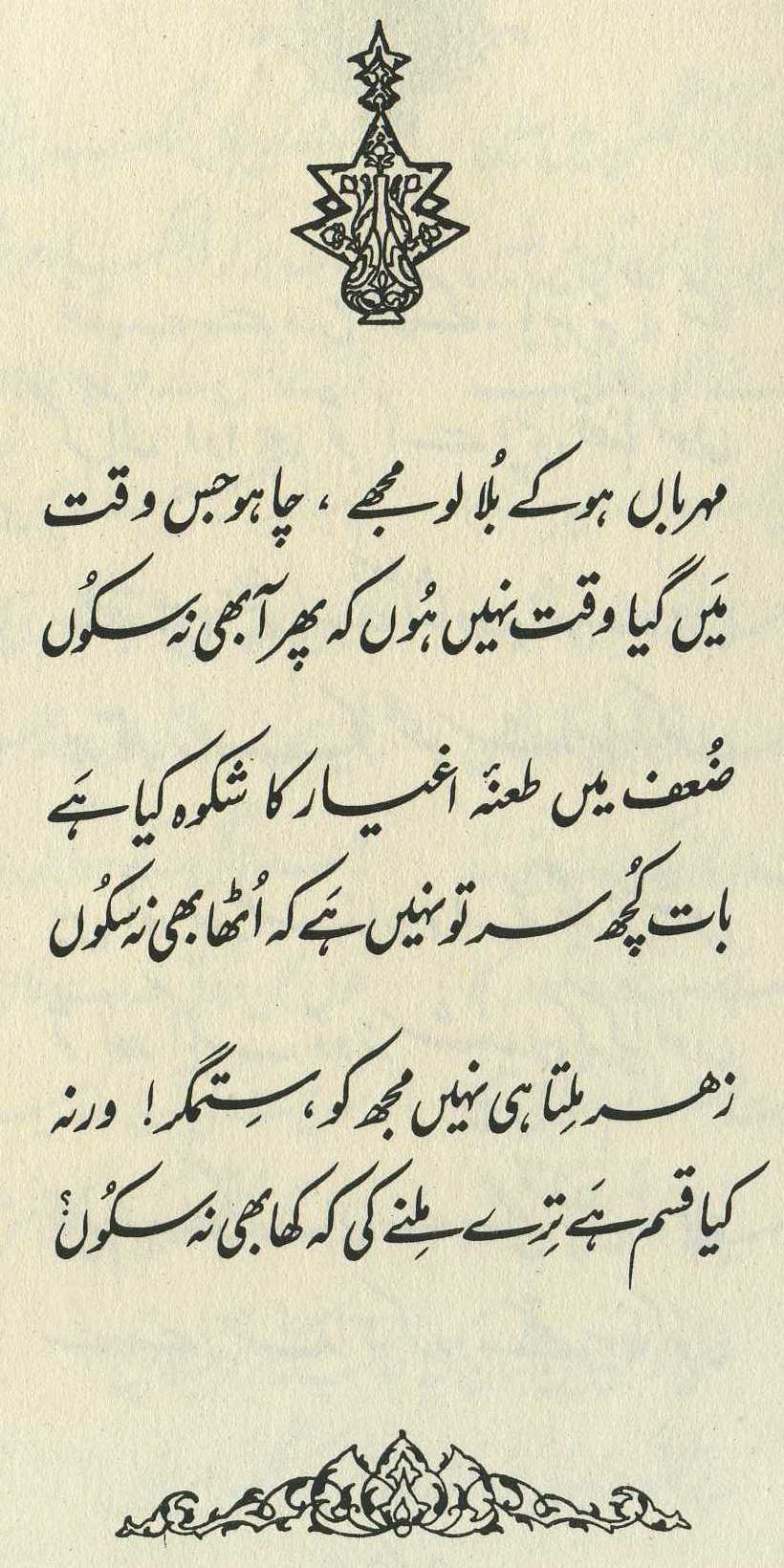
In all three of these verses there is the verbal device of one verb participating in two meanings. For this reason similitude has been established, but here the cause of similitude is not, as in the case of 'Khizr' [which literally means 'green'] and 'greenery', a merely verbal participation. For this reason these verses are very eloquent []. Momin Khan too has done a lot in this manner, and in a lament [] has composed a stanza in this pattern .
Atish , as well, has a verse with this verbal device that is very famous.
[the heart does not have a madness such that I will control myself
like a tight garment, I will burst open]. (88)
== Nazm page 88

He says, after a little bit of grief, don't consider that I have become vexed forever. No, it's not like this. Become kind, and call me at whichever time you want. I am not passed time, that I would not be able to come again. (139)
These verses are extremely refined and heart-stealing.... When you graciously call me, I am at your service. I am not passed time, the coming of which would be impossible. That is, it is still within my power; it's possible that in the future it might not remain in my power-- that is, after death. (182)
[Arshi provides extensive notes on this history of this ghazal in the section, pp. 411-19.]
It is worth noting that in the first line both and occur in related clauses and also share a common meaning, i.e., love. is derived from , love; while is from the verb which also means 'to love'. (Naim 1972, 20)
This is one of only a handful of ghazals from which Faruqi has selected every single divan verse as superior.
Bekhud Dihlavi labels this ghazal as a ' verse-set ' (p. 139), but he's the only one to do so, and in fact it's not a persuasive candidate for the label. Still, his impulse is understandable. These three small verses share a remarkably long refrain , and also-- as Nazm points out-- a common rhetorical device. In all three verses, this device takes the form of suggesting a transference or 'sharing' of the verb in the second line. This device is potent but also limited-- and surely limiting as well; it's not surprising that this ghazal is so short, and has neither an opening-verse nor a closing-verse .
In this verse, the 'sharing' consists of the transference of 'would not be able to come again' to 'passed time'. Strictly speaking, the grammar of the line doesn't tell us that passed time can't come again. But the structure works so naturally and unforcedly that nobody can possibly read the line without making the connection: 'I'm not passed time (which can't come again), [such] that I can't come again'.
Just to emphasize the point about time, the word is used twice-- in the first line to describe the beloved's powerful access to time (she can summon the lover whenever she wishes), in the second line to make the contrast: he can come again, past time can never come again.
Or rather, for another clever example of affinity, 'gone' [] time can never 'come' again. And as Naim observes, strongly suggests not just the beloved's being invited to call the lover anytime she would 'want', but also the hope that she will indeed 'want' to do so.
Doesn't this verse also somehow feel unusually translatable?
graphics/timedali.jpg