Verse 21833aabhii nah sakuu;N
G5
In this meter the first long syllable may be replaced by a short; and the next-to-last long syllable may be replaced by two shorts.
1
in weakness, what complaint is there of the Other s’ taunts?!
2
an utterance is not some head, that I couldn't even bear/'lift' it
'To lift, take up, raise, raise up, elevate, hoist; ... to support, bear, carry; to take upon oneself, bear the burden or responsibility of, undertake; to undergo, experience, suffer, endure'.
| References | |
|---|---|
| Arshi, Imtiyaz Ali | Ghazal# 105 |
| Raza, Kalidas Gupta | 381 |
| Hamid Ali Khan | Open Image |
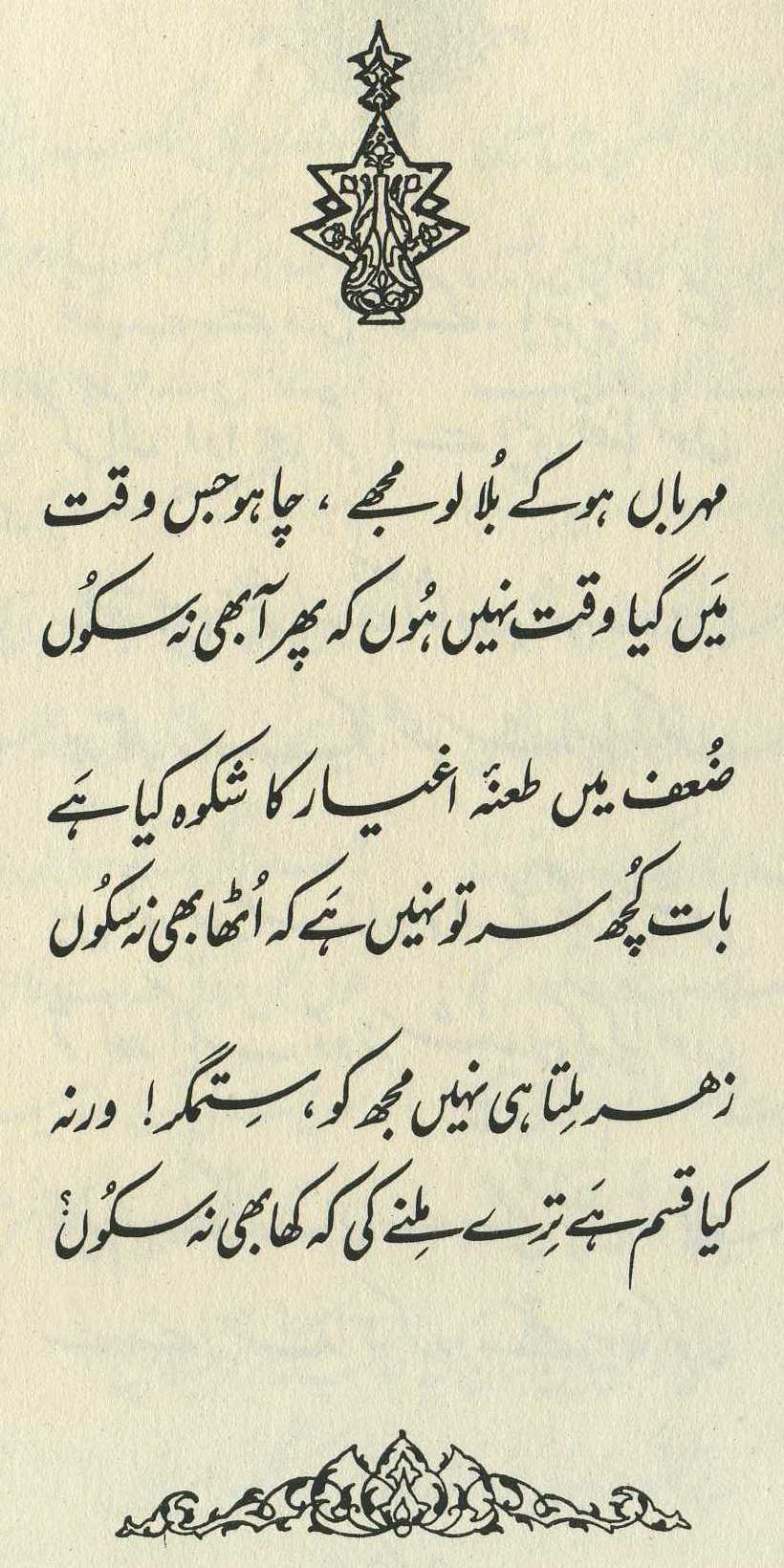
== Nazm page 88

He says, in the state of weakness, while I am complaining about the Others' taunts, why are you afraid? In the state of weakness, I can endure them. Your words are not my head, which because of weakness I can't lift up. (139-40)
When I am in a state of weakness, let the Rival s make whatever taunts they might wish. I will endure them all. To lift up [] my head is impossible for me, but a remark can be borne/sustained []. This verse seems to tell us the extremity of the Rivals' baseness and pitilessness and enmity, that they throw taunts at such a weak and feeble and oppressed one. (182)
: To be unable to lift the bowed head, out of shame; for the head to remain lowered under the burden of gratitude. Under the burden of shame, or gratitude, my head cannot be lifted. A taunt is only a word, which is not hard to endure-- especially since there is weakness also. (358)
Some general comments about this ghazal appear in 89,1 .
The chief charm of this verse is the same trick described and illustrated in the discussion of the previous verse: 'A word is not some kind of head (which I can't 'lift'/bear), that I can’t 'bear'/lift it'. The line officially tells us that the speaker is able to sustain/bear [] words, even if they're abusive; in the interstices of the grammar, we learn that the speaker, in his weakness, can't hold up [] his head. We can't do quite the same trick in English in this particular case, but we can do it in many similar ones: we could say 'A wineglass is not my heart, that it can't be lifted'.
Mahmood Piracha adds (Jan. 2021): 'There's an Urdu expression which means to bear the taunts of others. This is an accepted expression and I think warrants mention.'
The idiomatic force of in the phrase is almost impossible to convey in translation; 'some ' was the best I could come up with. The absence of the possessive pronoun (in English we'd say 'my head') is not conspicuous in Urdu, though it certainly works well in this verse, as further showing the speaker's detachment and indifference.
The lover's being too weak to hold his head up is no surprise; see 32,2 for an example. Very possibly this weakness is what the Others are taunting him about-- and he finds himself too weak even to resent their taunts.
graphics/headonknees.jpg