Verse 8after 1821aalkahaa;N
G8
In this meter the first long syllable may be replaced by a short; and the next-to-last long syllable may be replaced by two shorts.
1
the strengths/powers became weak/loosened/exhausted, Ghalib
2
that balance/equilibrium in the elements-- where?!
'Disappearing, vanishing; vanished; —cancelled; defaced; —removed, cleared off, carried off, scattered, dispersed; —loosened, untied, undone; —shaky; weak, feeble; exhausted, fatigued'.
'(pl. of ) Powers, virtues, &c.'.
'Temperateness, moderation; evenness, equilibrium; symmetry; the happy mean (in quantity or quality); frugality, temperance, sobriety; a state (of health, &c.) in which the four humours are well balanced, sound health'.
| References | |
|---|---|
| Arshi, Imtiyaz Ali | Ghazal# 96 |
| Raza, Kalidas Gupta | 294-95 |
| Asi, Abdul Bari | 162-163 |
| Gyan Chand | 302 |
| Hamid Ali Khan | Open Image |
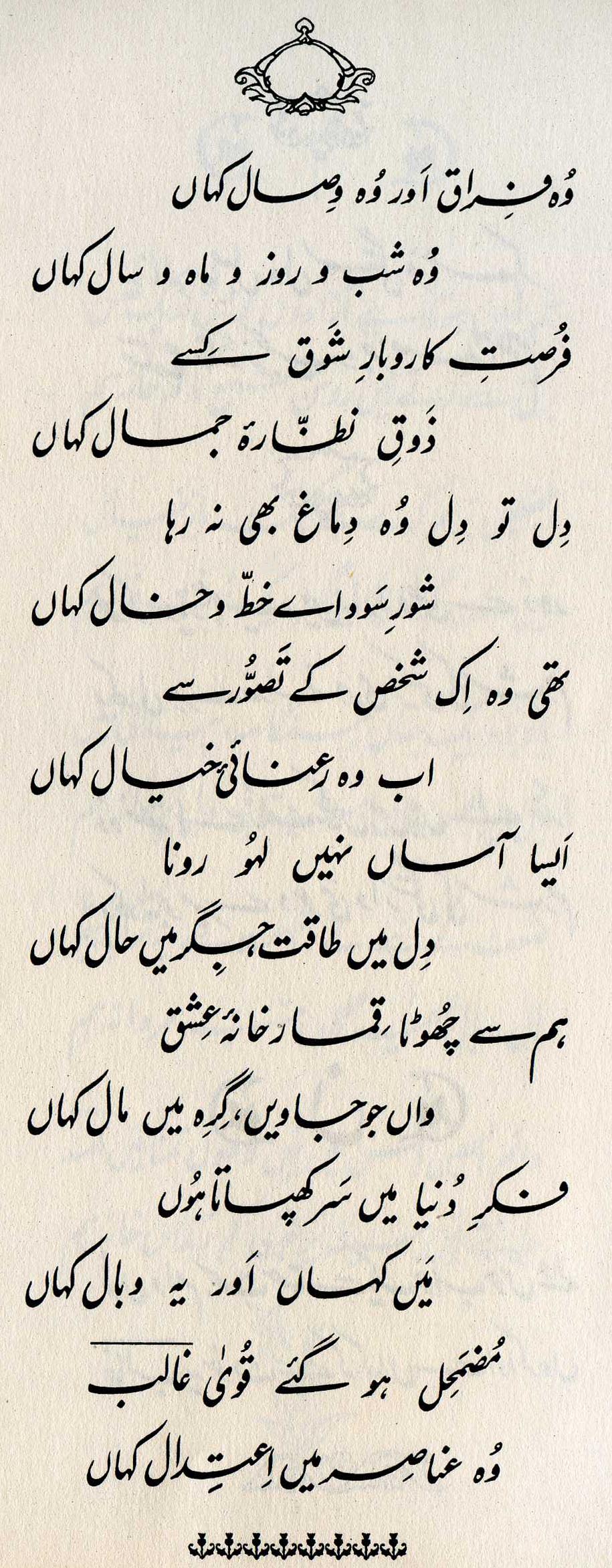
[1866?, to Zaki:] My kind friend, in the Persian language the writing of letters had already been renounced []. From the onslaughts of old age and weakness, the strength for laborious scrutiny and liver-utilization have not remained in me. The vital warmth is in decline, and this is the state: {85,8}. (Arshi 224)
==Urdu text: Khaliq Anjum vol. 2, p. 842
==trans.: Daud Rahbar p. 272
[c.1867, to Zaki:] The truth is that in composition and writing, that power over the faculty of speech has not remained. In the temperament that pleasure, in the head that madness-- where? None of the mastery [] of fifty or fifty-six years of practice [] has remained. For this reason, in the art of composition I [merely] converse. As for what remains of the senses, the proof is this verse of mine: {85,8}. ==Urdu text: Khaliq Anjum vol. 2, p. 828
[c.1867, to Zaki:] The truth is that in composition and writing, that power over the faculty of speech has not remained. In the temperament that pleasure, in the head that madness-- where? None of the mastery [] of fifty or fifty-six years of practice [] has remained. For this reason, in the art of composition I [merely] converse. As for what remains of the senses, the proof is this verse of mine: {85,8}. ==Urdu text: Khaliq Anjum vol. 2, p. 828
By 'balance of elements' is meant 'youth'. (84)
== Nazm page 84

He says, the time of youth has passed. Now where has the time of balance remained? The interval of youth is now finished. The strength/powers have begun to decline. (134)
Oh Ghalib, the strengths/powers have become weak, and no youthful kind of balance has remained in the elements. That is, youth has gone and has taken the strengths/powers with it. (173)
Some general points about this whole gazal have been made in 85,1 .
The strengths/powers have lost their strength/power. Now there's nothing but weakness. It's not that strength used to be unlimited. But there used to be a sense of balance, of harmony, of the powers and forces and humors of the body working smoothly together. (The four humors, and their balance, are of course defining elements of the Greco-Islamic medical theory with which Ghalib was very familiar.) Now where is all this balance and harmony? Now it's all gone-- gone where?
All this nostalgic awareness of the past is conveyed to us through the verb , 'became', and above all through the little adjectival , 'that'. There's a kind of pathos and lament here, but also a kind of mystery. After all, where indeed do the powers of youth go, when they're gone? But then, of course, where are the snows of yesteryear? And where does the music go, when the orchestra stops playing?
Just to make things more piquant, this whole ghazal was composed when Ghalib was in his twenties. So this verse is not only non-autobiographical, in the normal classical-ghazal way, but actually anti-autobiographical. For more on the problems of 'natural poetry' readings, see 66,1 .
graphics/fourhumors.jpg