Verse 3after 1821aalkahaa;N
G8
In this meter the first long syllable may be replaced by a short; and the next-to-last long syllable may be replaced by two shorts.
1 a
not to speak of the heart-- even/also that spirit/'mind' did not remain
1 b
a heart is a heart [after all]; even/also that spirit/'mind' did not remain
2
the tumult of the madness of down [on the cheek] and beauty-spot-- where?!
'The brain; head, mind, intellect; spirit; fancy, desire; airs, conceit; pride, haughtiness, arrogance; intoxication; high spirits'.
t:t>> : 'A line, a streak, or stripe, a mark; lineament;—writing, character, handwriting chirography; a letter, epistle;—down on the face, incipient beard, &c.; beard; moustaches'.
'A black mole on the face (regarded as ornamental); a spot, patch (natural); an artificial spot (made of , &c., for ornament, or to ward off the effects of the malignant eye)'.
| References | |
|---|---|
| Arshi, Imtiyaz Ali | Ghazal# 96 |
| Raza, Kalidas Gupta | 294-95 |
| Asi, Abdul Bari | 162-163 |
| Gyan Chand | 302 |
| Hamid Ali Khan | Open Image |
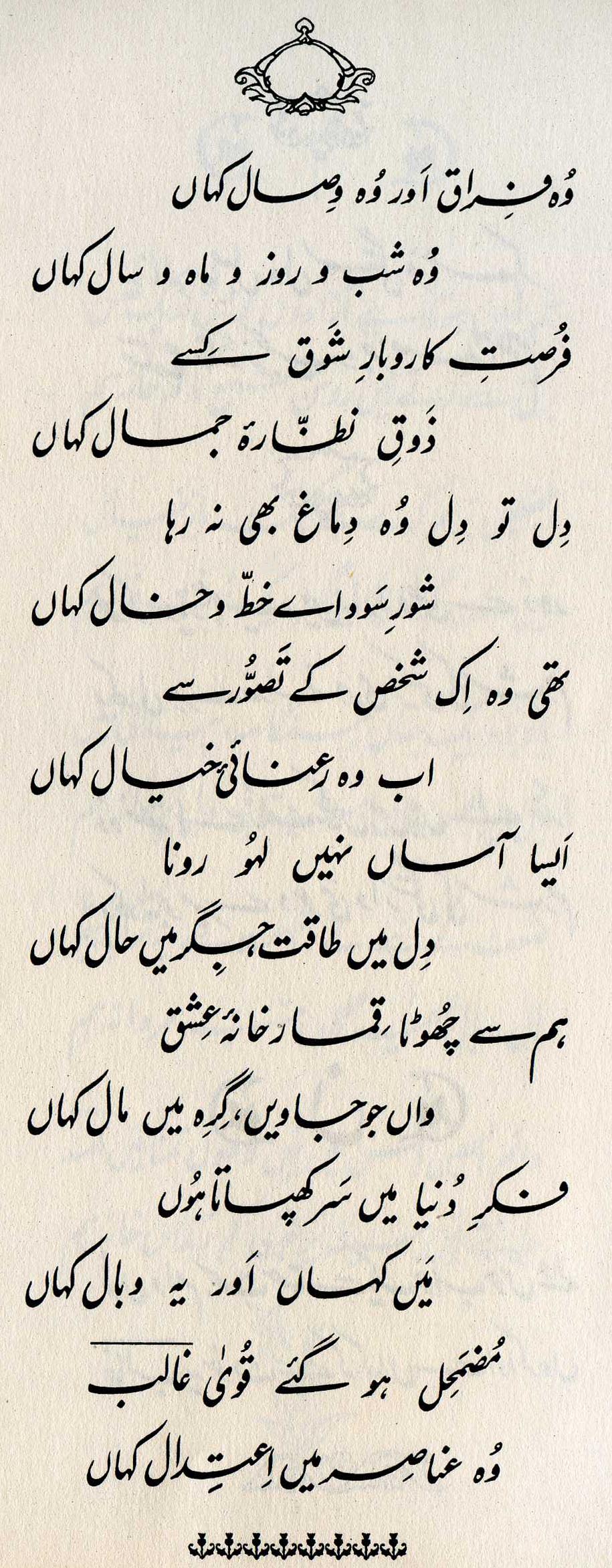
== Nazm page 83

He says, 'That heart in which passion built up-- if it got erased, then let it go []. But the sad thing is that that mind too did not remain, which felt madness for down [on the cheek] and mole.' (133)
Not to even mention the heart []-- now that mind itself has not remained what it used to be. When this is how things are, then how can the madness of passion remain? (218)
He says, 'Leaving aside the heart []-- not even that mind has remained, which used to be filled with the madness of somebody's down [on the cheek] and mole.' (170)
Some general points about this whole gazal have been made in 85,1 .
In this verse, Ghalib once again plays with an idiomatic construction. The first words of the verse, , have a colloquial sense something like 'not to speak of the heart' or 'leaving aside the heart [as a less significant case]'. This meaning (1a) can be seen in all three commentators' paraphrases.
But then, two ways to read it can easily be envisioned. Does 'not to speak of the heart' or 'leaving aside the heart' imply that the heart is of so little value that we brush it aside and hasten to the really important loss, the mind? Or does it imply that the loss of the heart is so expected and inevitable, and/or so far beyond words, that rather than even attempting to address it the only thing to do is to pass on to note with surprise that the mind is gone too?
In the second line we see the verse's obsession with passion, even with madness, and its final question-- where? Where is this 'tumult of madness'? Is this a rhetorical question, meaning that the 'tumult of madness' is now nowhere? Or is it an exclamation of amazement-- now that the lover is without heart and mind, how can he still be feeling this radical 'tumult of madness'? Or is it a philosophical question: if heart and mind don't exist, where would the 'tumult of madness' take place, where would it go to establish itself? Since there's no verb in the second line, both 'is' and 'would be' are quite available for us to imagine.
And when we look back at the first line, looms much larger and looks more mysterious. Its literal meaning also swims to the surface (1b). 'If it's a heart, then it's a heart'; 'when it's a heart, then it's a heart'; 'a heart is a heart, after all'. The heart, rather than the mind, feels like the center of the loss after all. Compare 'it's a heart, after all' [] in 115,1 .
The 'down on the cheek' generally suggests that the beloved is an adolescent boy; for more on such verses, see 9,2 . But the mention of the 'beauty spot' suggests that here it might also be considered to describe the soft down on the cheek of a woman.
ABOUT : The 'beauty spot' could be something natural, like a small dark mole or birthmark; but it could also be applied in a carefully chosen place, as a form of adornment that would focus the viewer's attention and avoid the risk of blandness or monotony. In South Asia, such seem mostly to have been placed on the cheek, and particularly somewhere near the corner of the mouth. Other examples of : 129,3x ; 145,8x .
This kind of adornment was of course quite distinct from the , the auspicious (and/or devotional, and/or cosmetic) mark placed by many Hindu women in the center of the forehead, directly above the eyebrows. Though this mark too can be quite elegant and even elaborate; I have seen large multicolored ones that match the wearer's sari. For a verse in which Mir seems almost to conflate the two kinds of spot, see M 485,5 .
graphics/khaal.jpg
graphics/tilak.jpg