Verse 4after 1821aalkahaa;N
G8
In this meter the first long syllable may be replaced by a short; and the next-to-last long syllable may be replaced by two shorts.
1
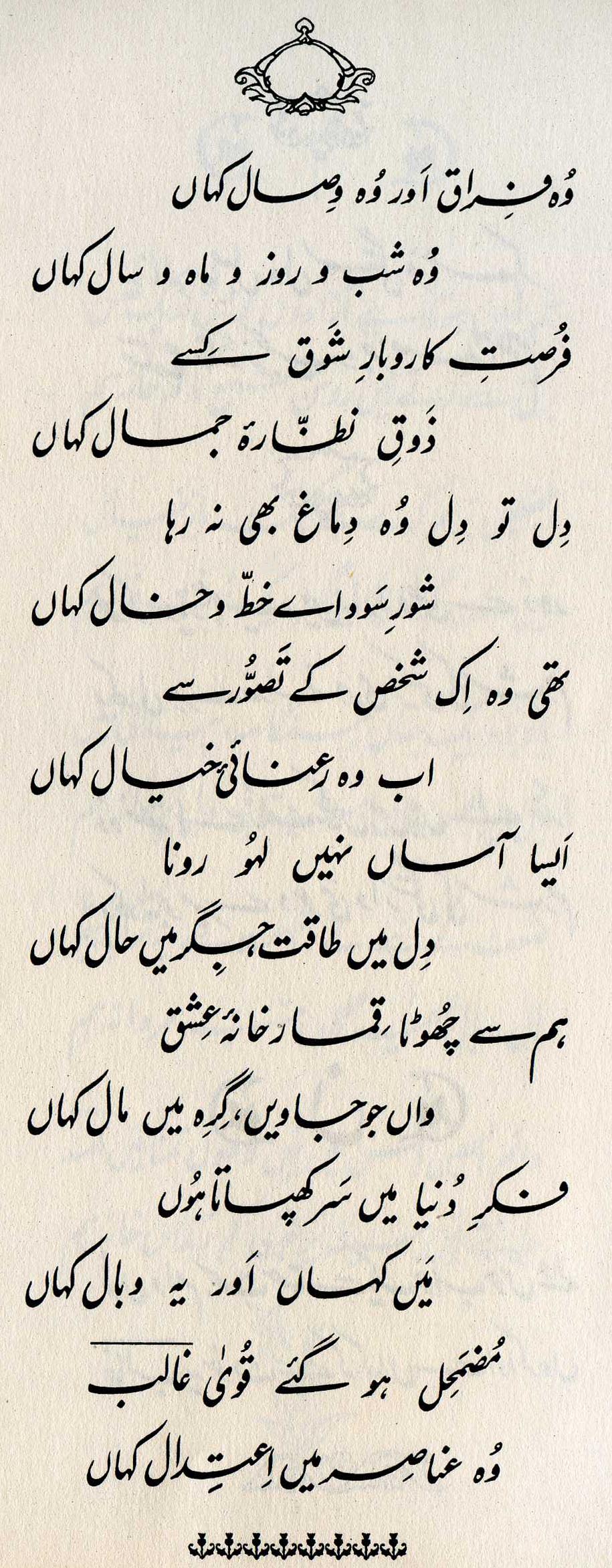
it/'that' was from the imagining of a single/particular/unique/excellent individual--
2
now, that gracefulness of thought-- where?!
'Imagine or picturing (a thing) to the mind; imagination, fancy; reflection, contemplation, meditation; forming an idea; idea, conception, perception'.
'Gracefulness of motion, graceful gait; grace, loveliness, beauty'.
| References | |
|---|---|
| Arshi, Imtiyaz Ali | Ghazal# 96 |
| Raza, Kalidas Gupta | 294-95 |
| Asi, Abdul Bari | 162-163 |
| Gyan Chand | 302 |
| Hamid Ali Khan | Open Image |
Here, the phrase is very eloquent []. If instead of it he had said [one mischievous one], then praise of the beloved would have emerged and it would have been clear that relish and ardor are still left, so that he has constructed the beloved in those words. And this would have been contrary to the claim of his situation. (83-84)
== Nazm page 83 ; Nazm page 84


All these things that have been mentioned above [in the preceding verses] were from the imagining of one individual. Now where do the high-flyingness and colorfulnesses of thought remain? (133)
The tyranny of old age, the cruelty of the circumstances of earning a livelihood, and the oppression of sad-heartedness have been shown in this verse. (173)
Some general points about this whole gazal have been made in 85,1 .
The verse makes a then/now contrast, with the first line describing the past and the second line, the present. But the two lines are welded together; although technically each could be read separately, there's no way we could tell what in the first line referred to (or what feminine noun was agreeing with) until we heard .
And in fact dominates the whole verse. It's such a graceful-sounding word in itself, and its long sounds (since the here sounds like ) almost demand to be prolonged and caressed. Then the effect is enhanced by the long sounds of and . This sensuous flowingness is especially marked since it follows the notably consonant-heavy, short-vowelled set of , , and in the first line.
It's also clear that this , this 'graceful movement of thought', is internally generated-- it's not attributed to the beloved's beauty, but to the , the 'imagining' or 'image', of 'one individual'. Nazm makes an excellent point about this phrase: that saying merely conveys an air of detachment appropriate to a former lover marvelling at the loss of his long-ago passions of the mind.
There's of course another possible interpretation of -- it could refer not to the beloved at all, but to the lover himself. On this reading, the ex-lover is explicitly marvelling at his own imaginative powers-- how was it possible for a single individual's imagination to create such 'graceful movement of thought' as his impassioned imagination used to create, and where is all that grace now? This kind of ambiguity of the possessive is pervasive in Urdu-- is 'your thought' in your head, or in my head (='the thought of you')? For discussion and examples, see 41,6 .
graphics/beloved.jpg