Verse 7after 1821aalkahaa;N
G8
In this meter the first long syllable may be replaced by a short; and the next-to-last long syllable may be replaced by two shorts.
1
in worry/anxiety about the world I 'exhaust/ruin the head'
2 a
how can I and this curse/ruin be equal/compared?!
2 b
I am-- where?! and this curse/ruin-- where?!
'Where (this) — where (that)?; how distant or how different is (this) from (that)! how little is (this) consistent with that! (e.g. ; — cf. Pers. )'.
'An unhealthy climate or atmosphere; --anything painful or distressing; bane, pest, plague; --a crime, sin, fault; --punishment (for a crime); divine vengeance; curse; misfortune; ruin'.
| References | |
|---|---|
| Arshi, Imtiyaz Ali | Ghazal# 96 |
| Raza, Kalidas Gupta | 294-95 |
| Asi, Abdul Bari | 162-163 |
| Gyan Chand | 302 |
| Hamid Ali Khan | Open Image |
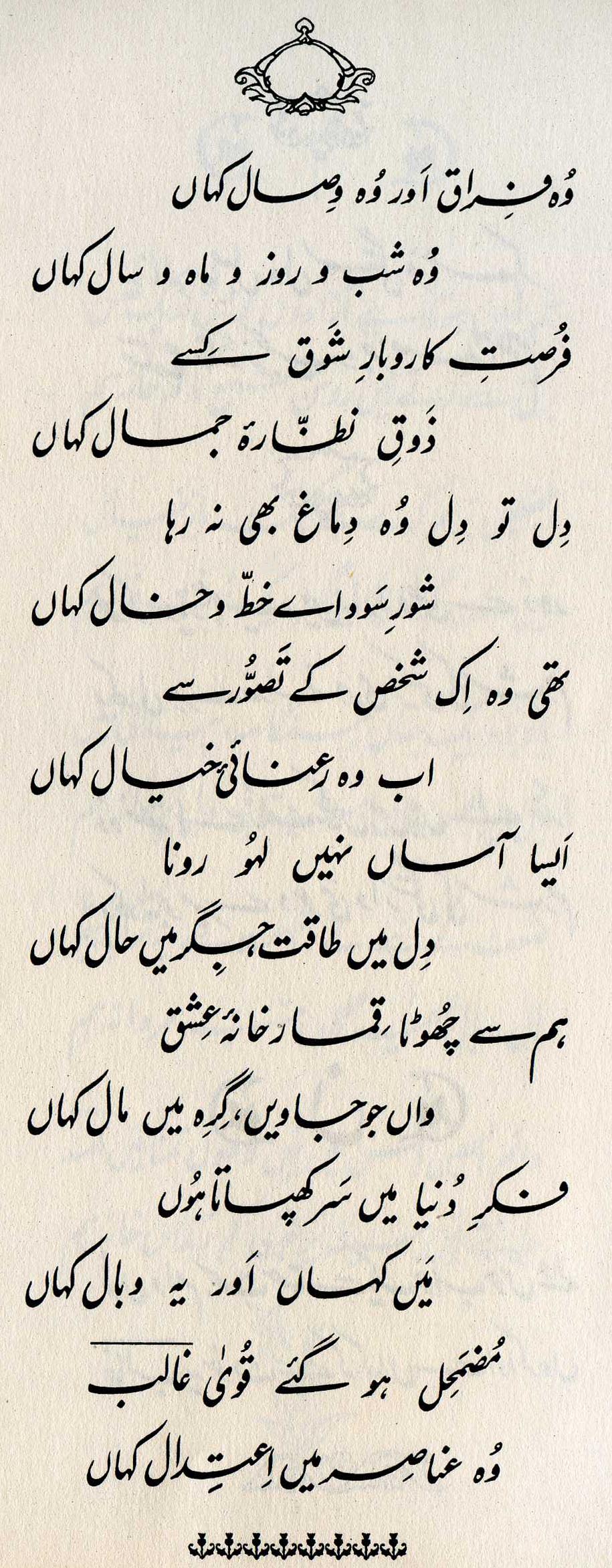
That is, there was a time when I had no relationship at all with any worldly cares or concerns. (84)
== Nazm page 84

He says, 'I was a slave of passion; I was involved with the grief of passion. I used to endure the difficulties of separation, I used to enjoy the pleasures of union. What did I have to do with the grief of the world? What did I consider that curse/ruin to be?' (134)
Now I am, and the worry about livelihood []. Where am I, and where this snare! He expresses the movement of the time, and his own oppression. That is, he shows the disrespect of the people of the world; and if things were not like this, then why would a free one like me become involved in these quarrels? (173)
Some general points about this whole gazal have been made in 85,1 .
This verse makes excellent use of the idiomatic pattern (see the definition above), where the point is that the two items are radically incommensurable-- how could they even be mentioned in the same breath? The famous proverb ['Where [is] Raja Bhoj, where [is] Gangu the Oil-presser?!'] comes to mind: it expresses the extremes of the social system, with its two ends that cannot be imagined as meeting. For another example of this usage, see 219,9 ; for a Persianized instance, see 349x,2 .
Here, as so often, Ghalib uses an idiom in an unexpectedly complex way. Consider some of its possibilities:
=How can the speaker, a former lover, have fallen so low as now to immerse himself in worldly worries? He should instead be experiencing the grief of passion, which is his only proper concern.
=How can the speaker, a helpless and hapless type with no resources, possibly cope with the manifold practical difficulties of making a living in the real world?
=The speaker's perpetual worry and anxiety is what really wears him down. He exhausts his brains with all this self-torment about life in general. How can his mind endure the ruinous burden of such constant anxiety and distress?
In other words, the flexibility of the idiom makes possible three quite different readings of the nature of the ex-lover's suffering. It might be due to shame at his personal history, to practical difficulties in the world, or to psychological self-torment. (Or, of course, all of the above.)
And the nature of the idiom also makes us ask about the relation between self-inflicted and external kinds of ruin. To 'exhaust one's head', , is a form of ruin that both is self-generated (since one does it to oneself), and is not self-generated (since outside factors bring it about). So the speaker may well ask, 'Where am I, and where is this , this curse/ misfortune/ burden/ ruin?!' He and it are incommensurable, poles apart, as the idiom makes clear. But obviously he and it are also related fairly intimately. After all, it's the very immediate 'this' curse, not the more usual 'that' one. Is the speaker trapped inside it [], or is it a (mind-generated) part of him? Or, as usual, both at once?
graphics/world.jpg