Verse 91853amnikle
G2
1 a
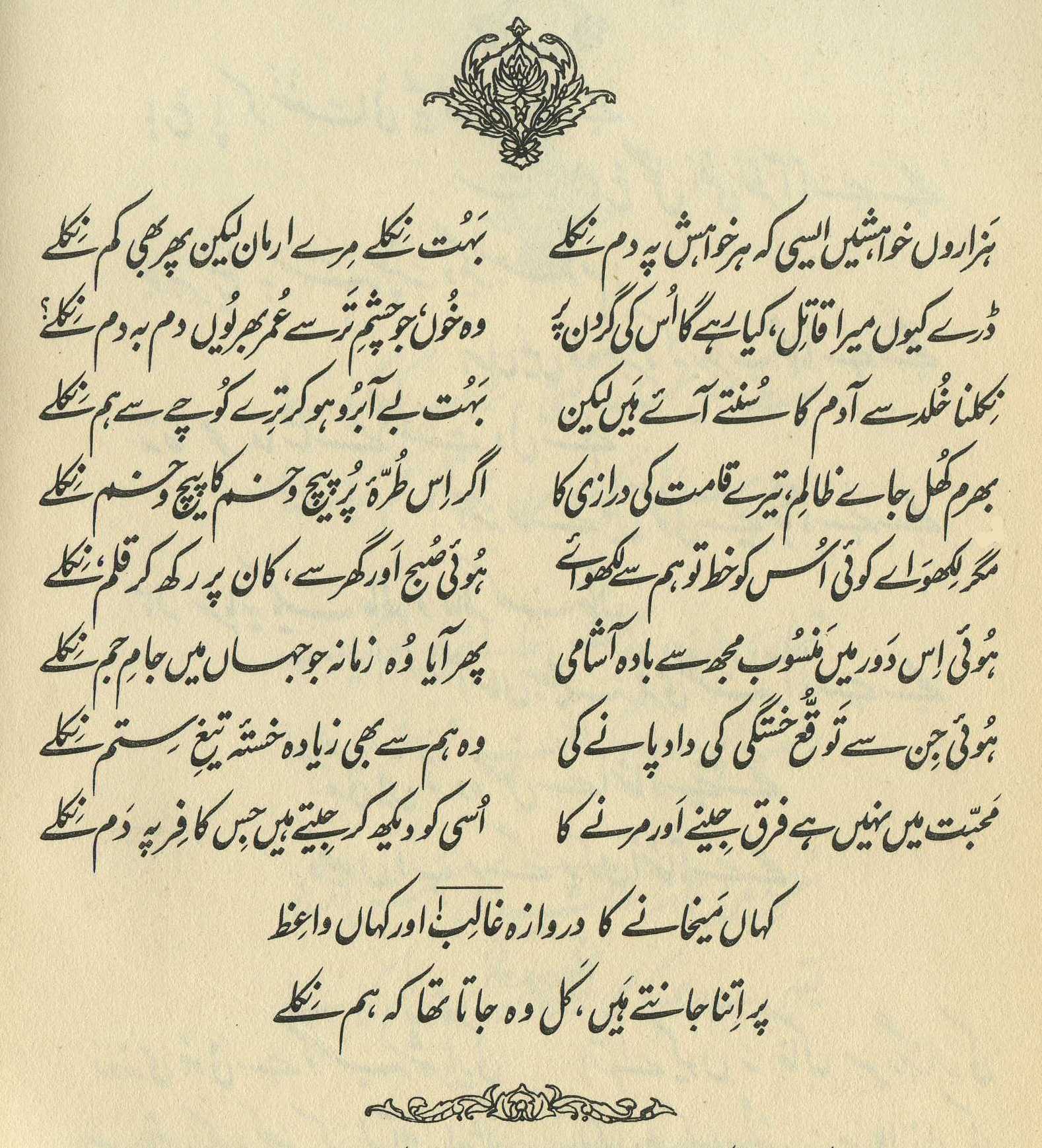
how can the door of the wine-house and the Preacher be compared, Ghalib?!
1 b
'where is the door of the wine-house, Ghalib-- and where is the Preacher ?!'
2
but we know this much: yesterday he went in/by, as/since we emerged
| References | |
|---|---|
| Arshi, Imtiyaz Ali | Ghazal# 230 |
| Raza, Kalidas Gupta | 443-44 |
| Hamid Ali Khan | Open Image |
That is, we too are surprised, but there's no doubt that yesterday when we folks had finished drinking and come out and the crowd left, then finding the coast clear he too went into the wine-house, and we saw him going in. The point is that wine is such a thing that even the Preacher furtively drinks it. (250)
== Nazm page 250

This closing-verse is a 'razor' [= a particularly brilliant verse] among Mirza Sahib's 'razors'. In the expression he uses an extraordinary mischievousness. He says, 'We too are surprised-- for, oh Ghalib, what connection does the Preacher have with the door of the wine-house? But one thing is certain: last night when we emerged from the wine-house, then we saw that the Preacher too was passing by that way.' The enjoyableness in this verse is that it hasn't been said outright where the Preacher was going-- whether into the wine-house, or passing by the wine-house in some other direction. (219)
With great astonishment he says, we don't know what connection the famously virtuous Preacher has with the wine-house, but what happened was that he was just about to set foot inside the wine-house, when we emerged from inside it. That is, we don't have the courage to call the Preacher a wine-drinker. But last night we saw an event that astonished us. The interpretation also emerges that wine is such a thing that people like the Preacher too drink it. (452)
For discussion, and another example, of the idiomatic expression , see 85,7 . Here the idiom works even better than in {85,7}, since the two 'where' questions operate not only for the abstract expression of incommensurability (1a), but also in a seemingly literal locational sense (1b). And perhaps the speaker, on leaving the wine-house, was a bit intoxicated, and thus the disoriented-sounding grammar of (1b) is doubly enjoyable.
Isn't it indeed a sly and irresistible verse? The faux-naïf tone is a treat. Here are some of the possible implication s:
=The Preacher was going openly into the wine-house to drink, just the way the reprobates do!
=The Preacher was going into the wine-house very late and furtively, hoping to remain unnoticed (by everyone, or especially by Ghalib).
=The Preacher had found an excuse to pass by the wine-house, in order to see what was going on there (or to check up on Ghalib in particular), and so Ghalib is entitled to needle him a bit about his voyeurism.
=The Preacher just happened to pass by the wine-house on his way somewhere else, and even that much proximity gives sufficient grounds for teasing him.
The multivalent possibilities of help to open up a range of readings: it can lead to the Preacher's entering 'as' Ghalib emerged (a temporal relationship) or 'since' Ghalib emerged (a causal relationship). But above all, it's the idiomatic that works so vividly here, and opens up even more complex possibilities. Do the wine-house door and the Preacher actually have something in common-- something that the full vigor of the idiom is seeking to deny? And if so, is this something good or something bad, something mystical or something worldly? As so often, the question is arrestingly posed for us, and then we're left there, arrested, to think about it for ourselves.
Faiz, who was a notable Ghalibian, was surely thinking of this verse when he composed this ghazal verse (from 'Dast-e Saba'):
[you yourself say: between the rakish one and the morals-policeman, tonight, is there any such difference?
this one is seated in the wine-house; that one has risen and come out of the wine-house]
graphics/winedoor.jpg