Verse 21853amnikle
G2
1 a
why would my slayer fear? as if it will remain on her neck!
1 b
why would my slayer fear?-- will it remain on her neck?
2
that blood that from wet eyes, life-long, {casually/'like this'}, moment/breath by moment/breath, would emerge
'Thus, in this wise, in this manner; —just so, for no particular reason; without just ground, vainly, idly, causelessly, gratuitously; to please oneself'.
'[Persian] Breath, vital air, life;—a moment, an instant'.
'[Arabic] Blood'.
| References | |
|---|---|
| Arshi, Imtiyaz Ali | Ghazal# 230 |
| Raza, Kalidas Gupta | 443-44 |
| Hamid Ali Khan | Open Image |
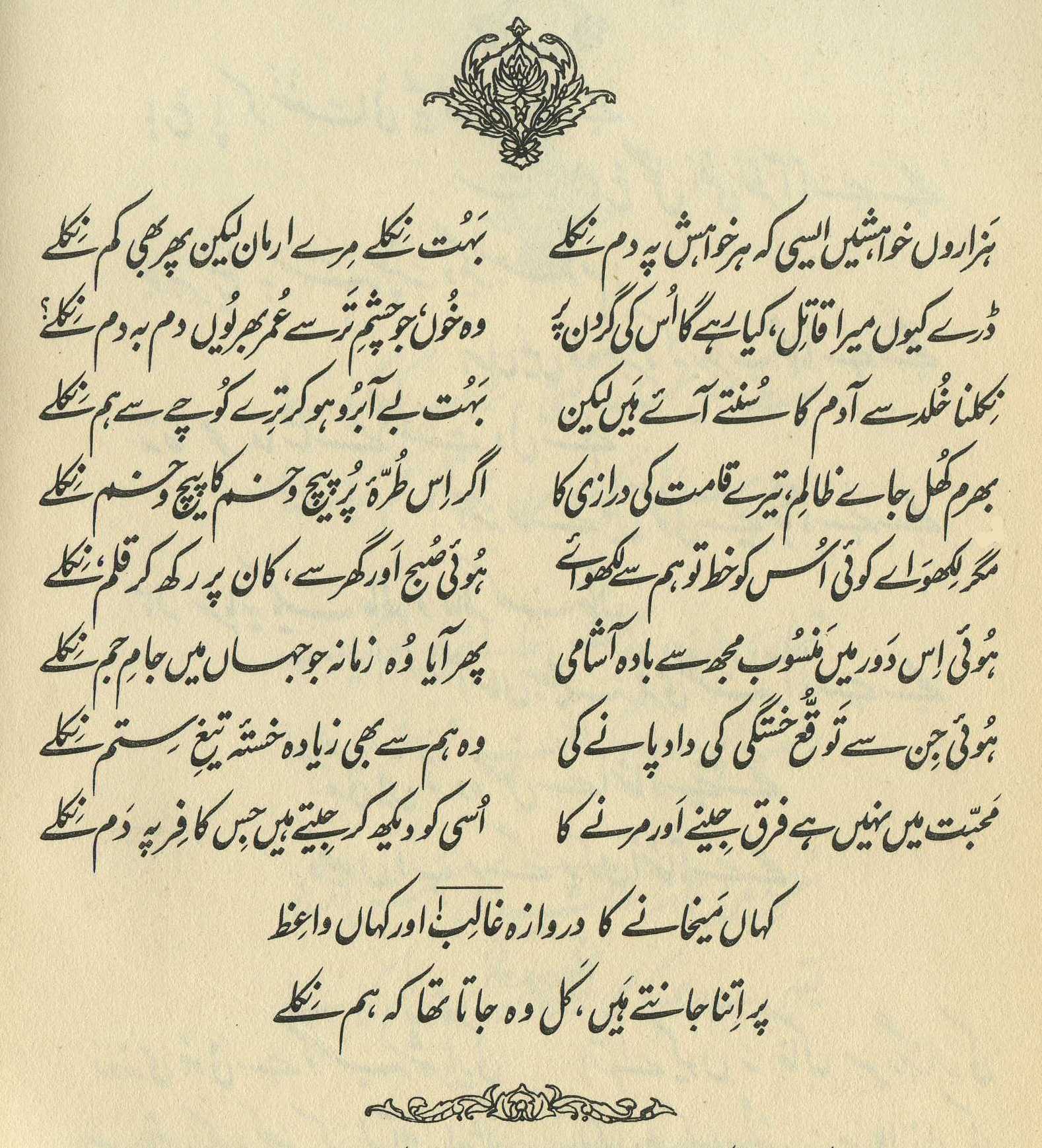
That is, the blood that flows from the eyes doesn't even remain in my body-- as if it will remain on the murderer's neck! (249)
== Nazm page 249

He says, 'Why does my murderer, having slain me, fear? My blood hasn't even remained in my own body-- it has constantly kept on dripping from my eyes along with tears. How could it remain on the neck of the murderer?' (307)
By way of a joke/pleasantry he says that when his blood will keep emerging from his eyes for his whole life, by the time of death it will already have become finished. So when blood itself doesn't remain, why will the beloved be declared a murderer? When things are such, why would she fear the Day of Judgment? The late Mirza Dagh has also composed this theme well:
[forgive that butcher idol, oh Lord of Judgment Day
there wasn't even any blood in me-- how can there be a blood-claim?] (450)
Blood remains on the 'neck' in Urdu the way it remains on the 'head' in English ('His blood is upon your head!'); for another example of the usage, see 64,6 . Why would the beloved hesitate to slay the lover? Perhaps because she fears that his blood would be upon her 'neck', in the moral sense, and that she would be punished as a murderer on Judgment Day. The lover seeks to quiet these fears-- he actually scoffs at them (1a). The verse suggests two obvious lines of argument that he might be using:
First, as Nazm suggests, the lover's blood is so notably in motion, so quicksilver-like, that it's absurd to think it would remain on her 'neck'. For after all, it doesn't even remain in the lover's own veins, where it belongs, but spontaneously keeps dripping away.
Second, as Bekhud Mohani proposes, the lover's blood has kept dripping away for his whole lifetime, so by the time she slays him there would hardly even be any left-- so how could there be any of it still available to remain on her 'neck'?
But formally speaking, the lover is asking a yes-or-no question in the first line (1b): will the blood remain on her neck, or won't it? And when we come to think about it, the answer isn't quite so obvious. For his description in the second line shows us the relentless, self-willed, unstoppable determination of the blood. It emerges constantly with every breath or moment, 'breath by breath' or 'moment by moment', like an army on the march; it does exactly as it chooses. And might it not choose to remain on terrain as utterly desirable as the warm, soft skin of the beloved's neck? After all, perhaps that's what it's been seeking all along. Maybe the murderer is right to be afraid.
The presence of 'like this' [] also makes it clear that the evidence is at hand: even as the lover speaks, the blood-drops can be seen to be dripping along, like a column of ants, with every breath/moment. (Or else they drip casually or 'gratuitously', so that their behavior seems uncontrollably willful.) For more on , see 30,1 . Moreover, the rhythm and sound effects in the second line add to our sense of the blood's regular, relentless movement: from to the rhyming , from to the rhyming , then from to the repeated . In Arabic-- and officially though rarely in Urdu (see Platts p.525)-- means 'blood', which adds one more excellent fillip to the wordplay.
graphics/blooddrops.jpg