Verse 31853amnikle
G2
1
people/we have always been hearing about the emergence of Adam from Paradise, but
2
having become very disgraced, from your street we 'emerged'!
| References | |
|---|---|
| Arshi, Imtiyaz Ali | Ghazal# 230 |
| Raza, Kalidas Gupta | 443-44 |
| Hamid Ali Khan | Open Image |
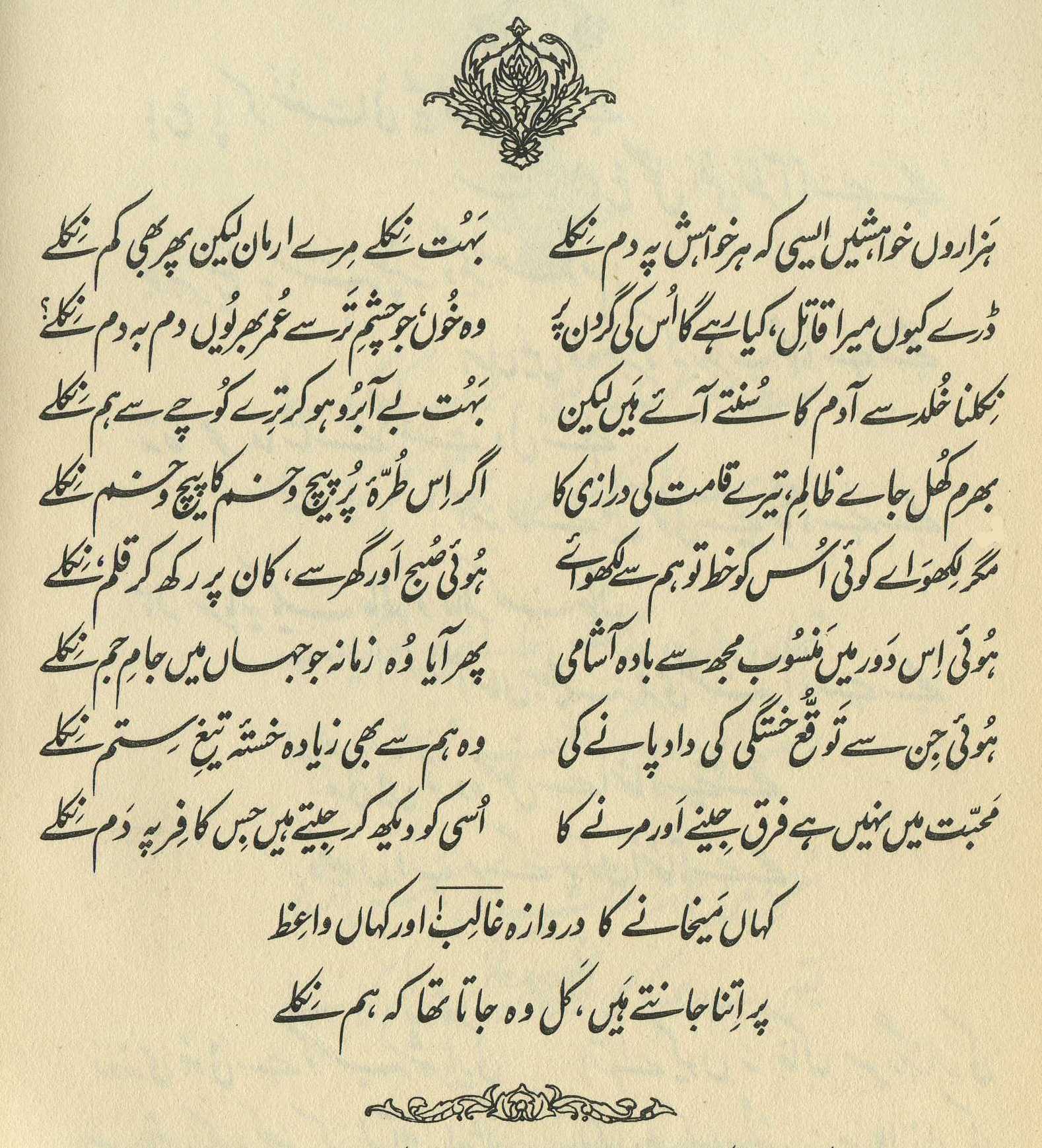
In the second line, emphasis ought to be given to the word 'very'. So that in comparison to Adam, he would be proved to emerge with more disgrace.
==Urdu text: Yadgar-e Ghalib , p. 164
He has said 'emerged' it because he feels ashamed to say that he was 'expelled' []. (249)
== Nazm page 249

Adam too was expelled with great disgrace from Paradise. But may the Lord not bestow on anyone a disgrace like ours! (450)
We have a statement with a number of points in the first line, then an emphatic 'but'; and the second line yields another statement. What exactly is being highlighted in the first line, and emphatically contravened in the second line? Here are some 'stress-shifting' possibilities:
=The fate of 'Adam' was long ago and far away, but our own sufferings are here and now.
=Adam emerged merely from 'Paradise', but we had to suffer the far worse fate of emerging from your street.
=Adam merely 'emerged' from Paradise, but we emerged from your street 'very disgraced'.
=If Adam is said to have 'emerged' from Paradise but in fact was forcibly and embarrassingly kicked out, perhaps we too were forcibly and embarrassingly kicked out of your street (as Nazm suggests).
=Adam emerged from Paradise merely 'disgraced', but we emerged from your street very disgraced (Hali's reading).
=People have 'always heard' about Adam's case, but our own case has not received any attention.
='We' are the ones expected to sympathize with Adam, but we ourselves have suffered even more severely.
The brilliantly amusing thing, of course, as Hali says, is the instantly apparent emphasis on 'very' []. (How does Ghalib make it so instantly apparent? My students pointed out (Apr. 2009) that the positioning right after does at least some of the trick.) How truly funny that makes the verse! The verse becomes a comic show of disproportion, as the lover insists on creating one of those 'it's all about ME' situations.
All the readings involve aspects of the same situation, but the emphasis on 'very' is particularly irresistible. The lover is so obsessed with his own humiliation that he won't even give the time of day to anybody else's. Instead of comparing his humiliation to Adam's, he compares Adam's to his-- and finds it wanting, as he impatiently makes clear. Adam's fall, after all, affected only the whole human race till the end of time; but the lover's expulsion affects him, and affects him now!
This verse is of course a charter member of the 'snide remarks about paradise' group; for others, see 35,9 .
Note for grammar fans: is a colloquially shortened form of the participial , 'we have come [along] [in a state of] hearing'.
graphics/falnamatopkapilate1500s.jpg