Verse 1after 1821aalkahaa;N
G8
In this meter the first long syllable may be replaced by a short; and the next-to-last long syllable may be replaced by two shorts.
1
that separation and that union-- where?!
2
those nights and days, and months and years-- where?!
| References | |
|---|---|
| Arshi, Imtiyaz Ali | Ghazal# 96 |
| Raza, Kalidas Gupta | 294-95 |
| Asi, Abdul Bari | 162-163 |
| Gyan Chand | 302 |
| Hamid Ali Khan | Open Image |
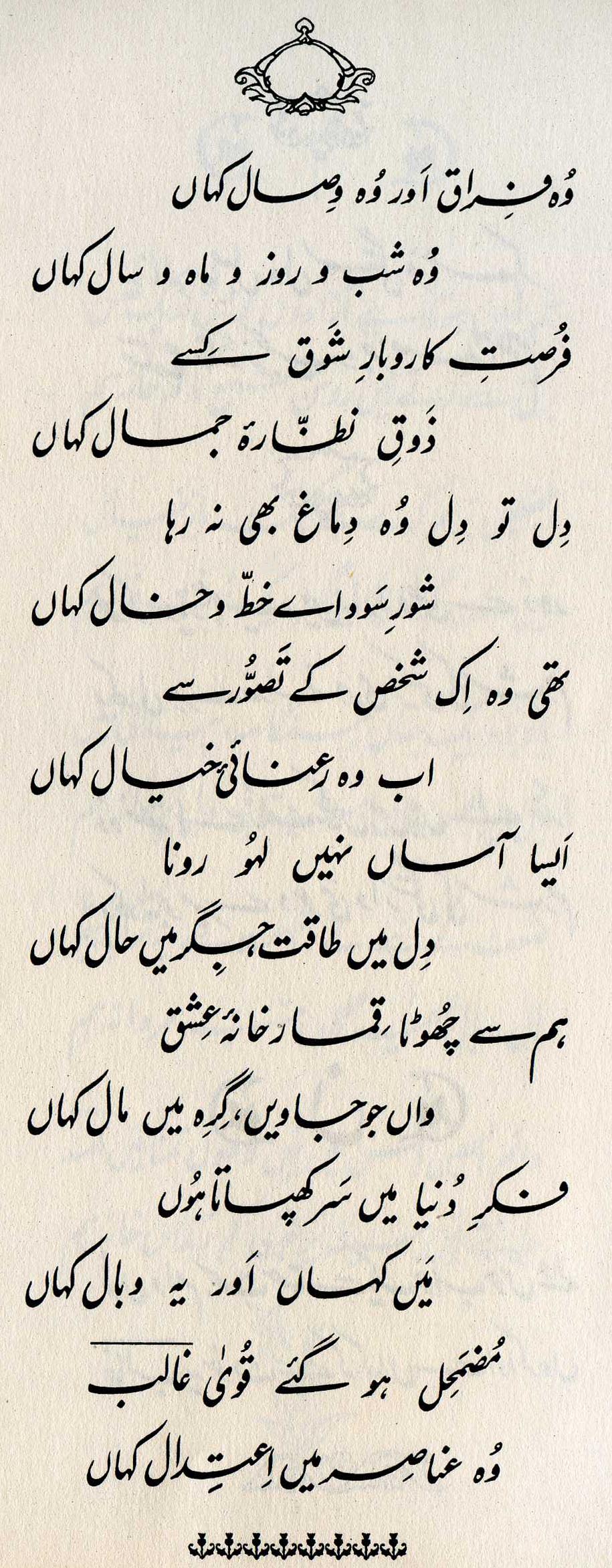
The poet remembers former times-- separation is a bad thing, but now he remembers that the heart and the passion have not remained, because of which separation was considered separation; and union, union. This whole ghazal is in the same one theme . (83)
== Nazm page 83

He says, that time is gone; and those nights of separation have been passed, the passing of which was more difficult than cutting through a mountain [as in 1,2 ]; and those pleasures of union too have been erased, which I still remember.... This whole 'continuous ghazal ' [] has been composed in this same theme . (133)
In short, those days, nights, months, and years have all taken their leave; things of past times now seem like dreams and fantasies []. (218)
That is, the nights of separation have passed, the time of union has also passed. Now neither those days exist nor those nights, nor those months nor those years. Somehow or other life is passing. In only one word, -- what details he has captured! Its excellence is worthy of attention. (170)
Nazm notes that this whole ghazal has the same theme ; basically, it's the classic 'But where are the snows of yesteryear?' motif of lost time with its irrecoverable joys and sorrows. By choosing a 'short meter ' the poet has restricted the amount of space in which he can operate, and by choosing a powerful, vivid, colloquial, almost controlling refrain like he has further tightened his structural options. Bekhud Dihlavi actually calls the result a 'continuous ghazal' [], but that's pushing it too far.
The word does powerful work throughout the ghazal. It is really short for or , but the idiomatic force of the omission of is so natural and legitimate that not even Nazm complains. The word works partly through simplicity and the sheer force of repetition. But also it works through its own double possibilities: as a straightforward, if abstract, question (I wonder-- where do the old days go when they're over?); and as a negative rhetorical question (Where are they now? Gone forever, of course, and you can whistle for them!).
As Josh observes, in this verse the little word also does its share of the heavy lifting. Its repeated use implies that we readers already know which ones (the ones the speaker has been thinking about; or the ones the speaker has already told us about; or the ones we've experienced ourselves). Or else it may suggest that they're beyond words-- the speaker can't describe them; overwhelmed by emotion, all he can do is point to them, gesture toward them. He's framing an elegy for his life.
And yet, this ghazal was written when Ghalib was in his twenties-- including the later verses that seem to complain of decline and old age and so on. They are part of absolutely usual ghazal convention, and were never meant to be taken as autobiography. In the last few years of his life Ghalib quoted the closing-verse , 85,8 , in several letters lamenting the ills of old age. This is one of the many advantages of stylization-- the poetry of his youth could still be meaningful in his old age.
graphics/calendar.jpg