Verse 4x1816angaa;xir
G2
1
Asad , even/also in old age the tune/concord of ardor for the friend/beloved is steadfast/firm
2
they are not devoid of melody, the bent-nesses of the lute/harp, finally
'Design, purpose, intention; method, manner; sound, concord, melody; one of the Persian tunes or modulations in music'.
'A soft, sweet voice; —a musical sound or tone; —melody; song; modulation; trill, shake'.
'Curved, bent, crooked, awry'.
'To be crooked; to limp'. (Steingass, p.475)
''Anything crooked or bent'; the hand expanded with the fingers somewhat hooked; ... a lute'.
| References | |
|---|---|
| Arshi, Imtiyaz Ali | Ghazal# 60 |
| Raza, Kalidas Gupta | 182-83 |
| Nuskhah-e-Hamidiyah | 106 |
| Asi, Abdul Bari | 117-118 |
| Gyan Chand | 204-205 |
| Hamid Ali Khan | Open Image |
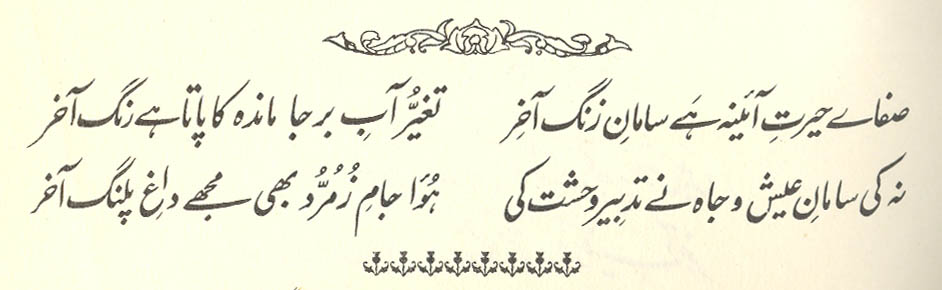
'Oh Asad, in these strings [of an instrument] the very same sound of ardor for the friend/beloved is present; the bentnesses of the lute are not devoid of melody.' That is, they have become bent, but in even these strings the very same ardor is steadfast.
In my view, instead of [Asi's text has instead of ] there should be the word , through which the 'bentnesses of the lute' would become extremely meaningful-- although 'strings of the lute' too cannot be called incorrect.
== Asi, pp. 117-118
[Zamin's text too has instead of , and he makes the same proposal that it should be instead.] If instead of there were , then it would have been a proper verse, although its poetry would still have remained artificial; and in that case, its meaning would have been: 'Through the neck of the lute being bent, no difference comes into its melodies; so why from the bentness of back in old age would there be a difference in the ardor for the friend/beloved?
== Zamin, pp. 169-170
'Asad, even in old age, the pursuit of ardor for the beloved is present. Even if the lute would be bent, it keeps on making a melody. If in weakness the body would be bent and soft, even then it will not be devoid of the melody of ardor.
== Gyan Chand, p. 205
For background see S. R. Faruqi's choices . This verse is NOT one of his choices; I thought it was interesting, and have added it myself. For more on Ghalib's unpublished verses, see the discussion in 4,8x .
'Natural poetry' fans should note that when the young Ghalib composed this verse about the hardships of old age, he was eighteen or nineteen years old. For more on this, see 66,1 .
The wordplay in this verse is delightful. For refers (see the definition above) to 'anything crooked or bent', such as 'a lute' (which can have a radically bent neck, as in the painting below), or 'the hand expanded with the fingers somewhat hooked' (which is close to the way the fingers would be positioned when playing the lute). The word can also refer to a 'Persian harp', which has its own curved shape; on this see 321x,4 . (One more appears in 169,10 .)
And of course, 'anything crooked or bent', including the stature of old age. Really only is used in Urdu, and is awkward and unidiomatic; it feels constrained by the meter. (This is the same criticism that Zamin made of in 63,3x , and on the same grounds.) Ghalib does tend to go in for such pluralized abstractions; for more examples, see 1,2 .
For a truly brilliant use of the bent-back image, see Mir 's M 17,8 .
graphics/lute.jpg