Verse 91853aamire aage
G13
1
faith stops me, since/while unbelief draws me on
2
the Ka'bah is behind me; the church, before me
'Belief (particularly in God, and in His word and apostles, &c.); faith, religion, creed; conscience; good faith, trustworthiness, integrity'.
and are archaic forms of and ( GRAMMAR )
'To draw, drag, pull; to attract, to draw in, suck in, absorb'.
'Unbelief, infidelity; incredulity; scepticism; ingratitude; paganism, idolatry; impiety, blasphemy'.
'A Christian church; a synagogue'.
| References | |
|---|---|
| Arshi, Imtiyaz Ali | Ghazal# 229 |
| Raza, Kalidas Gupta | 442-43 |
| Hamid Ali Khan | Open Image |
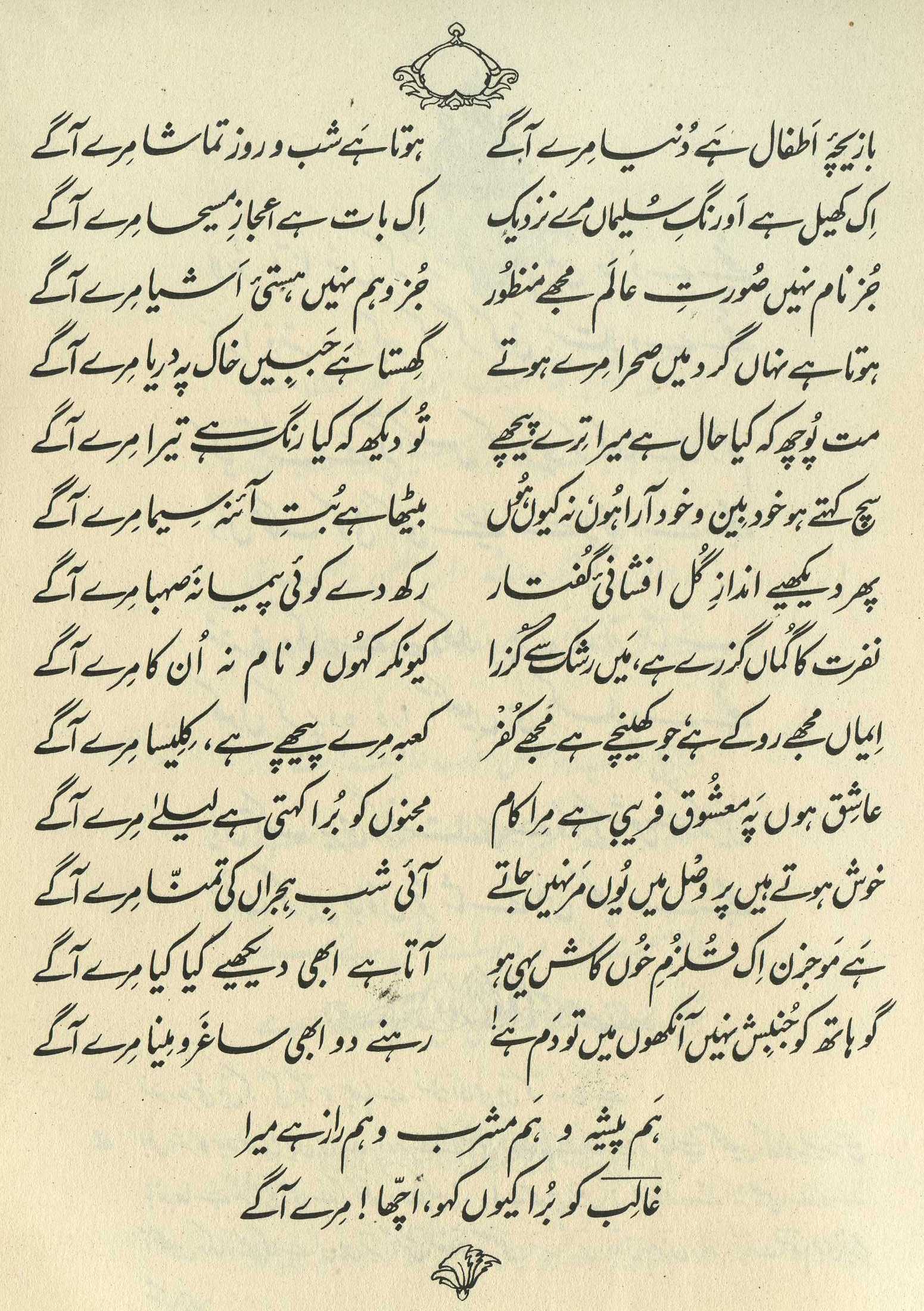
One day in my presence he expressed extreme regret at [an incident that showed the disgrace of Muslims] and said, 'There's nothing of Muslimness in me, so I don't know why I feel such grief and regret over the disgrace of Muslims.' But since his temperament was extremely mischievous [], when any hot [] idea occurred to him, he couldn't stand not to express it, even if people considered him an infidel or a rake or an apostate.
==Urdu text: Yadgar-e Ghalib , p. 75
That is, the Ka'bah, having fallen behind, stops me: 'Don't go that way'; and before me the church is drawing me on: 'Come this way'. (236)
== Nazm page 236

He says, 'Faith stops me. That is, the Ka'bah is behind my back. When I take a step forward, then from the direction of the Ka'bah an attraction is created. And unbelief draws me on. That is, the church is before my face, and it is drawing me on: 'Come this way'. (293)
By Ka'bah and church are meant wisdom and desire, the world and the next world as well. That is, sensual pleasures are bent on causing me to wander off the strait and narrow path. Wisdom and insight are stopping me. My life has become a tug of war: I can neither renounce the world, nor renounce the next world. (418)
If we were to take this verse absolutely literally, we'd have to imagine the speaker as standing paralyzed in an open space, with the Ka'bah exerting a magnetic force on him from behind, and the church drawing him onward from in front. Of course, no such open space exists in the physical world (there's no church within hailing distance of the Ka'bah), so we're unable to take it literally.
If we were to take it in a minimally metaphorical way, we'd simply move the 'open space' from the real world to the speaker's mind and heart. In that case, we'd be left with what sounds like a crisis of faith: the speaker as torn between two choices in his life. But in that case we'd also be left with an unacceptably dull kind of prosiness: 'Faith holds me back, unbelief draws me forward: the Ka'bah is behind me, the church in front of me'. If taken biographically, this sounds like something reported to a therapist, or confessed to a priest, or confided to a friend-- something of only a descriptive interest. Where's the poetic excitement in such a flatly narrative level of discourse? Why would anybody who heard such a statement be moved to exclaim, ?
Moreover, in this case even the 'natural poetry' people can't really go for a biographical connection, for in Ghalib's real life there's not a shred of evidence that he ever considered converting to Christianity. He does sometimes wonder whether he's a real 'Muslim' or not, as for example in Hali's anecdote above; but the wonder hardly sounds urgent or full of angst. For as Hali shrewdly observes, what Ghalib really loves is a 'hot' poetic idea, no matter what its theological content, and he's willing to go wherever it takes him. He's far from the only one, of course. The ghazal world is full of verses that would be 'infidel-ness' of the most direct (though improbable) kind, if anybody were foolish enough to take them literally. Here's one of my favorite examples from Mir : M 7,15 .
But to return to the present verse: we can't take it literally, and we also can't fruitfully take it in any kind of straightforward metaphorical way (as representing a personal religious struggle). So we have to recognize that the verse's excitement is in its starkness, its suggestiveness, its very open-endedness. Its vividness and simplicity pack their own kind of imaginative punch. For on examination, we see that it's virtually 'interpretation-proof'.
That's why the commentators have to either content themselves with paraphrase, or introduce their own ungrounded allegories. The verse can be used to stand for any kind of serious moral struggle: for example, between the admittedly good and true (though it may be archaic, and thus left behind); and the new and/or alluring (though admittedly, or at least supposedly, wrong and false). But 'any kind' of struggle is not very different from 'no kind in particular'. As so often, we're invited-- and compelled-- to fill in the blanks for ourselves. Ghalib enjoys making us work for our pleasures, and who are we to complain? The verse itself is so striking, so memorable, so full of what ought to be some rich meaning, that it lodges like a thorn in the imagination.
Another classic drive-'em-crazy-with-ambiguity 'religious' verse is the well-known 111,14 .
On the subtleties of , see 12,2 .
graphics/church.jpg