Verse 11853aamire aage
G13
1
the world is a game/plaything of children, before me
2 a
night-and-day is [habitually] a spectacle, before me
2 b
night and day, a spectacle is [habitually] before me
'Fun, play, sport; wagering; toy, plaything'.
| References | |
|---|---|
| Arshi, Imtiyaz Ali | Ghazal# 229 |
| Raza, Kalidas Gupta | 442-43 |
| Hamid Ali Khan | Open Image |
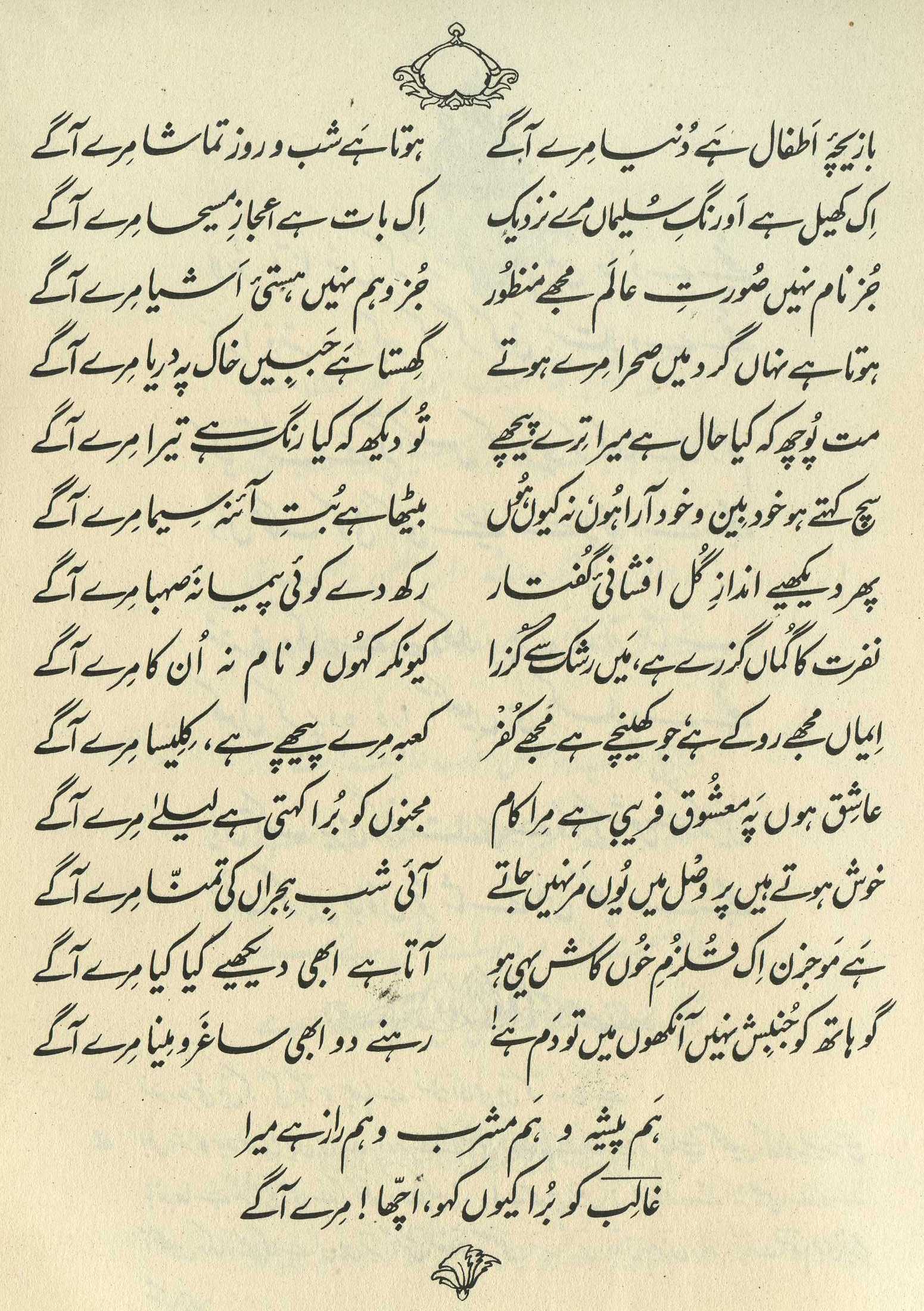
[May/June 1854, to Haqir:] What Rekhtah s [] do you consider to be new? and -- this ghazal [ 151 ] is old. and [{208}] has also been around for a year. It's a ghazal for the mushairah of the Auspicious Fort. [He then records the whole ghazal, with all the verses in order.]
== Urdu text: Khaliq Anjum vol. 3, pp. 1146-47
In the Dihli Urdu Akhbar [] of 22 May 1853 this ghazal is printed with the following introduction: 'On Monday morning the poets of the Auspicious Fort and of the city gathered in the Hall of Private Audience [for a mushairah]. His revered and lofty Majesty arrived, and took his place on the throne. His Excellency the Heir Apparent adorned a seat, and Mirza Mughal Bahadur and Mirza Khizr Sultan Bahadur and Mirza Javan Bakht Bahadur and the princes of lofty lineage, after the offering of obeisances, according to the command which is a twin of Destiny, were honored with seats according to their ranks and received esteem and favor. From noon to one o’clock His Majesty remained on the throne.' (332)
That is, the events of the world have no effect on my heart; I consider them a spectacle. (233)
== Nazm page 233

He says, in my view the world is a children's plaything; the events of this world have no effect on me. Night and day I see these events, and consider them the show/spectacle of a beautiful woman []. He has composed a peerless opening-verse . (292)
In my view [] the world is a children's toy, and the events of the revolutions of the world are in my view a spectacle. That is, the heart of a possessor of insight refrains from attaching itself to anything in the world. (415)
What a pleasure it is to reach this spectacularly rich and innovative ghazal! It's an old favorite of mine, and is always popular with students. And not only with students. A while back in Delhi I was giving a talk, and in the course of it I explained how I came to choose 20 and 111 as the ghazals for which to provide translation anthologies (mainly, I chose them because they were the most often translated, and thus offered the widest range of examples). I pointed out also that in the latter case, Ghalib himself had praised the ghazal extravagantly in a letter (see 111,1 ). S. R. Faruqi, who was present, said 'hmff!'. I knew what that meant, so at the first opportunity I asked him which ghazals he himself would have recommended instead, as the 'best' representatives of Ghalib's work. His choices were: at the baroque end of the spectrum, 230 ; at the simple end, 162 ; and in the middle range, this one. I think that {230} has only one or two magnificent verses, and that {162} is somewhat overrated-- but this one is truly among the treasures of the divan .
Throughout this ghazal, the refrain of course literally means 'before me', 'in my presence'. But it often has also the only slightly extended meaning of 'in my view', 'in my opinion', 'according to me'. (Think of 'it's fine by me'.) In this sense it resembles , literally 'near me', which has the same range of metaphorical meanings, and is used similarly in, for example, 208,2 . Then in 208,10 , the additional meaning of 'compared to me' appears as well.
The first four verses of this ghazal feel like-- not quite a verse-set , but a kind of informal group with the same general tone of tongue-in-cheek grandiloquence. Each one is so calmly, blandly, over-the-top extravagant that the effect is not only enjoyable but truly funny. The wit and humor become more apparent as we go along. Here, as so often, I part company with the commentators: they tend to read the whole thing straight, as verses full of heavy-duty mystical claims that are meant to be taken seriously. But of course, when Ghalib seems to be saying something pompous and one-dimensional, that's often when he's at his most clever and tricky. Read on and see how the four verses work together. For true closural effect, 208,3 is the most flatly pompous of all, then the delightfully witty 208,4 both inflates the balloon to the maximum-- and punctures it.
In the second line, the 'midpoint' can be taken either as a collective noun, the subject of the sentence and the content of the spectacle (2a); or as an adverb, describing the timing of some other, unspecified spectacle (2b).
This is a good occasion also to notice how Ghalib refers to his ghazals, in the letter above: in the traditional style, he gives two instances of the rhyme and refrain , so that we can triangulate and tell how much is which. But he's rather cavalier about which instances he chooses. In the case of his first example, 151 , doesn't even occur in the ghazal (nor is there any manuscript version available in which it does occur). (Possibly it might be an error of calligraphy in the Khaliq Anjum edition; if life were longer I would check out all these small matters.) And in the case of the present ghazal, he chooses his instances from 208,4 and 208,7 , apparently haphazardly, since he seems to have the whole text at hand. (Or else because they're particularly brilliant verses and thus come readily to his mind?)
Here's an update, with more about some of Faruqi's choices. More recently (Jan. 2012) he has written to me in an email: 'Mir is a greater poet still, because he has a much greater range of themes . He has more tricks up his sleeve than Ghalib. And he has more flowingness than Ghalib. Ghalib's Urdu is better than his Persian as you say, though only marginally so. Many of the devices that he can use to tremendous effect in Urdu are not within his reach in Persian. For example, he has nothing in Persian to show like (1) 78 ; (2) 48 ; (3) 126 , etc.'
graphics/world.jpg