Verse 11858-1865amkyaa hai
G9
In this meter the next-to-last long syllable may be replaced by two shorts.
1
the grief of the world is much, no doubt-- as if the wine is less/lacking!
'The world; time, fortune'. (Steingass p.1108)
| References | |
|---|---|
| Arshi, Imtiyaz Ali | Ghazal# 234 |
| Raza, Kalidas Gupta | 473-474 |
| Gyan Chand | 522 |
| Hamid Ali Khan | Open Image |
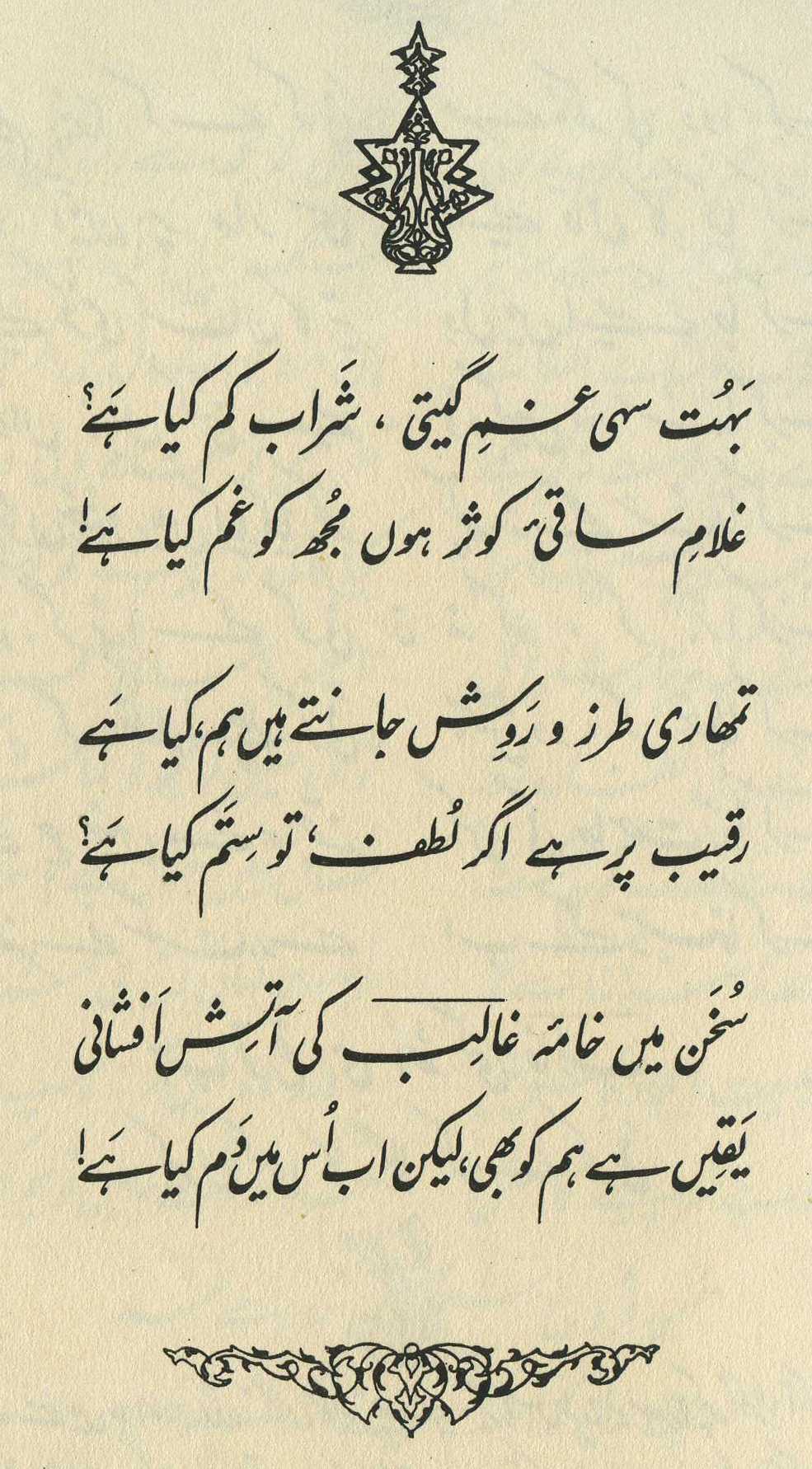
[early July 1858, to Mirza Hatim Ali Beg 'Mihr':]
{216,1}; 216,3 [these two verses introduce the letter]
Believing that the attachment of love is rightfully eternal, and considering that the connection of slave-hood to Janab Murtaza Ali is true, I say one thing more: that although vision is precious to everyone, hearing too has, after all, its own value. Granted that face-to-face knowing has outranked it, still it too is a proof of friendship. How is it necessary that if mutual vision has not taken place, we would consider ourselves strangers to each other? Indeed, we and you are longtime friends, if we so consider ourselves. In response to a salaam, a letter is a very great kindness. May the Lord grant that that letter in which I had written a salaam to you, would have passed before your eyes! If you perhaps have not chanced to see it, please get it from Mirza Taftah and read it.
Alas, that Major John Jacob [the one for whom 'Jacobabad' was named] was killed at such a young age! Truly, it was his practice to forbid me to think about Urdu, and to incite me to compose poetry in the Persian language. He too is among those kind benefactors for whom I mourn. Thousands of friends have died-- which of them should I remember, and for which should I lament? If I live, then I have no confidant; if I die, then I have no mourner.
I have looked at your ghazals. Praise be to God, may the evil eye be far off! You're a [knowledgeable] traveler [] on the road of Urdu; you are, {so to speak / speaking}, a master of that tongue. The Persian [verse] too is not less in excellence. Practice [] is the condition: if you keep composing, you'll enjoy it []. As for me, I'm in a state such that, as Talib Amuli has said [in Persian], 'I've sealed up my lips from speaking; you'd say / on the face, the mouth was a wound that has healed'.
When you've written me a letter without my having written one to you, then how would I not long for an answer to my letter? First please write about your own situation: I've heard that you're a Sadr Amin [=Subordinate Judge] somewhere. So why have you taken up residence in Akbarabad [=Agra]? In this turmoil, how was your connection with the rulers? Please definitely write about the situation of Raja Balvan Singh-- where is he, and does he still receive the two thousand rupees a month that he used to receive from the English government?
Alas, Lucknow! There's no word of what happened to that garden-place. What became of its riches, where did its people go? What fate overtook the women and men of the family of Shuja ul-Daulah? What's the story about the revered Hazrat Mujtahid ul-Asr [the highest Shi'a legal functionary in the state]? I suspect that as compared to myself, you must have more awareness [of all this]. I'm hopeful that what knowledge you have would not remain hidden from me. I've learned no more about your auspicious dwelling than that it's in Kashmiri Bazaar; apparently this much must be enough, or else you would have written more.
Please give my blessing to Mirza Taftah, and please let him know of the arrival of that letter in which he had written me the good news of your [intention to write a] letter. Peace be with you.
==Urdu text: Khaliq Anjum vol. 2, pp. 700-701
==another trans.: Daud Rahbar , pp. 82-84
[1865, to Ala'i:] [For the immediately preceding part of this letter, see 70,3 .] You asked for recent [] verses. Your happiness is dear to me. I remembered a closing-verse and only two lines before it that I had composed, that are not even recorded in the divan . Having thought about [] them, I wrote one opening-verse and five verses; I send you a ghazal of seven verses []. Brother, how can I tell you with what difficulty these six verses have come to hand, and they too not of a high rank: = {216,1} = 216,2 with the two lines in reverse order, called 'a second opening-verse ' = 216,4x = 216,5x = 216,3 Here, sahib, your mandate, a twin of Fate, I have fulfilled. But I don’t have a copy [] of this ghazal in my possession. If you will keep it carefully, and add it to the margins [] of the Urdu divan, you will do well. ==Urdu text: Khaliq Anjum vol. 1, pp. 422-423
[1865, to Ala'i:] [For the immediately preceding part of this letter, see 70,3 .] You asked for recent [] verses. Your happiness is dear to me. I remembered a closing-verse and only two lines before it that I had composed, that are not even recorded in the divan . Having thought about [] them, I wrote one opening-verse and five verses; I send you a ghazal of seven verses []. Brother, how can I tell you with what difficulty these six verses have come to hand, and they too not of a high rank: = {216,1} = 216,2 with the two lines in reverse order, called 'a second opening-verse ' = 216,4x = 216,5x = 216,3 Here, sahib, your mandate, a twin of Fate, I have fulfilled. But I don’t have a copy [] of this ghazal in my possession. If you will keep it carefully, and add it to the margins [] of the Urdu divan, you will do well. ==Urdu text: Khaliq Anjum vol. 1, pp. 422-423
That is, granted that in the world there's much grief-- but to divert the grief, the 'wine of Kausar' too is present, that one can drink till eternity. (248)
== Nazm page 248

He says, 'I grant that in the world there's much grief and sorrow, but in comparison with the grief, wine too is not less in proportion'. The meaning is that wine is a thing that causes one to forget the grief of the world; and since I am a slave of the Saqi of Kausar, I have no worries about obtaining wine. It will keep on being available just the same till eternity. Here I kept drinking, and there too I will keep drinking. (304)
In brief and clear words, the meaning of the verse is that one ought not to become anxious over the troubles of the world, since after it the pleasures of Paradise will fall to one's lot, and cups of the Wine of Kausar will be passed around. (447)
The first of Ghalib's two letters, I include because it begins with two verses from this ghazal, and then with an invocation of 'slave-hood' to Hazrat Ali in the first sentence, as a bond between Ghalib and his new correspondent, who is a friend of his dear friend Taftah, and one whom he's never met. It certainly makes clear Ghalib's special sympathy with Ali, although he always resisted any sectarian characterization. Moreover, this letter is dated so early after the Rebellion that it shows how quickly things were returning to (a new form of) 'normal'. Though Ghalib grieves over a dead English friend, and anxiously seeks information about other friends, this letter contains rhymed prose and other touches of literary elegance, and also a certain lightness of tone. The post office is obviously up and running once again. This new friend, Mihr, has sent Ghalib both Urdu and Persian ghazals to correct. Despite all the grief and shock, life is reestablishing itself.
Only two ghazals from the period after 1857 made it into the printed, established [] divan ; this one, composed in 1858, is the earlier of the two. The other, 70 , was composed in 1862, the year when his divan was published for the fourth and last time. The 1858 version of the present ghazal itself came in 1865 to include, as the second letter given above clearly shows, four extra verses that Ghalib meant to have added to his divan (though he also considered them not to be of a high standard). Bekhud Dihlavi comments on the newly-added verses too (p. 305).
On the colloquial implications of , see 9,4 . The effect is concessive: 'no doubt it's true that'; 'granted that'; 'agreed that'. Grief is no doubt much-- but the wine is hardly less! Why should we whine-- don't we have wine? (Sorry, rhymed prose is a thing that creeps up on you.)
Two possibilities thus open up here: what is being indignantly denied might be either the idea that the wine is less than the grief (whereas in fact, the two amounts are both large, and both the same), or else the idea that the wine is less or lacking in a more general way (whereas in fact, there's plenty of wine in the world). If we read the two lines together, then the suggestion seems to be that the Saqi of Kausar is a kind of provider or guarantor of earthly wine-supplies, perhaps as a gesture of compassion to grief-stricken humankind.
But of course, we don't know what the relationship of the two lines should be, so it's also possible to read them separately, as proposing two solutions to the problem of grief: in the short run, lots of earthly wine; and in the long run, some kind of (intoxicating?) heavenly nectar poured by Hazrat Ali from the divine fountain of Kausar.
graphics/wine.jpg