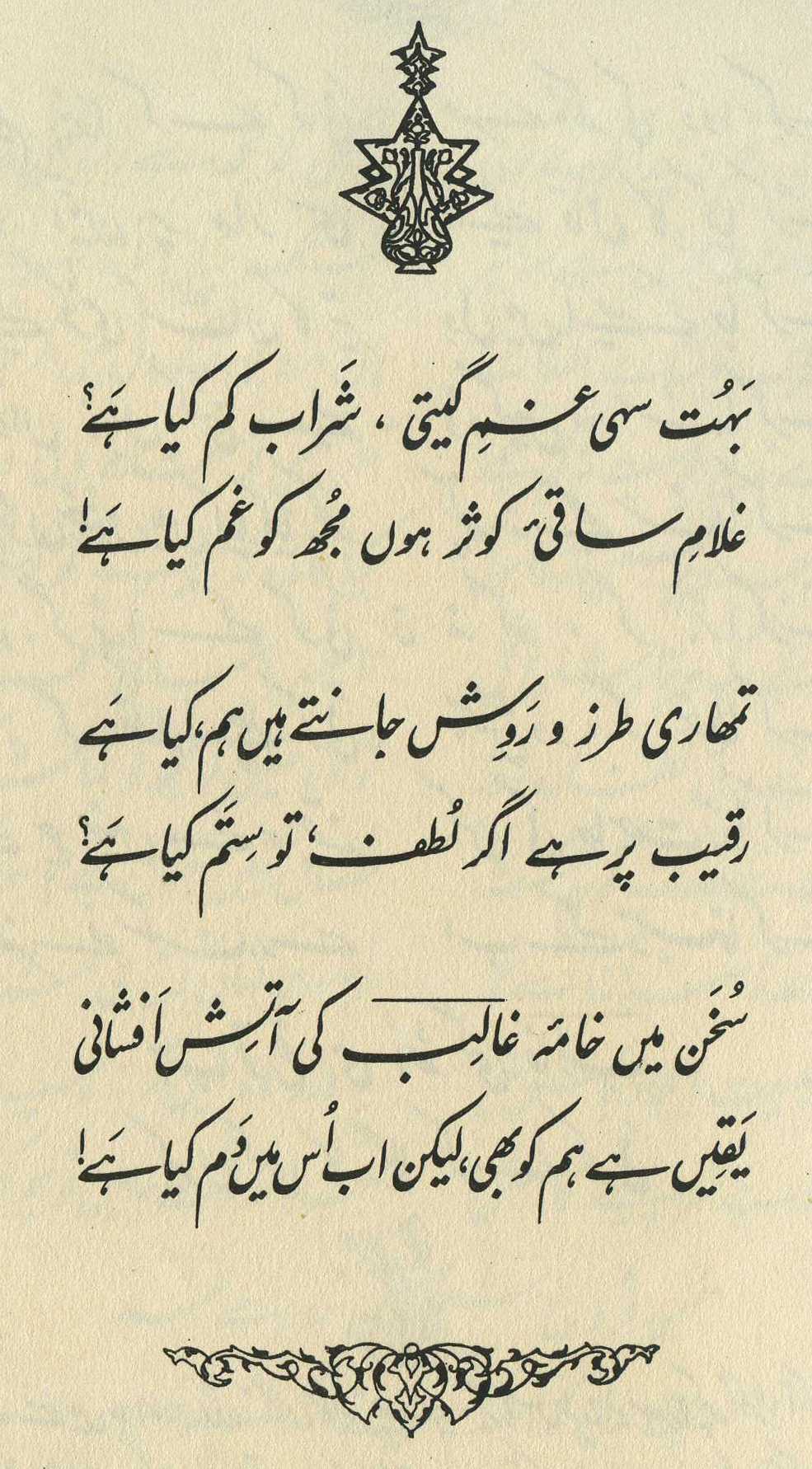
Verse 21858-1865amkyaa hai
G9
In this meter the next-to-last long syllable may be replaced by two shorts.
1
your form/style and gait/manner-- we know what it is
2
if there is kindness to the Rival , then what is (the) tyranny?!
tarz>> : 'Form, shape, fashion; way of acting, style of conduct, manner, way'.
'Motion, walk, gait, carriage; practice, custom, fashion, usage; rule, institution, law; conduct, behaviour; order, course, proceeding, procedure; manner, method, mode, way'.
| References | |
|---|---|
| Arshi, Imtiyaz Ali | Ghazal# 234 |
| Raza, Kalidas Gupta | 473-474 |
| Gyan Chand | 522 |
| Hamid Ali Khan | Open Image |
That is, your showing kindness to the Rival-- that very thing is tyranny, with regard to me. (248)
== Nazm page 248

He says, we are very aware of your habit-- that you always heighten the flame of jealousy/envy in the lover's heart. Your showing kindness to the Rival plays the role of tyranny, toward me. That is, the kindness with which you treat the Rival, becomes tyranny with regard to me. (304)
Cruelty is your habit, tyranny is your temperament. The way you treat the Rival-- if you call all this 'graciousness', then the Lord knows what 'tyranny' will be!
[Disagreeing with Nazm:] If the meaning of the verse would be expressed in this way, then the defect in it presents itself, that there's then no longer any need for the first line. (448)
This verse is a second opening-verse . When Ghalib writes it down from memory, in his 1865 letter to Ala'i cited in 216,1 , he reverses the order of the lines. This small slip of memory shows that the order of the lines was not strongly fixed in his mind (or strongly apparent to him on the written page). If the order of the lines could readily be reversed, the probability of an 'A,B' relationship between them would certainly seem to be enhanced.
The first line sets us up for something, but we have no idea what. The beloved's can be anything from the physical (bodily shape and form, gait and carriage) to the abstract (style and manner of behavior). And to say 'we know what it is' is only an insinuation-- there's no indication whatsoever of the content or nature of what the lover knows. Is the verse talking about her body, or her temperament? Is the verse praising, or blaming, whatever it's talking about? The listeners have to wait-- in mushairah performance conditions-- for enlightenment from the second line. Even then, in classic mushairah-verse style, the 'punch-word' is withheld until the last possible moment.
Nazm frames the second line as a kind of redefinition of 'kindness'-- if the beloved shows kindness to the Rival , then it's really 'tyranny' to the lover ('If this isn't tyranny, what is?'). In that case, the first line suggests that the lover knows her (sadistic) ways, and knows she is doing it on purpose in order to torment him. And the ambiguity in the first line (is it her physical airs and graces, or her behavior, that the lover claims to know all too well?) works beautifully, since the sadistic charm she shows make it quite possible that it's both.
But the line could also be read as a different redefinition of 'kindness'. She's so cruel that if she shows her own brand of 'kindness' to the Rival, then why would the lover mind? Where in that is there any 'tyranny' to the lover? The lover knows her so well, he knows that her 'kindness' will end up driving the Rival as mad as it has driven the lover himself. For an enjoyable explication of this reading, see 42,1 .
graphics/marilynandwilder.jpg