Verse 11852aa;Naur
G13
1 a
to such an extent in her every single sign/gesture is a different/additional sign/indication
1 b
although in her every single sign/gesture is a different/additional sign/indication
2
when/if she shows affection/love, then a different/additional suspicion/idea passes [through the mind]
'Sign, signal; beck, nod, wink, nudge, gesticulation; pointing to, indication, trace, mark, allusion, hint, clue; insinuation, innuendo; love-glance, ogling'.
'Sign; signal; mark, impression; character; seal, stamp; proof; trace, vestige; --a trail; clue'.
'To feel love or affection (for), to be attached (to)'.
'Doubt, distrust, suspicion; surmise, conjecture ... ;—opinion, fancy, notion, supposition, imagination; —presumption; probability; —conceit, pride, haughtiness'.
'And, also, for the rest, besides; again, moreover; but, yet, still; over, else; ...another, other, different; more, additional'.
| References | |
|---|---|
| Arshi, Imtiyaz Ali | Ghazal# 65 |
| Raza, Kalidas Gupta | 424 |
| Hamid Ali Khan | Open Image |
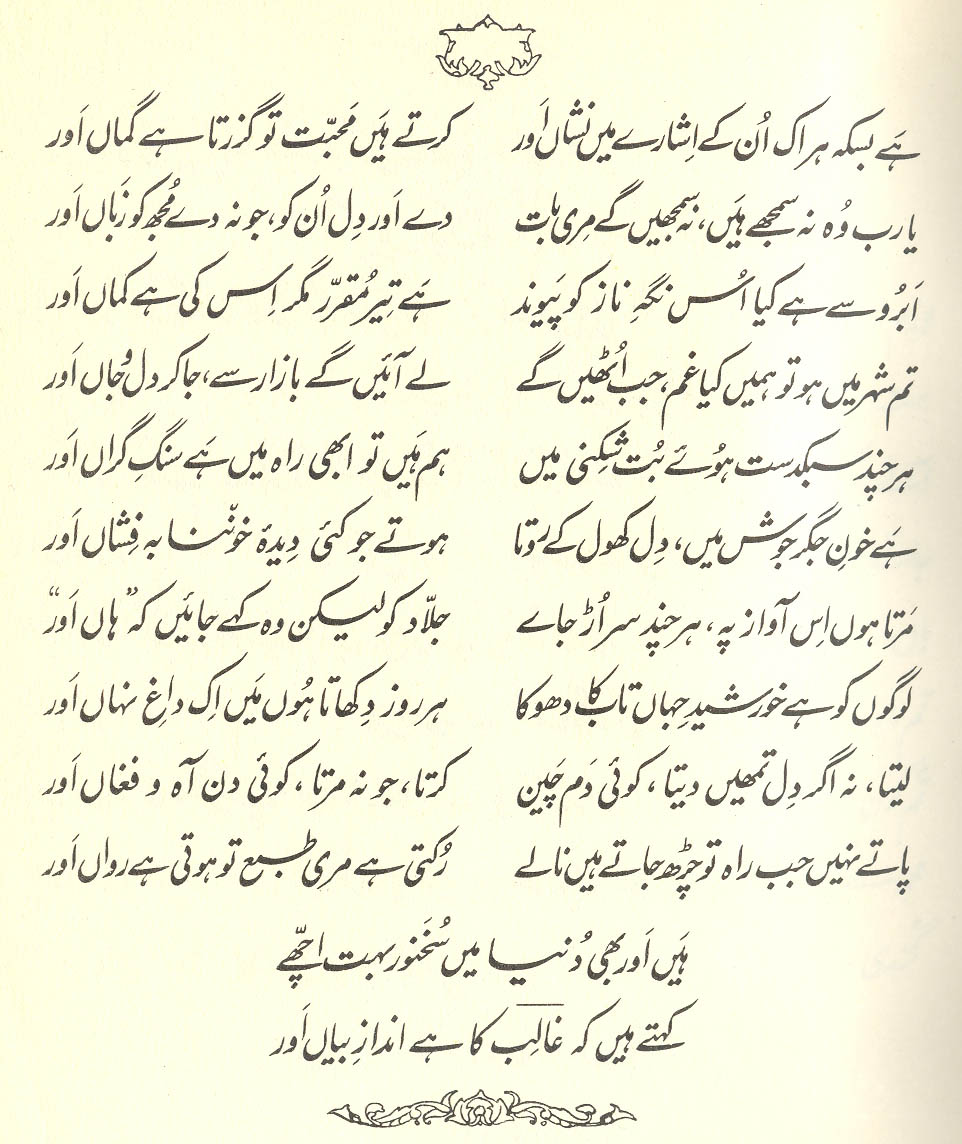
Ghalib appends to a letter written in 1858, verses {1, 4, 8, 3, 2, 5, 10, 7, 11}
==Urdu text: Khaliq Anjum vol. 2, pp. 717-18
==a trans.: Daud Rahbar , pp. 95-96
[1861, to Navab Ala ud-din Ahmad Ala'i:] Life of Ghalib! I remember that I've heard from your renowned uncle that a copy of the 'Dictionary of the Dasatir' is there. If it had been there, then why would you not have sent it? Well, [in Persian] 'What we think we need, most of it we don't need.' You are the new fruit of that plant that has grown up before my eyes; and I have kept enjoying that plant's breeze, and sitting in its shade-- how would you not be dear to me? There remains the question of seeing in person; for that there are two approaches: you would come to Delhi or I would go to Loharu. You are under compulsion, I am excused []. I myself say, beware! Don't listen to my excuse until you understand who I am and what the situation is: Listen: the worlds are two-- one world of spirits and one world of water and earth. The ruler of both these worlds is one, and he himself says [Qur'an 40:16], 'Who shall rule on this [Judgment] day?' and then himself gives the answer 'Allah, the One, the Almighty!'. Although the general rule is that criminals from the world of water and earth are punished in the world of spirits, it has also happened that they've punished sinners in the world of spirits by sending them to the world of water and earth. Thus I, on the 8th of Rajab 1212 AH [Dec. 27, 1897, when he was born], was sent here for my trial. For thirteen years I remained in custody. On the 7th of Rajab 1225 [Aug. 18, 1810, when he married] an order of life imprisonment was issued. They fastened a shackle to my foot, and designated Delhi as my prison, and placed me in that prison. They assigned me as hard labor the composition of poetry and prose. After some years, I ran away from the prison, and for three years wandered in the eastern regions. In the end they captured me in Calcutta, brought me back, and sat me down again in that same prison. When they saw that this prisoner was an escape risk, they added two handcuffs more [cf. 66,8 ]. With my foot wounded by the shackle, with hands chafed by handcuffs, the hard labor became even more difficult, my strength entirely failed. I am shameless-- last year I left my foot-shackle in the corner of the cell and, with both handcuffs, fled away. Through Meerut and Moradabad I arrived at Ramput. I had stayed there a few days short of two months, when again I was captured and brought back. Now I've promised that I won't run away again. And how would I run away? I no longer even have the strength to run away. Now let's see when the order for release would be issued. There's a small possibility that in this very month, Zi'l-hijjah 1277 AH [Dec. 1861], I might be freed. In any case, after release a man goes nowhere else except to his own home. I too, after liberation, will go straight to the world of the spirits; [in Persian]: 'Happy the day when I would leave this prison, From this desolate valley, when I would go to my own city.' In singing, seven verses of a ghazal are enough. I send two Persian ghazals and two Urdu ghazals, relying on my memory, as an offering to Bha'i Sahib: [The two Urdu ghazals are: seven verses from the present one {62: 1, 8, 6, 2, 4, 7, 11}, and some verses from 151 . ==Urdu text: * Khaliq Anjum vol. 1, pp. 371-75* ==another trans.: Russell and Islam , pp. 255-56 ==another trans.: Daud Rahbar , pp. 15-22
[1861, to Navab Ala ud-din Ahmad Ala'i:] Life of Ghalib! I remember that I've heard from your renowned uncle that a copy of the 'Dictionary of the Dasatir' is there. If it had been there, then why would you not have sent it? Well, [in Persian] 'What we think we need, most of it we don't need.' You are the new fruit of that plant that has grown up before my eyes; and I have kept enjoying that plant's breeze, and sitting in its shade-- how would you not be dear to me? There remains the question of seeing in person; for that there are two approaches: you would come to Delhi or I would go to Loharu. You are under compulsion, I am excused []. I myself say, beware! Don't listen to my excuse until you understand who I am and what the situation is: Listen: the worlds are two-- one world of spirits and one world of water and earth. The ruler of both these worlds is one, and he himself says [Qur'an 40:16], 'Who shall rule on this [Judgment] day?' and then himself gives the answer 'Allah, the One, the Almighty!'. Although the general rule is that criminals from the world of water and earth are punished in the world of spirits, it has also happened that they've punished sinners in the world of spirits by sending them to the world of water and earth. Thus I, on the 8th of Rajab 1212 AH [Dec. 27, 1897, when he was born], was sent here for my trial. For thirteen years I remained in custody. On the 7th of Rajab 1225 [Aug. 18, 1810, when he married] an order of life imprisonment was issued. They fastened a shackle to my foot, and designated Delhi as my prison, and placed me in that prison. They assigned me as hard labor the composition of poetry and prose. After some years, I ran away from the prison, and for three years wandered in the eastern regions. In the end they captured me in Calcutta, brought me back, and sat me down again in that same prison. When they saw that this prisoner was an escape risk, they added two handcuffs more [cf. 66,8 ]. With my foot wounded by the shackle, with hands chafed by handcuffs, the hard labor became even more difficult, my strength entirely failed. I am shameless-- last year I left my foot-shackle in the corner of the cell and, with both handcuffs, fled away. Through Meerut and Moradabad I arrived at Ramput. I had stayed there a few days short of two months, when again I was captured and brought back. Now I've promised that I won't run away again. And how would I run away? I no longer even have the strength to run away. Now let's see when the order for release would be issued. There's a small possibility that in this very month, Zi'l-hijjah 1277 AH [Dec. 1861], I might be freed. In any case, after release a man goes nowhere else except to his own home. I too, after liberation, will go straight to the world of the spirits; [in Persian]: 'Happy the day when I would leave this prison, From this desolate valley, when I would go to my own city.' In singing, seven verses of a ghazal are enough. I send two Persian ghazals and two Urdu ghazals, relying on my memory, as an offering to Bha'i Sahib: [The two Urdu ghazals are: seven verses from the present one {62: 1, 8, 6, 2, 4, 7, 11}, and some verses from 151 . ==Urdu text: * Khaliq Anjum vol. 1, pp. 371-75* ==another trans.: Russell and Islam , pp. 255-56 ==another trans.: Daud Rahbar , pp. 15-22
That is, even if she shows affection, then I know it's a trick. (62)
== Nazm page 62

He says that nothing about her is free of artifice and deceit. In the guise of love, enmity is expressed. Thus I'm always suspicious and on the alert about her. (109)
Even while she's saying something, her state of mind changes. Thus even if she shows affection, I feel no happiness, thinking that her love has no stability; and I also begin to think, let's see what comes after this love! (140)
This whole ghazal is a tribute to the protean possibilities of , with its extremely wide penumbra of meanings-- including both 'more of the same' (consider ) and 'something different' (consider ).
Here's another wonderful exploitation of the doubleness of ('although'), which can also be short for ('to such an extent; whereas') for more on this, see 13,5 . The commentators take the latter option, which is delightful enough: the beloved is so generally tricky that when she shows affection, one immediately suspects that she's up to something else. In Urdu, does not have the primarily physical sense of its literal English translation 'to make love' (see the definition above).
But choosing the 'although' reading moves us into another dimension that's even cleverer and more enjoyable: although in general she's tricky and deceptive, it's especially when she shows affection or love that suspicions are aroused. The speaker is suspicious of 'something more/other' behind her behavior all the time; but when she's making a show of niceness, he suspects something 'more/other' than even the usual kinds of 'more/other'. (The speaker may not even be the lover; perhaps everybody observes this deceptiveness in her.)
And just to compound the multivalence of the beloved's behavior, consider the two crucial words and , with their semi-overlapping meanings. Does the beloved make a sign/signal/clue with another sign/signal/clue in it, so that the two meanings almost coincide? Or should we emphasize the differences?
As a final touch of uncertainty, through whose mind does the do its ? We readily assume it's the speaker's mind, but there's no grammatical or semantic reason that it can't be the beloved's. Whenever she's being affectionate, this rare state of affairs perhaps triggers fresh suspicions and evil plans in her own mind.
The commentators treat this as a very simple verse, but in fact it's a verse about opacity, about obscurity, about misdirection and deceit. Its own structure suggests the very qualities that the beloved shows. She shows them all the time-- but when she makes an affectionate gesture, when she seems to open her heart, that's when you'd really better look out! So ultimately, this verse is also witty, and even quite amusing.
Note for fans of Ghalibiana: I couldn't resist putting in the whole of this famous letter, despite the fact that it's not really related to the verse. After all, it did include many verses from this ghazal.
Compare Mir , on the need to be suspicious of the beloved's show of affection: M 58,6 , M 775,5 ; M 944,6 .
graphics/hearttrap.jpg