Verse 5after 1821aabto de
G9
In this meter the next-to-last long syllable may be replaced by two shorts.
1
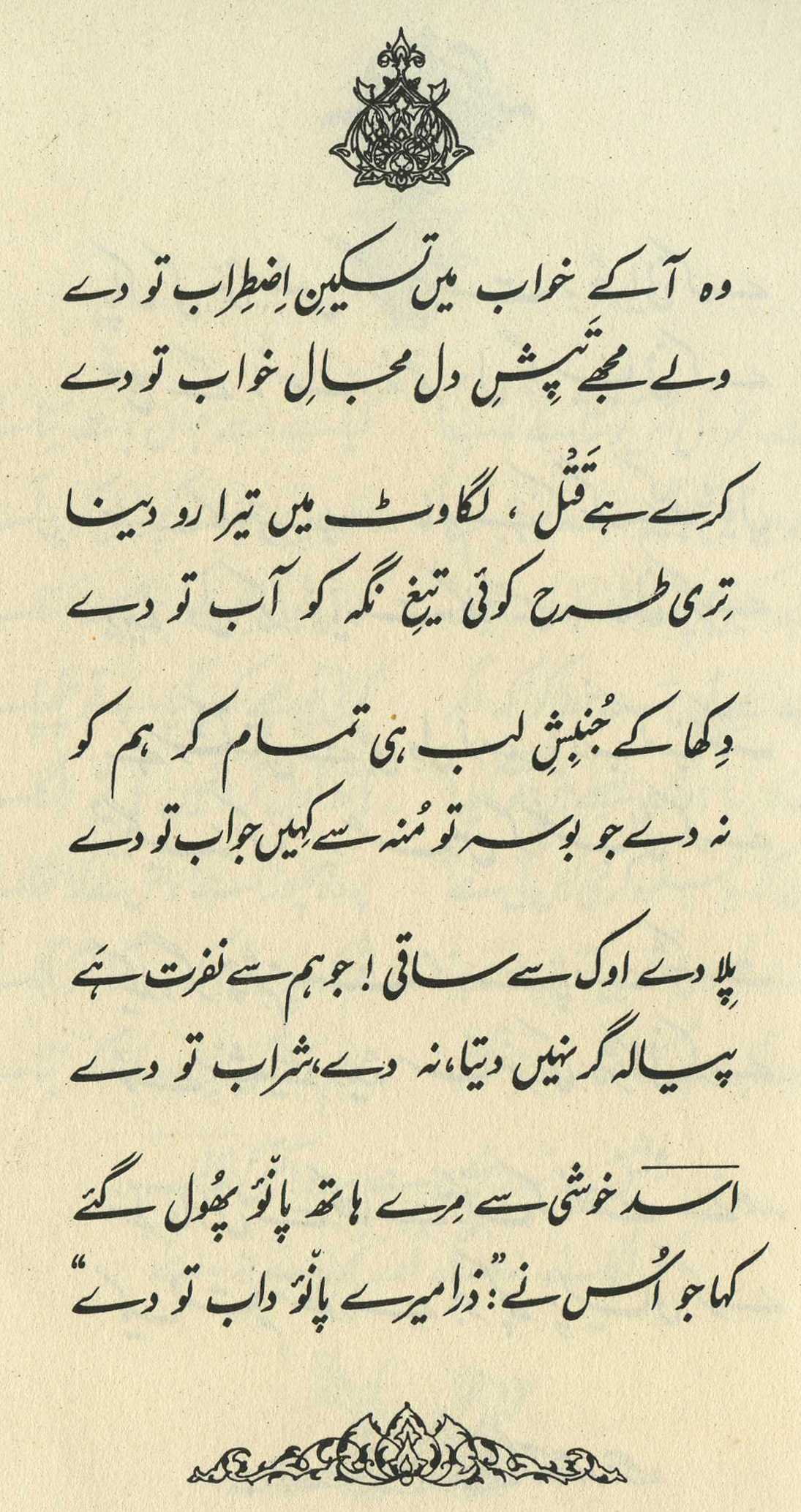
Asad , my hands and feet swelled/expanded with happiness
2
when she said, 'Just please press my feet a bit'
'To blossom, blow, flower; to bloom, flourish, to be in health and spirits; --to swell, be inflated, be puffed out; to swell out, to expand (with joy), to be pleased; to be puffed up (with pride, &c.)'.
| References | |
|---|---|
| Arshi, Imtiyaz Ali | Ghazal# 187 |
| Raza, Kalidas Gupta | 363 |
| Gyan Chand | 491 |
| Hamid Ali Khan | Open Image |
[He discusses the uses of versus .] And in this verse is redundant []; by redundant is not meant that it's for padding , but rather that in this situation to speak redundantly has entered into the idiom. (217)
== Nazm page 217

The meaning is that the arrival of my hands at her feet is a proof that through good fortune the time of the fulfillment of longing has come. (276)
The hands and feet 'swell/expand' with happiness at a time when some such thing would happen for which a person would feel a fierce longing, but for the fulfillment of which there would seem to be not even a possibility. (382)
This verse is a one-trick pony, but at least it's a nice trick. For one's 'hands and feet to swell' is, idiomatically, a sign of great happiness (see the definition above), and in the first line we take it in its usual metaphorical sense. In proper mushairah -verse style, the kicker is withheld until the last possible moment: only at the very end of the second line do we realize that what is making the speaker's own hands and feet swell, is the prospect of being able to press on the beloved's feet. Thus we have the two occurrences of 'feet', and above all the enjoyable opposition of 'to swell' versus 'to press down upon'. To touch one's hands to someone's feet is an expression of great respect and/or affection-- and the lover's desperate humility is such that he regards the chance to press the beloved's feet as an amazing joy.
On the double meaning of as both 'a little bit' and 'please', see 177,2 .
ABOUT FOOT-PRESSING: Traditional South Asians were constantly performing this service for each other: younger people were supposed to do it to their elders as a sign of respect and affection, and rich people had servants do it for them. The pressee usually lay or reclined on a couch or bed, and the presser sat on the foot of the bed (if an intimate) or squatted beside the bed (if a servant). The action was a kind of squeezing, pressing, and massaging of the feet, ankles, and legs below the knees. It feels nice, but probably you have to be a traditional South Asian to experience the full cultural flavor. Other foot-pressing verses: 121,3 ; 121,9x .
Here's an affectionately satirical print by William Taylor (1842), showing the morning routine of a typical East Indian Company 'civilian' (administrator) in Bengal. Amidst other preparations for the day, he's also having a quick foot-pressing:
graphics/wmtaylor1842.jpg
And here's the goddess Lakshmi performing the same service for Lord Vishnu:
graphics/sheshashayana.jpg